

Writer: John Galsworthy
Adaptors: Shaun McKenna and Lin Coghlan
Director: Josh Roche
This version of The Forsyte Saga is a masterly piece of storytelling.
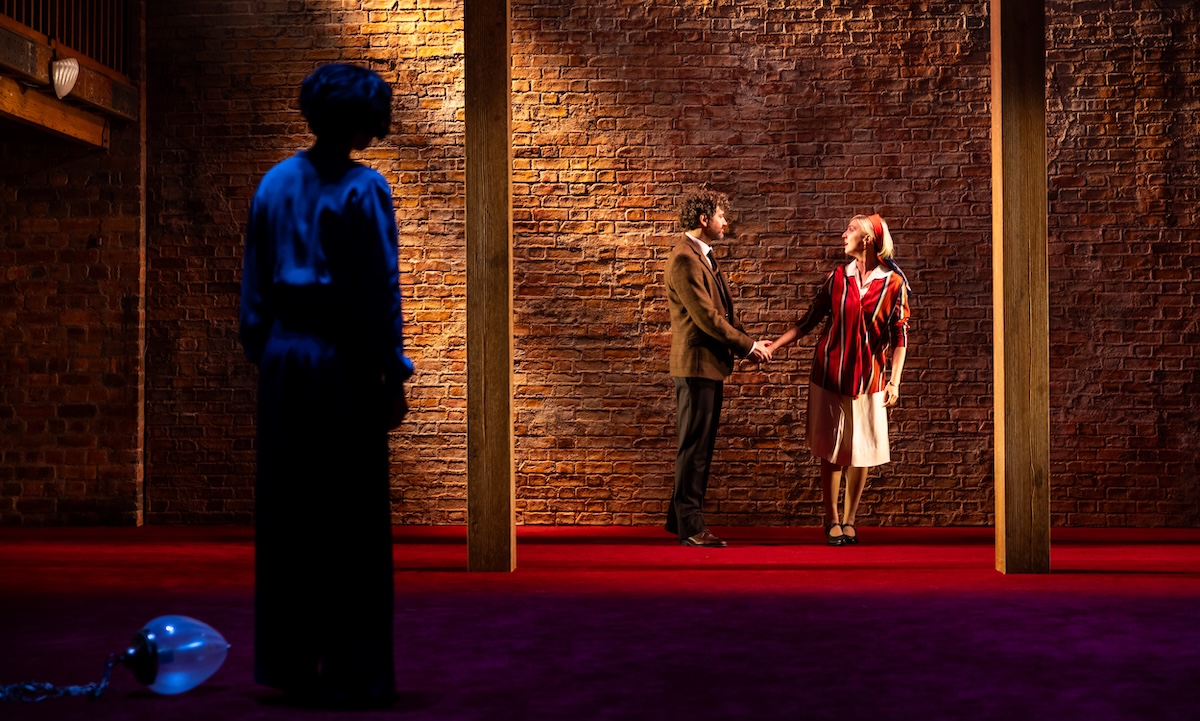
Instead of trying to fit the entirety of Galsworthy’s sprawling epic into a pair of plays suitable for the stage, adaptors Shaun McKenna and Lin Coghlan have picked out the essence of the story, losing many subplots and minor characters along the way, resulting in a tight and coherent narrative that runs through the pair from start to end. Some liberties have been taken with the Galsworthy story for dramatic effect, which might irritate some purists, but if you take this as a piece of theatre rather than a strict retelling of the novels, it works extremely well. With a design by Anna Yates that comprises only a few lights, a handful of chairs, some sumptuous drapes and the architecture of the theatre, the entire focus is drawn to the characters and their stories. Combined with the thrust stage in the Swan and some well-thought-out staging and business, it allows the audience to feel totally immersed in the world of the Forsytes as though we are part of the gathering in the Drawing Room, or with them in the coppice at Robin Hill.
This is the story of Soames Forsyte, set over a period of some 40 years, but told through the eyes of the two great loves of his life – his first wife Irene and his daughter Fleur. Starting in 1926, it uses Fleur as a narrator, trying to uncover the hidden secrets in her family’s past as we head back to 1886 and relive the stories through her discoveries, before she becomes one of the main protagonists in her own part of the Forsyte tragedy. There’s an excellent performance here from Flora Spencer-Longhurst as Fleur, watching events unfold around her as she wonders what exactly was the trigger for the tragic events that followed. She tells the story and fills in the gaps for the audience between and around the action, with shock and horror as one dark secret after another is revealed before she inevitably becomes a continuation of the ongoing tragedy herself, while apparently believing she can change the narrative when it comes to her own part of the story.
Joseph Millson gives us an acting masterclass as Soames. Often portrayed as a deeply unpleasant character with no redeeming features, this is a far more nuanced character struggling to deal with the changes around him. Deeply emotionally repressed by childhood Victorian values which continue into his adulthood – “We don’t do that” says his mother as he becomes upset at Irene’s departure – he softens as he grows old, caring about his daughter Fleur. From viewing his wife as a piece of property, almost like another part of his art collection, to be shown off, his second wife leaving him too, becomes almost an aside. He doesn’t love her; she failed to produce a male heir, but he no longer feels so possessive. His story arc creates the thread that binds the two plays together, and he sums up the whole tragedy with great understatement as he consoles Fleur: “Love is chaotic”.
Fiona Hampton’s Irene also shows great depth, spitting her hatred at Soames and visibly mellowing as she becomes accustomed to her new life apart from him, with Jamie Wilkes doing an excellent job giving us contrasting characters as young Jo Forsyte and Michael Mont. Andy Rush provides an ongoing theme as the two young men who play their own part in the ongoing tragedy, Philip Bosinney and Jon Forsyte, with Florence Roberts giving us well-differentiated portrayals of June, Annette and Anne. Michael Lumsden is an excellent old Jolyon, kicking off the split with his brother James (Nigel Hastings), with good work too from Emma Amos as the old guard Emily and Juley in Irene, before giving us her version of June and Holly in Fleur.
There is undoubtedly a change of feeling between the two plays, which could be seen as a reflection of the changing times. Soames is a man entrenched in Victorian values, reflected in the heavy intensity of Irene with its high drama and stiff behaviour. Fleur gives us a far lighter take on things – there’s been a war, and the world has changed, with rich young people having different expectations and a more frivolous attitude towards life. “Nothing really matters” they say, “It’s all a comedy”, even though the family saga still has its fair share of drama with a moving and poignant ending.
With its excellent storytelling, you don’t need to be familiar with the books or any of the TV and film versions of the story to appreciate these plays, though if you can only catch one, make it Irene if you can.
Runs until 10 January 2026
The Reviews Hub Star Rating
-
10
