

Writer: Clare Norburn
Director: Nicholas Renton
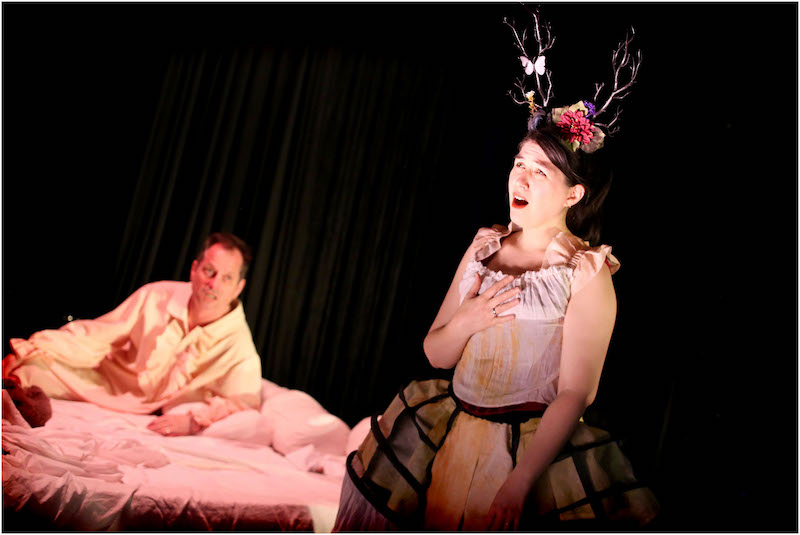
A rumpled bed fills half the small stage. A trio of musicians strike up Purcell’s dramatic Abdelazer overture, where a stately opening in the French Baroque style is followed by an energetic fugue. Clare Norburn’s engaging concert-play imagines Henry Purcell’s last fever-ridden days in 1695. A series of scenes looks back over the composer’s life, filling the gaps in an enigmatic biography with research, conjecture, scenes of life in Restoration London, and plenty of music. The play features 20 compositions by Purcell and a couple of other seventeenth-century numbers, including a haunting verse from Pelham Humphrey’s setting of Donne’s sonnet “Wilt Thou Forgive that Sin?”
Playwright and producer Clare Norburn has an excellent track record with this kind of musically-led drama. She is artistic director of The Telling, a company that stages her characteristically pacy blends of songs, music and theatre. In 2024, the troupe toured her Christmassy romp What the Dickens, also directed by Nicholas Renton, with a selection of topical tunes. Purcell, The Musical has a similar emphasis on the women whose lives are interwoven with those of these celebrated male creators.
Sarah Lambie plays the composer’s wife Frances Purcell, with dignity and pragmatism, as well as the incandescent figure of a lost childhood friend. Fellow-soprano Héloise Bernard is the seductive young actress Letitia Cross and gossiping neighbour Mrs Gibbons, among others. Their many songs include the spirited argumentative duet “A Dialogue between Two Wives” from Purcell’s music for The Canterbury Guests. Because of recovering from voice-weakening illnesses, some of their songs are sung from the musicians’ corner by Laura Coppinger and Dominique Saulnier. The fusion is handled with admirable grace and professionalism.
Hope O’Brien’s costumes are inventive and evocative, conjuring wife and lover in sleeveless black and crimson, a flower-and-antler-crowned Fairy Queen for the poignant Entrance of Night, and Purcell in nightshirt, britches and wig. Niall Ashdown’s unpretentious delivery as Henry Purcell grounds this fantastical fever-dream in an endearing monologue. The underlying themes in Purcell, The Musical are often gloomy: infant mortality, loss, bereavement, jealousy, plague. Ashdown tells the tale of Purcell’s four dead children with affecting simplicity. But, at other times, he’s very funny. His background in improv and comedy helps him to respond to the audience with humour and humanity.
Ashdown also plays a series of incidental characters from Purcell’s life. Wrapped in the composer’s blanket, he becomes a barnstorming Welsh preacher or a West Country tradesman. His vacillating impression of Lord Mayor of London Thomas Bloodworth, whose inaction caused the fire of London to spread so widely, is unmistakably Kier Starmer, provoking gales of rueful laughter. He dances, sings a duet, and skillfully manages the play’s emotional shifts.
As much part of the show as the actors, three skilled musicians (Joanna Lawrence on violin, Miriam Nohl, playing the cello and Oliver John Ruthven, an atmospheric harpsichord) deliver a full concert’s worth of varied music. The second half starts with the Rondeau from Abdelazer, a piece that even those of us who know little about Baroque music will recognise.
When Purcell, The Musical was first written in 2018, it was called Burying the Dead. The original title foregrounds darker aspects of the piece, but the jauntier new name more accurately suggests the mix of registers. The first half ends in a tavern with the roisterous number Make Room For The Great God Of Wine! from Purcell’s semi-opera Dioclesian. The Restoration tradition of theatrical productions that integrate music, dance and spoken drama feels like one which Clare Norburn fits right into. The Telling’s concert-plays are always an entertaining night out, beautifully performed by expert actors and musicians.
Runs until 22 May 2026 and then continues to tour
