

Choreographer: Pina Bausch
Artistic Director: Boris Charmatz
One of the last pieces created by Pina Bausch in 2006, Vollmond, featured in the Wim Wender’s documentary, Pina. Now, courtesy of French dancer and choreographer, Boris Charmatz, Artistic Director at Wuppertal Theatre, audiences can experience this mesmerising work, live. With four of the original cast: Azusa Seyama-Prioville, Julie Anne Stanzak, Silvia Farias Heredia and Ditta Miranda Jasfi, alongside a talented new generation of Pina Bausch devotees, this is two and a half hours (including an interval) of sheer poetry and elemental magic.
Unveiled on Valentine’s night beneath an almost full moon, Vollmond, (‘full moon’ in German) is about love and relationships: hopes, dream, illusions, thrills, sensuality, power dynamics, complications, chaos, and agony, all filtered through the physical experience of the elements: earth, air and most notably, water. The humans bring the fire.
The power of Bausch’s dance philosophy is her ability to combine the epic and every day, prosaic and poetic. A keen observer of human life and relationships, much of what we see on stage is gestural, repetitive. This captivating, kinetic and sonic blend of physical theatre, movement and dance is full of adult angst and childlike delight.
We witness the dance equivalent of poetic couplets as dancers push and pull at each other, challenge and test each other’s limits; relationships can be baffling and bewildering, a constant puzzle. Some are tortured by the illusiveness of connection, their souls apparently afflicted with Saint Vitus dance. But alongside, the deep, emotional strands of the piece, are many amusing surprises including witty dialogue, jokes and visual gags. Balloons pop, water pistols fire, faces are slapped, strange laughs enacted, all delivered with total aesthetic regard and controlled spontaneity.
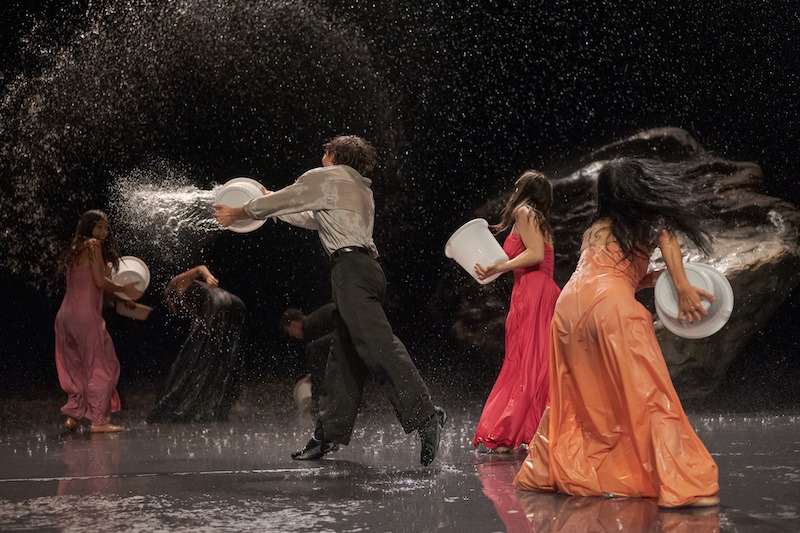
On stage is an enormous, burnished rock, that gleams beneath the implied moonlight. This central image set on a boundless landscape is timeless and universal and references the Bible, classical art, Henry Moore. In this monumental set by Peter Pabst, the rock is solid and immoveable, while dancers climb or stand on it, hide behind it or attempt to possess it. The rock’s permanence contrasts with the transience of the weather, seasons and ever-changing human emotions and relationships.
Fourteen dancers perform all kinds of feats with artistry and flair. They row on imaginary boats, fence with sticks instead of swords, windmill about the stage, tease, seduce, make love – or war –, dominate, or serve. Marion Cito, who has designed costumes for Bausch since 1980, delivers her trademark signature chic. The men dance in loose trousers and shirts; the women, often in high heels, wear simple, elegant dresses: bias cut slips or full-length gowns. These gendered, coded pieces – perhaps too hetero-normative for some sensibilities – nonetheless encapsulate their own kind of dance. The score by musical collaborators, Matthias Burkert and Andreas Eisenschneider, is beautifully curated and spans, to name a few, Amon Tobin, Cat Power, June Miyake, and Tom Waits.
While every dancer demonstrates enormous talent and stamina, the visual takeaway from Vollmond is the water. The water is the star of the show, the memory every audience member will retain. Not only does it comprise a superb technical feat, it’s also a divine feature that brings its own drama, symbolism, and narrative.
Activated by the performers who interact with its shifting properties, rain becomes a powerful visual backdrop. It starts with a single drop, syncing perfectly with a single musical note, until it starts to fall from the heavens in gorgeous, cleansing sheets, releasing positive ions into the air. It becomes a river and dancers swim or are pulled through the cascading stream or appear in swimming garments to take to the water.
Think of Anita Ekberg in the Trevi Fountain in Fellini’s La Dolce Vita or Gene Kelly in Singing in the Rain. In Vollmond, these ideas are distilled to their absolute essence, rain as art, emotion, and poetry. The droplets of water appear to crystallise under the lights, as the dancers draw with or ‘choreograph’ the water using plastic bottles to form glittering arcs in the air. As fabric, flesh and limbs become progressively soaked, we are reminded of the sensuality of the body, the joy of community and gift of nature.
In a passionate, rousing climax, scored to a wild jazz soundtrack, the dancers explode into movement. Caught in a cascading downpour, they use plastic buckets to drench each other further in a spectacular, life-affirming display. Last performed at Sadler’s Wells in 2013, this is dazzling magic for grown-ups; a remarkable piece, it’s sure to have Bausch fans swooning in the aisles.
Runs until 23 February 2025
