

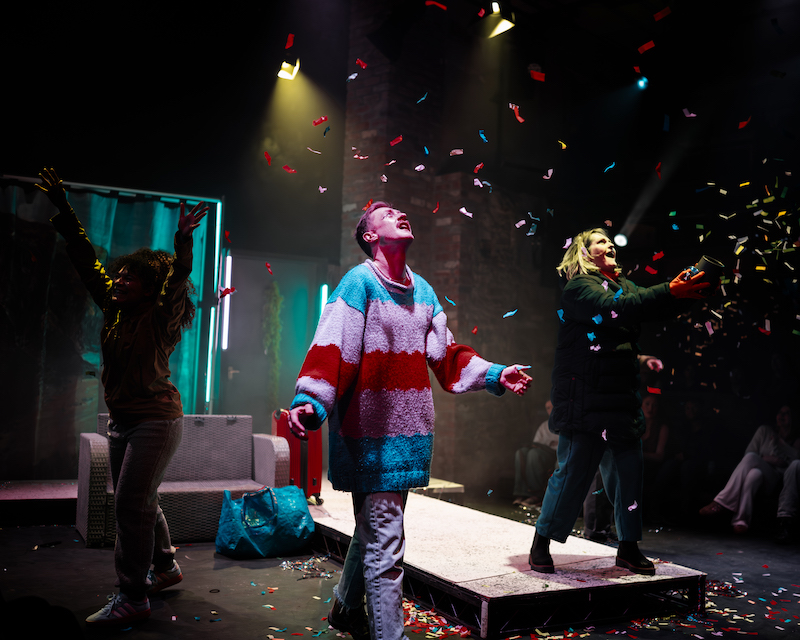
Writer: Brenda Callis
Director: Frazer Meakin
When members of the LGBTQIA+ community leave a small town and move to a city, it’s not unknown for them to break ties with the place they came from. In Smalltown Boy, that’s true of Leo, a young man who moves from a Cornish seaside town to the big lights of Bristol.
By the time Brenda Callis’s play starts, Leo has already died, leaving boyfriend Harry – who feels more comfortable in their drag persona, Edie – bereft. Edie still performs, though, opening the play as a cabaret performance that’s partly sung and partly lip-synced. Elliot Ditton’s Edie is charismatic from the off, showing us that we could bask in their non-binary presence for the entirety of the play’s duration.
But when Harry receives a phone message inviting them down to Cornwall, as an act of closure for the mother and friends Leo left behind, they are conflicted. Leo’s things were packed up, and his funeral held, without their involvement, so there’s an understandable resentment that the grief of the community Leo never spoke of should take precedence over Harry’s own.
And so the journey to Cornwall is undertaken not by Harry, but by Edie in full drag, assuming that they will be able to confront what they assume to be the rampant homophobia that drove Leo to migrate to Bristol. Instead, Edie finds a mother (Kate Milner-Evans’s Claire) and a childhood best friend, Shiquerra Robertson Harris as Hannah, who accept Edie even if they don’t completely understand them.
Callis’s script retains the aspects of a drag show, with Edie frequently breaking out into a show tune lip-sync as events overwhelm them. It’s a full-throated embodiment of how Harry uses Edie as armour against the world, as well as a channel for the self-confidence they cannot muster out of drag. Much humour is gained by quick changes or by microphones appearing in the unlikeliest of places.
That sense of escape into drag is infectious, too. During a fight with her gardener boyfriend (Theo Cowan), Hannah subconsciously turns herself into a wrestler (which is basically drag for straight people), while both Cowan and Milner-Evans get their own opportunities to drag up.
But mostly, there is a sense of people struggling to find answers when the one person able to provide them is gone. There are discussions about how Leo may have felt as an outsider, just as Hannah still does because of her skin colour; she remains because the only way small towns change is for people like her to stay. Ditton excels in Edie’s quieter moments too, talking about how the allure of drag has faded when their boyfriend, and biggest fan, is no longer there to share it with.
And Edie’s wobbles of confidence are somewhat taken on by the production as a whole. With a criminally short run, it feels as if Smalltown Boy hasn’t quite worked out the level at which it wants to play itself. It definitely feels like a drag twist on typical British film whimsy – Local Hero meets Priscilla: Queen of the Desert, perhaps – while never quite landing on an identity of its own. It’s also hampered at times by sound issues, the volume of played-in music occasionally drowning out the spoken word on stage.
Were this production to run longer, one feels the show would surely find its feet. It would deserve to. Smalltown Boy confounds expectations, acknowledges that sudden loss and grief often leave questions that can never be truly answered, but also affirms that drag is many things. It is Edie’s armour, and it is their weapon – but can also be a comfort, and an escape.
As the strains of Bronski Beat’s title song play over the scattering of Leo’s ashes, one yearns to see more of this imperfect little show. All the small-town boys, girls, and non-binaries who have moved to the city will find themselves in this charming piece.
Runs until 14 March 2026
