

Writer: Samantha Harvey (based on the novel by Barbara Pym)
Director: Dominic Dromgoole
The quiet, unaffected life is the subject of Barbara Pym’s novel Quartet in Autumn, adapted for the stage by Booker Prize-winner Samantha Harvey, as four office workers in late middle age contemplate what their lives have amounted to without anyone else to rely on, all stuck in their ways to differing degrees. Dominic Dromgoole’s production at the Arcola Theatre is full of subtle character excavation, merging dramatic scenes with internal monologues that explore respective unimportant self-importance.
Letty, Marcia, Edwin and Norman share a quartet of desks in an unspecified office, working side-by-side but never really knowing each other. They share gossip, talk about their home life, their holiday plans and the care they are receiving outside of work, even though much of it is deluded. More than acquaintances yet much less than friends, the atmosphere becomes increasingly snarky as Letty and Marcia head for an uncertain retirement.
What responsibility lonely people should have for one another filters through Quartet in Autumn as the characters explore how much they really mean to one another in their non-friendly friendship. Marcia, the most restrained of the group, feels no connection to the others at all, resenting their presence in her life, while the Christian Edwin and the kindly Letty, who has never been loved, feel a greater requirement to bring the group together even after their retirement. Harvey’s adaptation draws the women rather more credibly than the men as they go off to their new lives at the end of Act One, the context of Marcia’s OCD behaviour and never-married Letty’s complex frenemies offering more traction than the broader brush losses that affect Norman and Edwin, as though being a widower is personality enough. But Pym’s characterisation is rich and shrewdly observed.
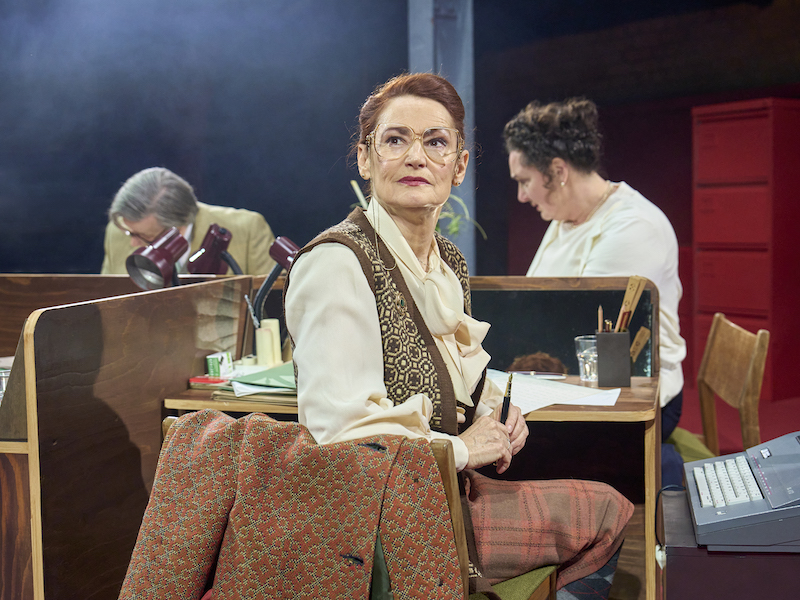
Act One in the office is more successful as a group of people thrown together by work rather than by choice allows them to be equal parts, irritated and reliant on each other to get through the days. Here, the writing is full of details, shared office coffee grounds, faux outrage during gossip sessions, sniggers behind people’s backs and the selfishness of everyone barely listening to each other as they are consumed by their own thoughts and concerns, disregarding the humanity of everyone else. Dromgoole directs this scene well with an intersection of desks designed by Ellie Wintour in which characters move around, in and out of their own and the collective story.
The second act is patchier, extending the advertised running time by 15-minutes as the group gathers in other circumstances, but it doesn’t feel as tightly worked as the first, less to say as plot replaces character observation as the driver in order to provide an ending of sorts. You are glad they find each other, and the message of discovering yourself in later life is a strong one, but this final segment could be pacier or more profound about the importance of contact for those stuck in abandoned lives.
With strong performances from Kate Duchêne (Letty), Anthony Calf (Edwin), Pooky Quesnel (Marcia) and Paul Rider (Norman), this is gentle theatre about gentle people who are all ridiculous but also lonely and ultimately worth knowing.
Runs until 20 June 2026
