

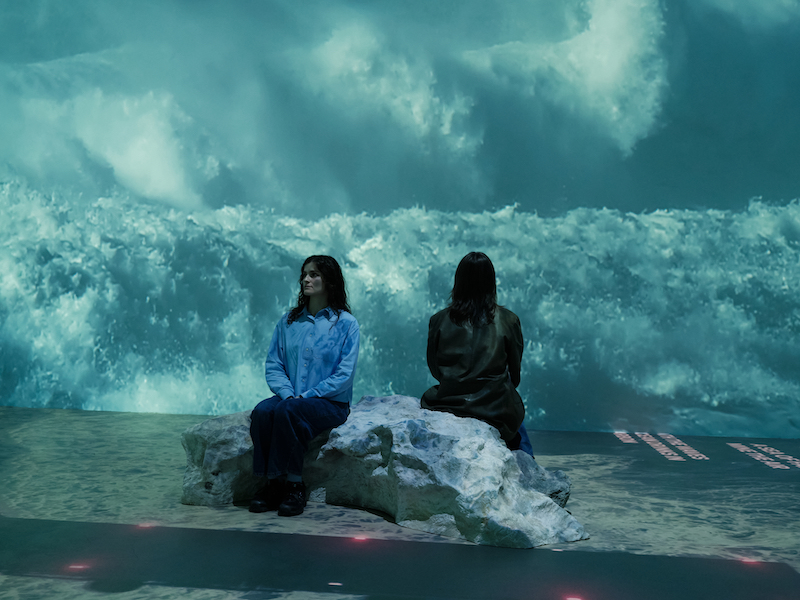
Liam Young’s In Other Worlds is an immersive exhibition exploring life after the climate emergency. Covering six futures all linked by hope but tied together by a semi-dystopian vibe, In Other Worlds relies on drastic alterations to modern life as we know it. Whether a future is bent towards science-fiction machine-world hybridity or survivalism rooted in indigenous people’s knowledge, the focus is on harmony between the needs of the Earth and the reality of the mess we have created. It is at its most beautiful when the wreckage of the past is repurposed to work in line with Earth’s needs.
While the initial invitation, voiced by Diego Luna, emphasises the need to embrace the challenge of the climate emergency in a more personal and emotional way, the exhibit culminates in grand ideas for a future of semi-failure. Nevertheless, even when the final future presented appears bleak, it is centred around hopeful collaboration, which leaves a positive mark on the universe when humans are long gone.
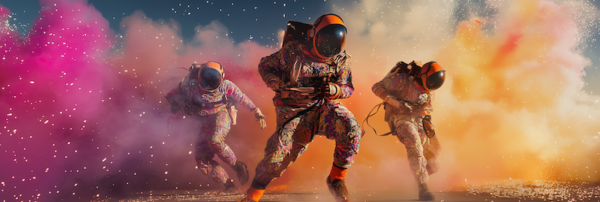
Although the politics of the piece may be grand in scope, the exhibit is artistically microscopic in its approach, with attention to detail visible in delicate model making by Young and pristine costume design by both Young and Ane Crabtree. Young and Crabtree’s designs pair the practical and rugged with the beauty of traditional dress in an innovative and glorious cacophony of colour. Young’s contribution is unexpectedly delightful when brought to life for underwater use by JMJ Wetsuits. Visitors are struck by Young’s architectural expertise in the precision of the model designs, which capture the brilliance of his skill and imagination. This is evident whether one is paying close attention to his partial designs of a megacity of the future or the culturally diverse mask-making of its proposed inhabitants.
The astounding visuals are married with audio tales of the future inspired by Young’s worldbuilding. Young himself contributes to some of these scripts alongside heavy hitters of the narrative form, including Lisa Joy, Kim Stanley Robinson, and Natasha Wanganeen. All the stories are paired with actors of a very high calibre (Maxine Peake, Richard Ayoade, Denise Gough, Jeffrey Wright) and even Jordan Stephens, not typically known for his acting prowess, is utterly engaging. Not all the material shines, however, with Wanganeen’s main contribution reaching for an authentically amateur tone but coming off dry and dispassionate.
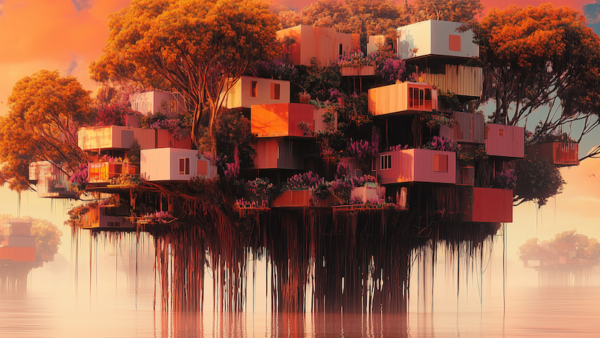
The film elements provide a rich backdrop to the experience, creating a persistent sense of dynamism to move one through the space. In the penultimate film, visitors are surrounded by an otherworldly vision of the techno-oceanic future, vast in scale and emphatically emphasised by rhythmically moving data points that have tones reminiscent of a Ryoji Ikeda installation.
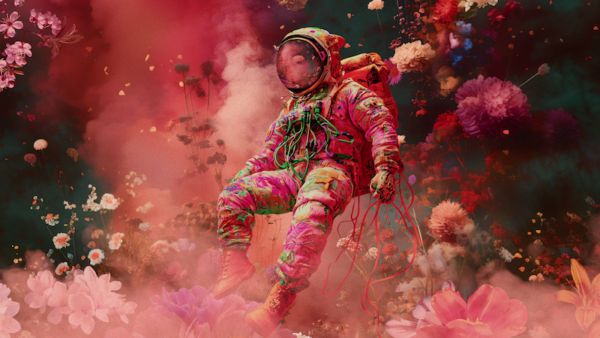
Preceding this film is a series of highly colourful and more joyful video series, which are glorious to look at but confusing in palette and movement. The standard of creators involved reassures visitors that close human craft has gone into every element of these films, but the colour balance of the highly orchestrated unfolding of petals is, unfortunately, reminiscent of a style that artificially generated art has adopted. This means that what should be a glorious transportation into another universe comes off as easily scrolled past slop that dominates social media apps. This is by no means the fault of Young or the other creators involved in these films, but we live in a fast-changing world (as the creators highlight throughout In Other Worlds), and the pace of AI-generated content has caught up with the stylistic inventiveness of these fine artists.
In Other Worlds is not a typical immersive art exhibit; it reaches beyond banal, surface-level beauty towards a version of artistic futurism that combines hope with despair to make a richly textured experience fit for a complexly utopian space like the Barbican Centre.
Runs until 6 September 2026
The Reviews Hub Star Rating
-
8

1 Comment
I actually found it to be quite a dull exhibition with too much focus on headphones to be creatively immersive. Especially for the £20 price tag.