

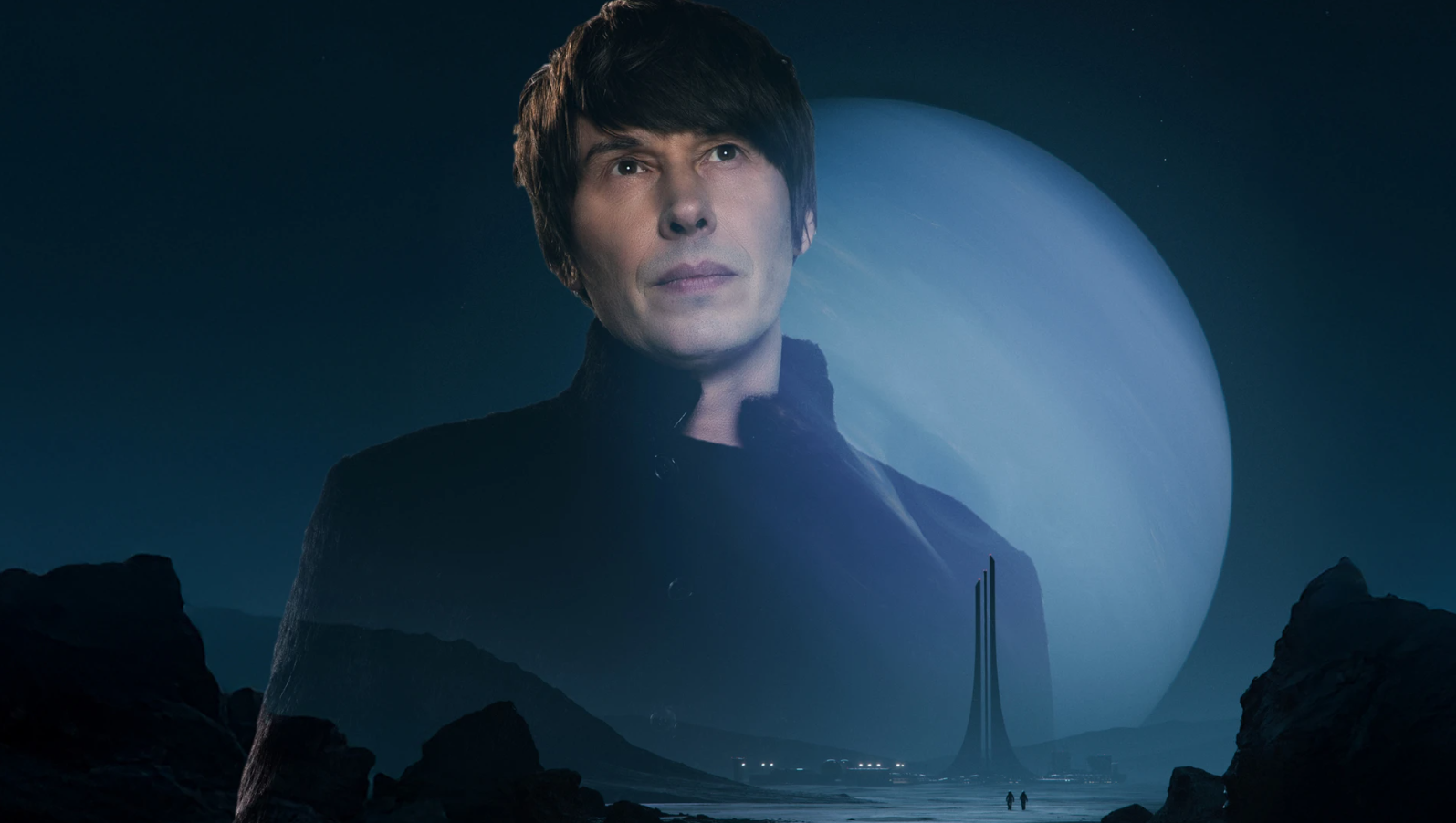
Writer/host: Brian Cox
It’s a bold theme for an evening’s entertainment, but Professor Brian Cox’s new show takes its audience on a journey from the smallest measurable things to the theory of the multiverse and back again, in a multimedia odyssey through history, science, mathematics and philosophy. His work on radio and television has garnered a huge fanbase, and the full house audience at the Playhouse comprised a wide range of ages and balance of genders, demonstrating his broad appeal. But this is a show that demands close attention and isn’t afraid to throw difficult concepts at its audience. If the science is hard to follow, it doesn’t really matter – the key is just to surrender to the flow of ideas and be swept along by the ambition and the spectacle.
Emergence impresses on every level. As presenter, Brian Cox is on stage almost throughout and speaks with passion and fluency for over two hours. Not only is that an astonishing feat of memory, but his words are synced with visuals on a huge LED screen. Only one brief technical hitch, involving a nod to his rock musician past, occurs during this complex and often interactive presentation. The screen offers stunning high-definition images and animations that take the breath away: planets, moons, a snowstorm of galaxies, a livestream from the International Space Station which at that moment was crossing the Pacific Ocean at dawn. Music is used with subtlety to accompany the sequences, including a haunting specially composed song by PJ Harvey about the Voyager probes, during a sequence on planetary exploration. The narrative blends scientific rigour with poetic touches, underpinned by a celebration of imagination and the human instinct to explore.
Brian Cox is a genial and unassuming presence on the stage, but his passion for his subject intensifies as the performance progresses. The show is framed by a story about Johannes Kepler, the German astronomer, wondering in the early 17th century why every snowflake has six corners. Developing this theme about symmetry and patterns in the physics and maths that underpin our understanding of the universe, as well as in the structure of matter, Professor Cox asks us to consider that science is as much about seeking as discovering, and that the ‘delight and excitement of not knowing’ are to be preferred to those elements in society who believe that uncertainty is a weakness. It’s an evening full of wonders, offering us quarks, quantum ripples and the cosmic web, but ending with a plea for us all to take seriously our responsibility, as the only ‘intelligent’ life we currently have evidence for, to take better care of our Pale Blue Dot and each other.
Reviewed on 8 October 2026 | Image: Contributed
