

Writer: Shirley Jackson
Adaptor: Stef Smith
Director: Martin Constantine
Not all love stories end in terror, but this one does. The latest rendition of The Haunting of Hill House is filled with both light and dark moments, but the latter is what’s sure to sink deep into the psyche and leave the audience haunted for weeks to come. The chilling tale preys on what lies in the darkness, whether it’s paranormal, secrets, or just mommy issues.
Adapted from Shirley Jackson’s beloved horror novel by Olivier and BAFTA winner Stef Smith, The Haunting of Hill House sticks close to the original story with the same set of main characters, and based on costume design and dialect choices, the 1950s setting is kept as well. The adjustments made for the transition from page to stage are largely successful, only swapping out major elements for those that occur outside of the house in the original text.
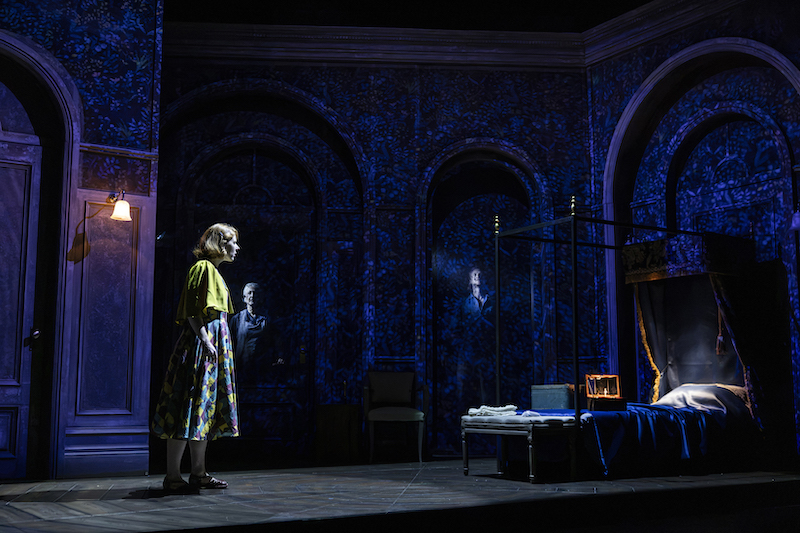
The approach to set design is both creative and effective, relying on the same backdrop of walls and doors, with projected lighting used to change the wallpaper patterns. Such alterations are combined with self-moving set props and furniture propelled via a moving floor section to indicate different rooms in the home where the scene is taking place. The lack of visible humans swapping these out only adds to the spookiness of the show, aiding in building the suspense with each stage shift.
One of the simplest but most effective props is a small dollhouse that rests at the front right of the stage throughout the performance. Its interior lights up, often indicating where in the house the current scene is taking place. Such a small design choice offers the audience a point of grounding, which is especially needed during the latter part of the play where the action increases and scenes start to transition quickly, making it challenging to keep tabs on where the action is happening.
When it comes to performance, Sophie Lenglinger as Theo steals the show with a consistent, all-consuming stage presence. Much like the character, Lenglinger commands the audience from her first scene until her exit.
In the first half of the show, the lead actor, Clancy Ryan, struggles to find her footing as Eleanor, but in the second half, she seems to find her stride, suddenly commanding full control of the stage. Additionally, Sian Howard is particularly memorable as Mrs Dudley, offering perfectly timed comedic relief throughout the production, and just enough heart when it’s needed.
Lighting and sound are a vital part of The Haunting of Hill House’s success, working in unison to build tension and deliver powerful jump scares. From the first second of the play, their impact is felt with an acoustic stinger and lighting shift combination that elicits gasps throughout the entire theatre. Yet, such heavy reliance on the two elements poses a risk of affecting the production negatively when attention to detail is overlooked, as is the case with one of the first harsh strobe light scenes. The actual performance given by Ryan at this point is incredibly visually impactful, but because the stage lighting is too high, it pulls the covers off the trick for the audience as the actor’s outline is visible before the flashing begins. As a result, the illusion is broken, and a loss of engagement occurs, but luckily, it’s only momentary.
Such oversights are limited throughout the 120-minute production, with the majority of the show moving so incredibly smoothly that the audience is fully immersed in the storyline, reacting in unison with gasps, screams, and laughs. Overall, the choices made throughout design, writing, and casting are strong, coming together to deliver a terrifying show that is sure to creep into the minds of the audience and resurface long after the curtain falls.
Runs until 10 October 2026 and continues to tour
