

Choreographer: Marcus Jarrell Willis
Composer: Marc Strobel
James Baldwin’s 1956 work Giovanni’s Room is widely regarded as not only one of the best gay novels of all time, but one of the best in literary fiction. It tells the story of David, an American who is staying in Paris while his girlfriend travels through Spain. He meets and has a passionate affair with Giovanni, the Italian barman at a gay club, causing him to reflect on his sexuality and relationships.
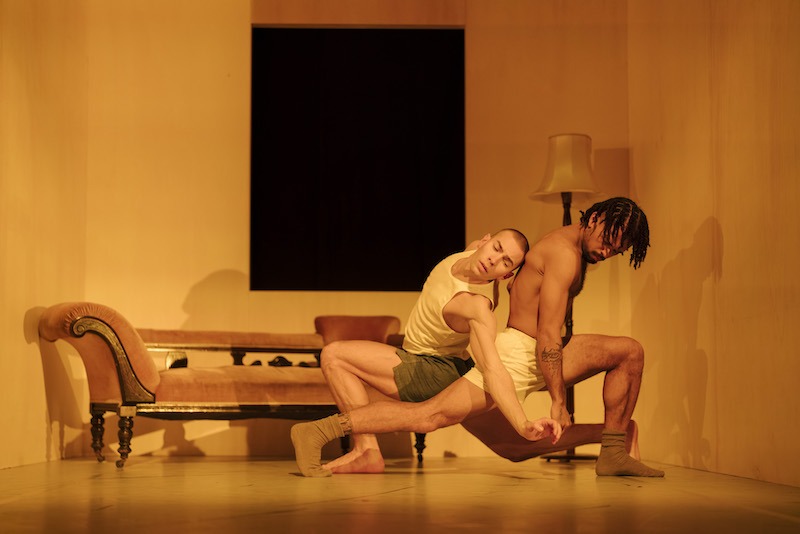
Teige Bisnought’s David is introduced to us as a stuttering, hesitant man, not entirely in control of his own body; he echoes moves from Dylan Springer’s Giovanni as if controlled by his dreams. Phoenix Dance Theatre’s new adaptation, although wordless, explores time and the power of recall in a manner similar to the novel. While on paper all events can be presented as memories, here they also feel like premonitions and fate.
Similarly, the small Parisian garret in which Giovanni and David come to share is omnipresent throughout, a cube upstage that divides the stage into thirds. Act I focuses on the build-up to the couple’s romance, and Act II the fallout – but the room represents David’s sexual awakening as an ever-present force in his life.
Without dialogue, some of the side characters from Baldwin’s novel do lose some definition. His drunken, abusive father is clear, but the influence of his aunt Ellen could also be interpreted as maternal. It is sufficient to paint a picture of David’s background, and why he is progressing with a marriage to Hella as a path to 1950s heteronormativity. But, like David, the whole ballet only really starts to come alive when it hits the Parisian gay bars.
Marcus Jarrell Willis’s choreography is at its most clear as the full-company ensemble number, a delightful Lindy hop sequence, becomes more muscularly flirtatious as the men take over to dance with each other. Alongside them, Springer is slighter and campier as Giovanni, but the growing attraction between the tourist and the barman is palpable.
There is a sexiness and sultriness between the two male leads that manages to add steam without being salacious. The couple’s pursuit of each other and their inevitable arrival into the room that has always been waiting for them carries a charge that focuses more on the emotional than the erotic.
In Act II, as the relationship continues until it breaks down, lighting designer Luke Haywood uses multiple sudden blackouts to give us flashes of still-life tableaux of the two men. Loving, frustrated, bored with each other, and back to loving – within a few short seconds, we experience the full gamut of the couple’s time together.
It is when the men part – albeit still present in each other’s thoughts and memories, on stage at the same time but no longer together – that the storytelling begins to waver. Bisnought’s portal of David as he continues to explore his sexuality – sleeping with a woman in an attempt to “prove” his heterosexuality to himself, then having a dalliance with a sailor, during which he is discovered by Hella – carries with it a sense of profound sadness. But the frisson of Act I is missing, resulting in a more detached experience.
Visually and dramatically more interesting is the path of Giovanni, as Springer takes us through the barman’s violent and ultimately tragic encounter with his employer. As the gallows awaits him, we see a return of the choreography that opened Act I, but with the context now much clearer of a man’s final dance before death.
Like the novel, then, nobody ends this story living happily ever after. But along the way, we do get some compelling storytelling and strong dancing, joy mixed in with sex and heartbreak. A hundred years after James Baldwin’s birth, Inside Giovanni’s Room is a testament to the strength and enduring appeal of a remarkable novel, brought to life with immense tenderness.
Continues until 14 June 2025
