

Book: Scott Brown and Anthony King
Music and Lyrics: Eddie Perfect
Director: Alex Timbers
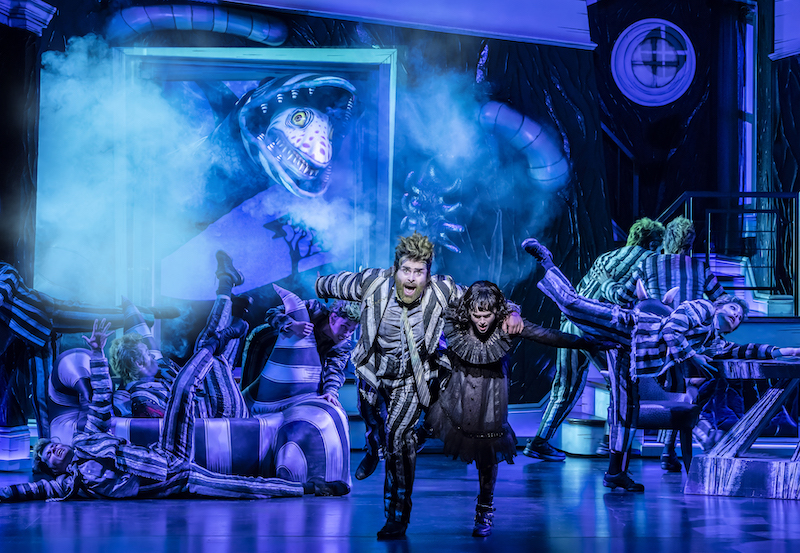
Beetlejuice, a musical about death, practically resurrected from the dead by viral TikTok fandom, has finally arrived in London, finding a home at the Prince Edward Theatre, a cavernous enough space to accommodate its gargantuan Broadway ambitions. As a feast for the eyes, the production is utterly spectacular. David Korins’ set design delivers a phantasmagoric haunted house packed with illusions, spooky projections, a gigantic puppet sandworm, oddly random explosives, and more special effects than you can shake a skeleton at. Kenneth Posner’s gorgeous purple-and-gold-led lighting design is as good as you will see anywhere in the West End. Whether the piece offers quite as much for the brain or the ear – oh for an earworm as well as a sandworm – is another matter entirely.
Scott Brown and Anthony King’s book reimagines the eponymous Beetlejuice (David Fynn), a relatively minor figure in Tim Burton’s iconic 1988 film, as a sexually ambiguous, fourth-wall-breaking, coke-snorting, wise-cracking, foul-mouthed “singing Sword of Damocles”. Imagine Bill Murray mashed up with a particularly acid adult pantomime dame. There is shedloads of knowing humour in Fynn’s caustic performance, a deliciously nasty quip about James Corden’s genitalia delights, as do running jokes about Andrew Lloyd Webber and another West End musical (“Fuck Paddington!”, we are told). But film purists may find themselves exclaiming an occasional WTAF.
Demonically deceased Beetlejuice finds himself in a twee Victorian Connecticut house: Korins’ design aesthetic, reminiscent of 1970s Scooby Doo-style animation, is all bright colours, skews, slants, and odd angles. Determined to find a way to return to the land of the living, he orchestrates the electrocution of the house’s archetypal New England liberal residents, Adam (David Hunter) and Barbara (Chelsea Halfpenny), who are accurately described as looking “like they run a struggling coffee shop”.
Into the empty house moves grieving Lydia (the tremendous Hannah Nordberg valiantly loses the battle to convince anyone she is close to being a teenager, but boy, can she sing). Joining her are her sleazy-but-redeemable dad, Charles (Alasdair Harvey) and his new squeeze-cum-life-coach, Delia (Aimie Atkinson delivers perfect comic timing), who “smells like the bathroom at the Mandarin Oriental Hotel”.
Lydia, grieving her dead mum, is obsessed with death (a mirror to Beetlejuice’s obsession with life) and hence able to see ghosts. The show’s emotional arc centres on her journey through grief to reconciliation with her father, though it is the bad-taste narrator and master of ceremonies, “the sexiest daddy in the West End”, Beetlejuice, who gets most of the decent laughs.
Lydia teams up with Adam and Barbara to scare her father out of the house during a dinner party with boorish business associates (the roast pig comes scarily back to life). Charles sees the haunting as an opportunity to make money, so Lydia takes the next step and summons Beetlejuice back to life through repeating his name three times, a decision she naturally comes to regret.
In a nod to Greek mythology, plot shenanigans have Lydia cross the threshold between the living and the dead, driven by the desperate hope of finding her dead mother, an event which cues What I Know Now, a fiery, high-energy Latin pop and mambo showstopper that is unquestionably the best number in the show. Dad follows, determined to reconcile with his wayward daughter.
Beetlejuice, meanwhile, hatches plans to marry to facilitate his permanent return to life. The dastardly demon breaks the fourth wall early on to highlight the foreshadowing role of the sandworm, so one guesses where this is going. The rather too tidy denouement reminds us that dealing with grief is never easy and rarely simple.
Setting aside the two calypso songs featured in the original movie, the Banana Boat Song and Jump in the Line, much of the rest of Eddie Perfect’s eclectic musical palette (ballads, pop, and jazz-rock) is broadly forgettable generic Broadway, though Nordberg shines in the opening number, Invisible. The real joy in the show comes from what you see, rather than what you hear.
Alex Timbers’ direction is pacy with a sharp eye for comedy, though the tone threatens to tire a little in an evening that feels a tad overlong. The challenge Timbers faces is asking us, on the one hand, to buy into a tale of adolescent grief and, on the other, to accept a barrage of quick-fire, meta-led smut and jokes about underage sex. Sometimes it works, but too often the one confounds the other, leaving us wondering quite how to respond emotionally. If the music were more memorable, this probably would not irk quite as much as it does. Still, there is no finer-looking show on the London stage, so just sit back and enjoy the view.
Runs until 17 April 2027
