

Writers: Andrew Singer and Christina James
Director: Christina James and Freya Griffiths
Plays that feature wealthy investors hijacking ethically questionable medical advances for their own profit, rather than the good of humanity, are like buses. You wait ages, then two come along in quick succession. This week marked the press night of Hampstead Theatre’s excellent dystopian medical thriller ROI (Return On Investment). Andrew Singer and Christina James’s Panacea explores markedly similar themes, though from different perspectives and in very distinct styles.
Professor Gus Jamieson (a tremendous Will Batty) is a genius medical microbiologist with Autism Spectrum Disorder. He has genetically engineered an infectious vaccine, a virus called Panacea, that produces antibodies against a host of diseases. Once a few individuals are vaccinated, the virus spreads rapidly, so giving everyone else in the same population protection. The technology is proven in principle. Now he needs permission to test the technology by spreading Panacea in a local bat colony. If that is successful, then human trials beckon. Pandemics and even infectious diseases themselves will become a thing of the past. By fortuitous happenstance, Jamieson, who thinks very highly of himself and his scientific abilities, will become “the most powerful man in the world”.
Jamieson faces opposition from his university’s ethics committee, embodied by fellow researcher Chris (Charlie Culley), who is not at all sure the trial is a good idea. What worries Chris are the “unknown unknowns” and the “black swans”: unpredictable side effects that have a massive impact. Specifically, the risk is that Panacea will recombine with other viruses already inside the body to create incurable mutations: novel viruses that might wipe out humanity entirely. Equally ethically troublesome, though a little less catastrophic, is the issue of informed consent. Once released into the environment, everyone in the entire world will catch Panacea, whether they have asked for it or not. Who has the right to decide that?
Enter an ambitious PhD student, Sophia (Nina Fidderman in sinister money-mad investor mode), who is passionate about Jamieson’s research and determined to see the project go forward. Sophia’s father just happens to be the university’s biggest donor and an uber-wealthy businessman with an eye on Panacea’s immense profit potential. Can Sophia and her dad fix the ethics committee with cash and threats, and what will the cost be to Jamieson (and by implication the rest of us)? Complications arise in the form of the Professor’s new girlfriend, Julia (Marianne James), who wants the project stopped, and psychotherapist Marti (Emily Wallace), who is worried about Jamieson’s rapidly spiralling mental health.
As the extensive programme notes reveal, self-disseminating vaccines are scientifically plausible, though for obvious reasons, global regulators are cautious about seeing any move beyond the modelling stage. Panacea makes a decent fist of airing some of the moral and ethical complexities surrounding their potential use.
In some ways, more dramatic interest comes from the waxing and waning of the love affair between the lonely, blunt-speaking, neurodivergent Jamieson (who spends a fair amount of time talking to his cat Mr T) and gutsy, loved-up “Chablis girl” Julia. The relationship is rather too obviously a metaphor for heart versus head and caution versus ambition, but there is pathos in the connection, aided by a nuanced, charismatic turn from James. “It’s her or me,” Julia says of her nemesis, Sophia, though really, she is talking about Jamieson’s entire project.
Will the professor choose love or ambition? There are hints in the scene transitions, which feature Marty Robbins’ country-western ballad El Paso, the tale of a cowboy whose importunate desire dooms him to certain death. U2’s In the Name of Love gets an airing, too, as if to emphasise the point.
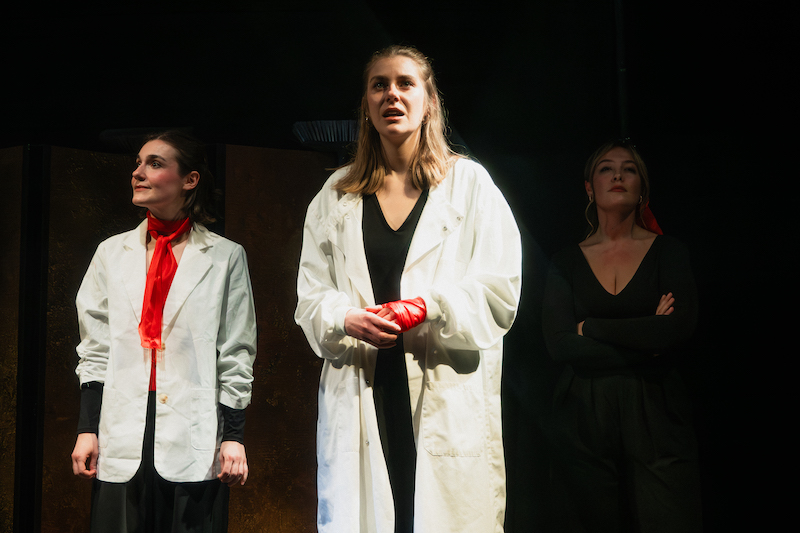
Singer and James conjure up a verse-speaking Greek chorus, twirling red tape and dancing over reams of white paper, to deliver a prologue and between-act exposition. It is a risky, unexpected choice in a piece about scientific ethics, but one that pays off in spades, bringing to life the chaotic, other-worldly, anxiety-prone state of Jamieson’s mind. Wallace impresses as psychotherapist Marti, though the character is mostly a mechanism for the professor to reveal inner torture. Culley’s turn as the cautious, even-headed Chris provides the perfect foil to Batty’s messy-headed, tempestuous, guitar-strumming professor.
It is a lucky coincidence that London has two simultaneous, well-put-together plays on offer about the messy intersection between business and medical science. If you can see both, do.
Runs until 21 March 2026
