

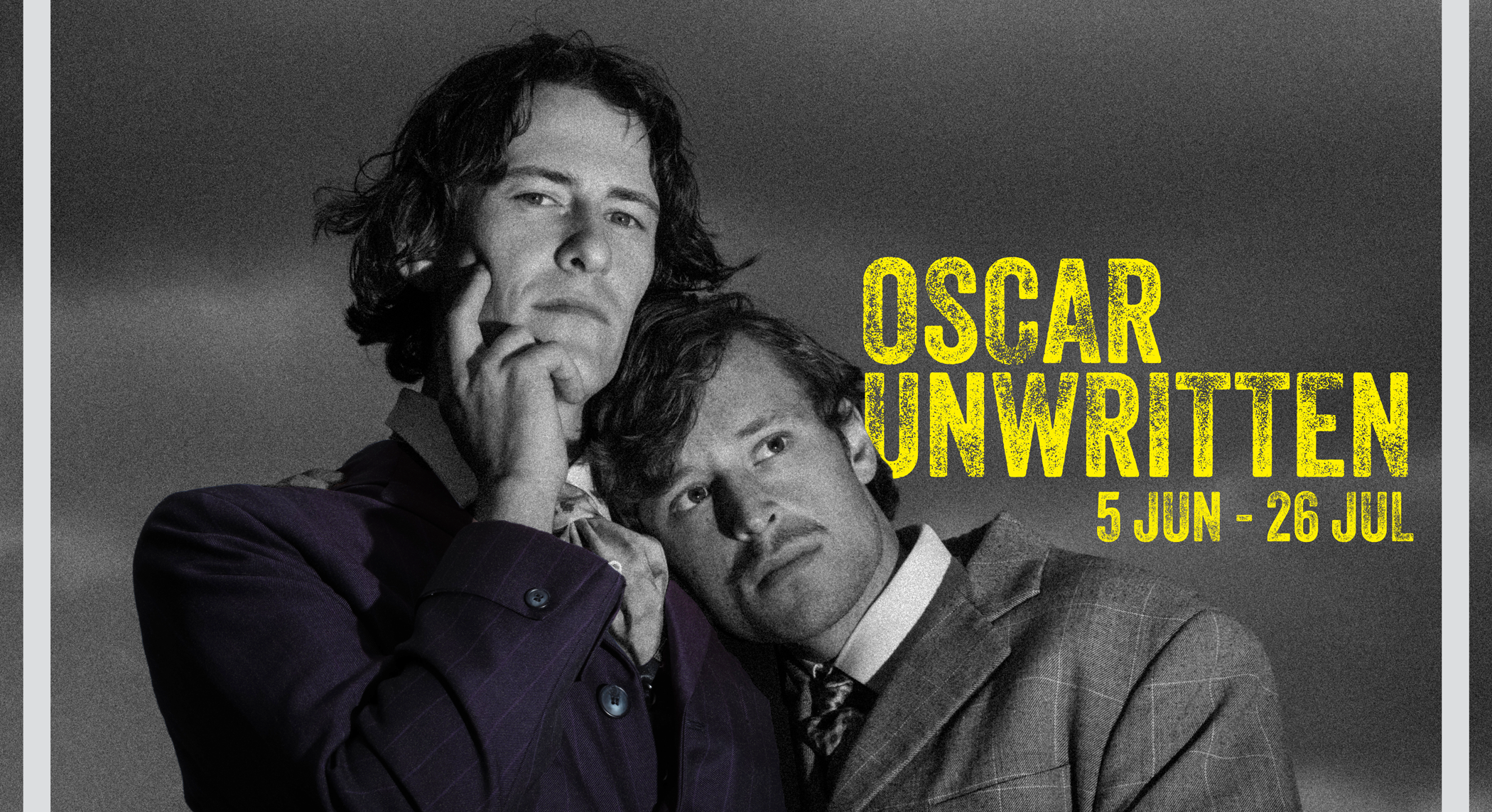
Writer: Tim Scott
Director: Sarah Jane Scaife
We meet with our lovely guide, Trinity College alumna Anya, at the Campanile in Front Square for this afternoon’s literary walking tour around the campus. The tour will finish at the Samuel Beckett Theatre where we will see Tim Scott’s new play, OSCAR UNWRITTEN.
Stopping first outside the Graduate Memorial Building, the Rubrics and the Eavan Boland Library, we are given the history of the beautiful buildings and are regaled with engaging anecdotes about the famous literary alumni who frequented them. Who knew that Clontarf born Bram Stoker married his friend Oscar Wilde’s first love Florence Balcombe in 1878? That W.B. Yeats didn’t apply to attend Trinity at all because he didn’t think he would pass the entrance exam? Or that it was because of her essay Even if You Beat Me on her experiences as a European champion debater while a student at Trinity that Sally Rooney garnered the attention of established literary agent Tracy Bohan, leading to the publishing of Rooney’s debut novel, Conversations with Friends.
We are reminded how unlike Swift, Goldsmith, Stoker, Wilde, Synge and Beckett, James Joyce had to pursue his education at U.C.D. because as a Catholic he was restricted from enrolling at Trinity in the first instance by historic Penal Laws and in the second by the Catholic Church Ban of 1871. Anya bids us farewell by the quirky oak-cladded theatre named for playwright Samuel Beckett and we take our seats for its director and theatre manager Tim Scott’s own literary endeavour. The walking tour has been a marvellous prelude to the show.
Himself a journalist, among other things, Robbie Ross sits at his desk surrounded by the accouterments of his trade. He is wrestling with the dilemma of whether “to write or not write” “all of it”, a full and unabashed biography of his deceased former lover and life-long friend, Oscar Wilde. As though summoned by the “custodian” of “his memories”, the libertarian manifests lying on his death bed behind a second black scrim. Rising, and with customary confidence, he sallies forth across the divide and asks if Ross “means to save” him “posthumously” even though adventuring back through his past will surely “be like looking at an old photograph through a misty glass”.
And so we wander aft, bearing witness to the trajectory of Wilde’s colourful and controversial life. We hear how his family moved just 360 metres from 21 Westland Row to the grander, 1 Merrion Square, and how the death of his beloved sister Zola at nine years of age devastated them. How “he was an eccentric dresser and a keen debater” at Trinity, and that fellow student Ned Carson was “blinky eyed”. “Oxford was where everything was possible” and “where he lived life intensely”.
Characters Dorian Gray from Wilde’s novel The Picture of Dorian Gray and Salome from his one-act tragedy of the same name enter from behind a third set of bleed-through scrims. These “thought experiments”, “made in his own desire” accentuate various dramatic actions within some of the scenes. Wilde’s wife and mother of his two boys, Constance, arrives. She “is someone who will challenge him” and is the only person who “speaks to him honestly”. She squares up to her philandering and mostly absent husband, warning him that his family are “not a pretty little exhibition” that he “can visit on a whim”.
Wilde’s 21 year old lover, Oxford undergraduate, Lord Alfred ‘Bosie’ Douglas, is petulant and provocative. Outraged by his son’s scandalous affair with Wilde, Bosie’s father, the 9th Marquess of Queensberry, hires private detectives to investigate the “posing sodomite”. They gather evidence of the writer’s homosexual liaisons with underage male prostitutes, and Wilde is sent down for two years for gross indecency. He died of meningitis in a hotel room in Paris three years after his release from incarceration.
It is unsurprising that this play is impeccable in its conception, direction and performance. The Samuel Beckett Theatre serves as the academic hub for Trinity’s School of Creative Art’s Drama department. Except for Lorcan Strain who plays the role of Oscar (BA Hons Performing Arts, DIT Sligo), the majority of the production company is alumni, current students and Lir Academy graduates. Each of the actors deliver a flawless portrayal of their character/s. The set and props are minimal but sufficient so as not to distract from the script and the performance. Costumes are immaculately reproduced. In the absence of scenery, intermittent lighting projections and soft piano music enhance the storyline. As Assistant Professor of Drama at Trinity, OSCAR UNWRITTEN’s director, Dr. Sarah Jane Scaife knows what she is about, and it shows.
What is surprising, however, is how serious the play is. Wilde is famously renowned for his wit and satirical epigrams. While Scott’s script is clever and tight and he makes full use of the writer’s brilliant dialogue, I think he misses a trick in not fully exploiting the humourous, sarcastic and flamboyant aspects of Wilde’s persona.
Walking back through the beautiful grounds of Trinity College, my eyes are drawn to the rooms in which Wilde lived, as pointed out earlier by Anya. It is hard not to feel conflicted towards Trinity’s notorious alumnus. While acknowledging his great works on one hand, it is hard to overcome his distasteful penchant for young men and boys and the possible exploitation of those from poorer backgrounds especially, as outlined in court papers. Robbie Ross was only 17 years old and had been entrusted to the care of Oscar and Constance as a student lodger, in loco parentis, by his mother, when their entanglement began. There is also Wilde’s treatment of his wife and family. What there can be no ambivalence about, however, is today’s play. OSCAR UNWRITTEN is an unqualified success for all involved. Catch it if you can.
Runs Until 26th July 2026.
