

Writer: Nina Segal
Director: Guy Jones
“Our story begins at night time, in a medium-sized village (which is to say a very, very, very small town)  somewhere outside the M25”.
There’s a river, and when it bursts its banks the village is surrounded by water, unexpectedly an island cut off from the rest of the country. There a leader emerges – and what follows takes events in an unexpected direction.
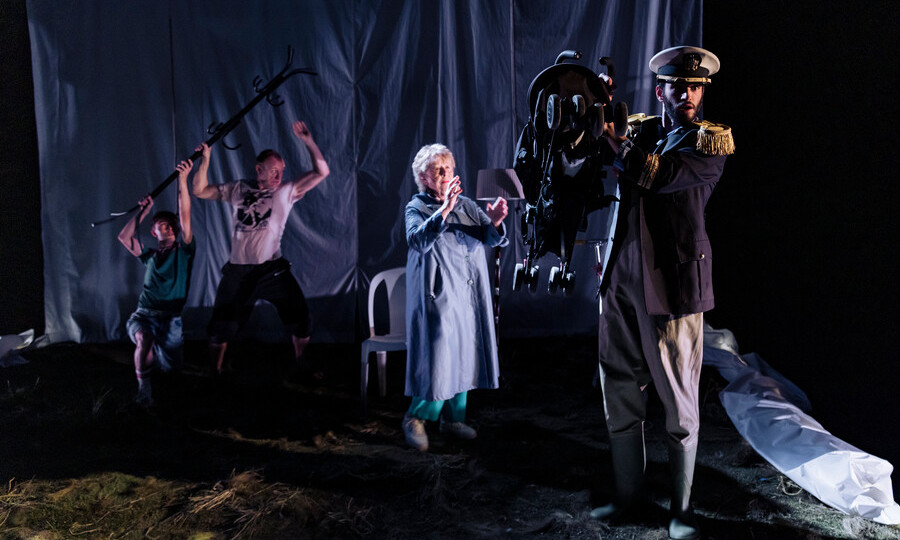
As the flooding starts, inept MP Leonard (played with a slimy faux-charm by Alex Bhat) tries in vain for the heroic photo-op he craves and, finding himself usurped, departs for sunnier climes. He leaves the field clear for Margaret (Linda Broughton), an apparently innocuous – though determined – old lady who turns out to have some unexpected political views.
O Island! is a fascinating and more than a little disconcerting piece about insularity and how quickly and easily extremism can emerge – and how people even vote for it, before finding too late what they’ve voted for and how it starts to affect them personally. It’s an acutely well-observed piece, and though comparisons to Lord of the Flies are inevitable, it is the echoes of current events and political situation that make this most striking. While it may seem to be all about the UK, with references to Public School and stopping outsiders crossing the water to reach them, suddenly an idea or a phrase pops up to remind us of recent events elsewhere too.
Initially almost farce-like in its humour, it quickly darkens and develops a fascinating sense of horror, the laughs becoming those of embarrassment rather than farce as the realisation of what’s being portrayed sinks in, and the parallels become increasingly apparent.
It’s viewed from outside, through the eyes of Inge (Anna Andresen), a documentary-maker who acts as an intermittent narrator until she decides she can no longer just stand by and watch. We also have Laurie (Joe Barber), a teenager who’s a decent lad being seemingly led astray who gets some of our sympathy and his father Mick (Tim Treloar) who develops a taste for the opportunities he finds. There’s opposition too, in the form of Vi (Jade Ogugua) who experiences buyer’s remorse and objects to the way things are progressing.
It’s engrossing, and if anything the play is too short to do it justice. The different factions are there, albeit portrayed by single individuals, but we never see how their views develop and why they end up doing the things they do. Did Margaret always have these views and seized her moment, or is it a case of ‘power corrupts’? Why does nice-guy father Mick become what he becomes? Time in a single-act play doesn’t permit these questions to be answered, and we’re left with superficial characterisations.
It may have more impact on audience members who take an interest in politics than those who don’t, but this is a piece that will strike a chord with all.
Runs Until 5 November 2022
