

Writers: Joanna Nevin, Martin South and Simona Hughes
Director: Simona Hughes
Jane Austen wrote Northanger Abbey as a satire of Gothic fiction. Moving Parts Theatre Company, performing it in the garden of John Keats’s house on a balmy Hampstead evening, stages this satire of a satire in a setting so perfectly literary it might itself have been dreamed up by a novelist with a fondness for plum trees. The result is an evening of such charm and intelligence that one forgives the occasional heavy hand required to construct it.
The production’s frame is audacious: two university students – an Irish feminist and a cheerful dolt – interrupt the action at intervals to read aloud from the novel and bicker about its meaning, carrying Austen’s authorial voice into something contemporary and comic. It tips, here and there, toward over-explanation, narrating what the stage has already shown. But it earns its licence. The joke, crucially, is on the kind of person who reads Gothic novels expecting life to imitate them, which is, of course, Austen’s original joke. The meta-ness holds.
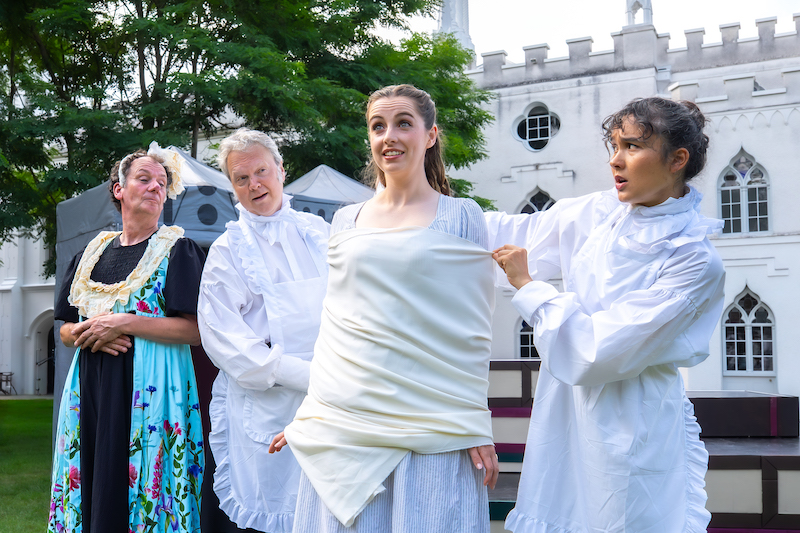
Anna Blackburn’s Catherine Morland arrives with the necessary comic instinct, her face a running commentary on the absurdity unfolding around her. Dominic Bryant’s Henry Tilney has the required charm and lightness of a 19th-century beau. Martin South’s General Tilney – grunting, nostril-flaring, enslaved to money rather than murder – makes Austen’s real point with satisfying economy. Andy Canadine’s work across multiple roles, including a Tilney maid of memorable disposition, brings an exuberance that the production wears well.
Theatrical equivalents are found for Austen’s literary tricks with ingenuity. A set of central steps doubles, triples, as a bumpy carriage ride to Northanger Abbey and then the spiral staircase within it. Brilliantly, the fans carried by the ensemble punctuate the drama with flamboyance. Now a chest heaving with Gothic implication, opened to reveal nothing at all; Now a ruff of General Tilney.
Keats House lends the whole evening a resonance no black-box theatre could manufacture. Austen and Keats never met, but they were exact contemporaries, writing in the same literary moment. There is something apt about her most literary novel finding a home, just for a night, in the garden where Romantic poetry was made. On a warm June evening, the leaves rustle in the breeze. The audience eats and drinks and laughs. A little girl throws a rose onto the stage.
It is, in every sense, a very horrid night out.
Reviewed on 26 June 2026 and continues to tour
