

Curator and set designer: Leslie Travers
Head of costume: Tracy Dunk
Manchester’s Royal Exchange stages theatre-in-the-round which gives audiences the opportunity to sit very close to the actors. This gives rise to challenges for costume designers as, up close, synthetic clothes are unconvincing necessitating the use of demanding authentic materials. Such costumes, however, offer the advantage of being durable and this longevity facilitates the staging of Mythic Reinvention, a free admission celebration of the craft of making costumes featuring actual outfits from productions at the theatre over its fifty year history.
The Royal Exchange lacks a formal exhibition space so the costumes are displayed in the foyer which runs around the theatre module with some of them situated on the actual module and on the mezzanine. Just as the theatre allows audiences to get close to the action visitors to Mythic Reinvention can study the exhibits at very close range. Patrons at The Rivals Bar may be surprised to find a fully-costumed model of Robin, the comic relief from Doctor Faustus, sitting on the bar.
Each display features a descriptive notice setting out the credits for the play from which the costumes originate along with brief but informative anecdotes. The shade of forest-green in Iago’s uniform complements the colour of the theatre seats. As the central actor in The House of Bernarda Alba remains seated for most of the production, the image of a cane chair is screen-printed onto the rear of the costume and can be seen when they rise from their seat.
Tricks of the trade are highlighted with costumes from Frankenstein and Let The Right One In featuring hidden compartments to emit blood. With period productions consideration has to be made as to whether to adhere to authenticity or atmosphere. The collar of a dress in The Duchess of Malfi is a replica of a genuine Medici collar whereas in The Winter’s Tale a Bohemian theme is adopted regardless of the actual period. More contemporary plays allow the opportunity for costumes to be developed in consultation with the actors.
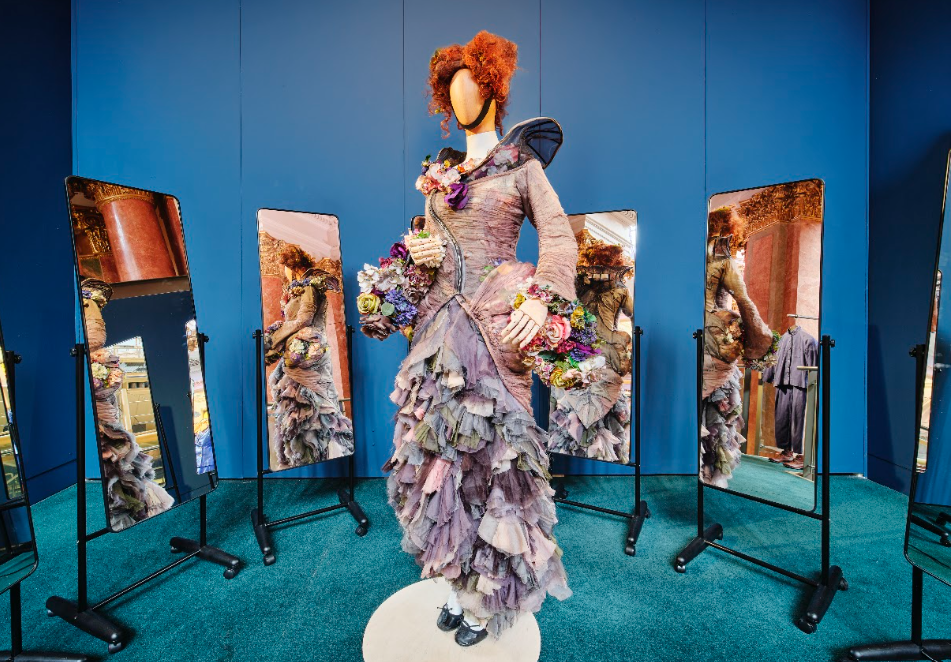
The circular nature of The Royal Exchange means the back of a costume is just as visible as the front, a point made with a gown from The Skriker which is not only surrounded by a circle of mirrors but also rotates so as to allow full appreciation. Orlando features a central character who swops gender so the selections from the play include costumes for both sexes facing each other through a mirror.
Mythic Reinvention gives an idea of the work involved in the process of creating the outfits. Filmed interviews are provided setting out the opinions of various designers. The backstage recreation of the actors’ dressing rooms is perhaps a bit too neat to be entirely credible but offers the opportunity to play dress-up and try on a costume.
A design workshop is recreated in painstaking detail. Racks of clothing in various stages of completion hang around the workshop tables which are crowded with reference books, flyers, rough designs , photographs and examples of the information taken from actors to facilitate their fitting into the costumes ( the actual measurements are discreetly redacted).
Mythic Reinvention not only offers the rare opportunity to appreciate the sheer effort and expertise involved in costume creation it demonstrates how the work enhances and shapes the actual productions. The exhibition allows comparisons to be made between how costumes help influence the atmosphere of different productions of a play. The costume for the 1999 version of King Lear, an elaborate cloak with rather dainty slippers, suggests a vain but delicate monarch whilst the 2016 tough leather tunic indicates a warrior king. The designs for the 2026 version (the actual clothes are not yet finished as the production does not open until next month) are for a sharp-suited contemporary ruler in the style of the Succession TV series.
Mythic Reinvention is an emotional rather than simply an appreciative experience; a nostalgic treat bringing back fond memories of past productions at the theatre. It certainly eats up time; anyone planning to attend the free exhibition should allow at least an hour to get the full impact.
There is, however, poignancy to the exhibits. Live theatre was hit hard by, and is still showing the effects of, the Covid pandemic; the Studio Theatre at the Royal Exchange is one casualty having never re-opened. Whilst it is exciting to be able to celebrate the past successes of The Royal Exchange it is hard to avoid the nagging worry as to whether it will be possible to maintain such high standards of quality in the future.
Runs until 15th November 2026
The Reviews Hub Star Rating
-
8
