

Writer: Terence Rattigan
Director: Anthony Lau
It’s surprising that this late Rattigan isn’t more often revived. Its premieres in London and New York in 1963 were poorly received, but perhaps Man and Boy, with its explicit rather than the sublimated homosexuality that Rattigan is known for, was just too early for that time. The tale of a crooked financier facing the end of his reign is very much of our times, or as Gregor would put it, “as of this moment.” Anthony Lau’s inventive production completely challenges our established views on the playwright who is more known for The Winslow Boy and The Deep Blue Sea.
It’s 1934 in Greenwich Village, New York, and a post-coital Basil Anthony and Carol Penn are listening to the news on the wireless in his apartment. The big news is the failed merger between American Electric and Manson Radios, the repercussions of which have thrown the stock markets around the world into turmoil. There is talk of Manson’s chief, Gregor Antonescu, not having as much money as he once claimed. And this is the middle of the Great Depression.
As a card-carrying Socialist, Basil should be delighted that capitalism is in trouble, but the issue is more personal as Gregor Antonescu is his father. Basil Anthony is just an Americanised version of Vasilly Antonescu. And then his father, escaping the paparazzi, turns up at his door asking if he can conduct an emergency business meeting in Basil’s somewhat shabby apartment.
Basil hasn’t seen his father for five years. The last time they met, Basil tried to shoot his father but missed. Gregor isn’t bitter, but he appears disappointed in his son who hasn’t followed in his footsteps at all. Gregor is fiery and committed, seeing the acquisition of money and the power it brings as a sport. In contrast, Basil is “soft” and plays piano in a bar for $24 a night. The fact that Basil failed to shoot his father seems something that they both regret.
However, Gregor hasn’t appeared on Basil’s threshold to make amends for the past, but to use him as a pawn in a deal to save his reputation. Carol is ushered out while Gregor’s right-hand man Sven is ushered in. Soon, the head of American Electric, Mark Herries, arrives along with his jumpy accountant, David Beeston. The stage is set for blackmail and subterfuge. Gregor is a master at this game.
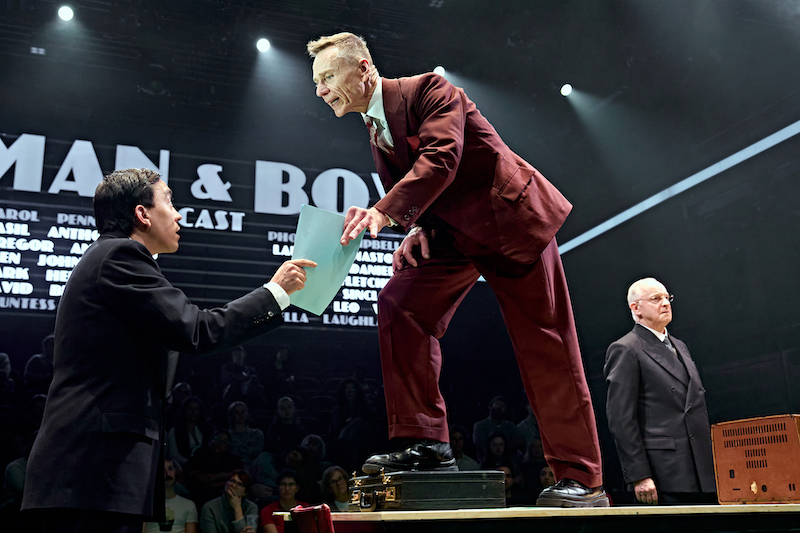
Rattigan wrote five or six versions of the play, one of which is a long script in real time, which, without an interval, would play for over two hours. It is up to directors to make their choice on where to place the intermission. Lau’s choice, although he uses the final version which Rattigan prepared for his Collected Plays, seems quite sensible, but when we come back, something is different about Gregor. Vulnerabilities that weren’t there before are now visible in Ben Daniels’ towering performance. In the role originally earmarked for Rex Harrison, Daniels is excellent throughout, almost animalistic in the way he bays for the blood of Herries, but it would be good to see traces of his insecurities earlier.
As son Basil, Laurie Kynaston is meek, but foolish, nicely naïve, yet at the same time too forgiving. His more metrosexual masculinity is at odds with that of his father. These two worlds collide in the second half, but Gregor is never the monster that Rattigan wanted him to be.
Leo Wan gives a very comic performance as the harassed accountant for American Electric, while Malcolm Sinclair manages to provoke sympathy in his role as the otherwise predatory Herries. Nick Fletcher is Sven, loyal though sharply undercut with pragmatism. It’s a shame that we don’t see more of the bubbly Carol (Phoebe Campbell), and Isabella Laughland as Gregor’s wife, the lofty Countess, is funny, but the arrival of her character only delays the very Shakespearean ending.
That business is to be understood as a sport is seen in Georgia Lowe’s traverse set, covered in green baize like a snooker table or the covering of a card table in a casino. With the characters’ and the actors’ names appearing in spotlights every time someone new enters the action, the set also alludes to the theatre in a meta way that looks spectacular.
Rattigan wrote that he hoped one day in the future someone would rediscover Man and Boy, the play that he thought was his best. His wish has come true in dazzling fashion.
Runs until 14 March 2026
