

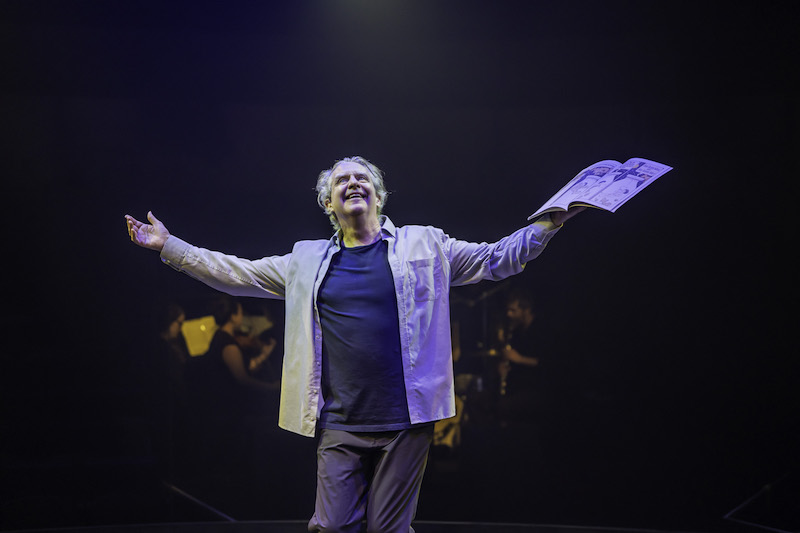
Writer: Phelim McDermott
Directors: Phelim McDermott and Kirsty Housley
Music: Philip Glass
Not quite a one-man show, as Phelim McDermott is joined onstage by puppeteers and musicians, Tao of Glass is part autobiography, part treatise on mortality. It’s also an homage to theatre and to the minimal music of Philip Glass. It’s about shows that were never performed. It’s about friendship, parenthood and creativity. It’s about chaos and, finally, heartrendingly, it’s about stillness.
Tao of Glass is almost impossible to describe, and its narrative takes us from Max Wall performing in Waiting for Godot in Manchester to the picture books of Maurice Sendak, from McDermott hiding in a wardrobe on the Almeida stage to lying on the floor at sohoplace listening to a piece by Glass which delves into the deepest parts of us. And yet, despite its philosophical material, Tao of Glass overflows with generosity and spirituality.
When he was a young boy, McDermott was fascinated by the theatre and what it could do. Here, with the help of three puppeteers, he also shows us how stories can be told. In the first set piece, with stirring live Philip Glass music, Sendak’s In The Night Kitchen is realised through shadows on a screen. The stage revolves, and so we can see how the scenes of a boy falling through an American skyline are created. It’s thrilling and Glass’s sparse music, always refusing any kind of climax, makes it even more so.
The other set piece, in true musical style, opens the second half when McDermott encounters another form of glass, the top of an expensive coffee table. Intricate and yet simply made with paper and Sellotape, the images represent a lost temper, a missing muse, even a breakdown of sorts. Who needs high-tech trickery when there are sheets of staff paper floating down elegantly from the ceiling?
The pictures and shapes formed gracefully by Sarah Wright, Vic Llewellyn and Janet Etuk are always striking, but it is the two last scenes, when Glass’s music takes prominence, that grip most. Glass’s repetitions, McDermott claims, penetrate the hidden spaces in our psyche, spaces which he refers to as The Essence, after Arnold Mindell’s Deep Democracy theory. As a preverbal state, The Essence is similar to Freud’s Unconscious or Lacan’s The Real. McDermott believes that Glass’s music can somehow reach this space, and Glass has written a piece, Coma, that attempts this psychic journey.
This may all sound academic and profound; however, McDermott is never distant or condescending as he explains various theories and Chinese Wisdom. He’s so kind and engaging that we want to join him on the revolving floor as clarinettist Jack McNeill and Kasia Ziminska serenade him as he sinks, like the hero of In The Night Kitchen, into a deeper state of consciousness.
When the spell is broken, we emerge refreshed and hopeful while a tug of the inevitable whispers in the undertow of sound waves.
Runs until 12 September 2026
