

Conductor: Marie Jacquot
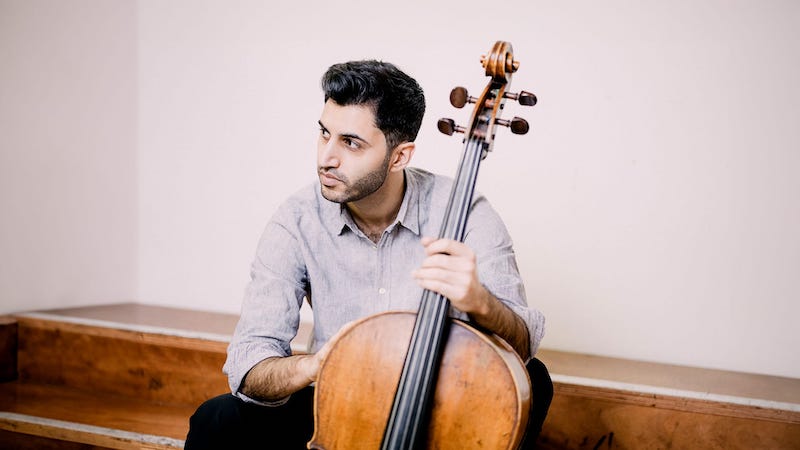
In a concert featuring two great romantic masterpieces, two bright stars, cellist Kian Soltani and conductor Marie Jacquot, each lead a part of the programme, allowing us to get a taste of their musicality and vision, and providing an enjoyable take on these classics.
The first half of the programme stars Soltani playing Antonin Dvořák’s one and only Cello Concerto in B minor. Written while Dvořák’s sister-in-law and childhood love was seriously ill and then revised after her death in 1895, the third movement includes an exploration of another one of the composer’s themes – the song “Leave Me Alone (Kéž duch můj sám)”, Op. 82, B.157, No. 1, which she adored.
The concerto is striking, with wonderful themes showing off the high range of the cello as well as the dark and melancholy tones that are so unique to the instrument. The LPO’s warm cocoon of sound, starring Annemarie Federle on principal horn, envelops and draws the listener in, setting the stage for one to admire each and every note uttered by the performer. Soltani’s technical skill is apparent, proudly presenting the well-known theme of the first movement with assurance that comes from true understanding of the work and then fulfilling our expectations with perfectly placed double stops stretched over the neck of the instrument and strong and spirited vibrato throughout.
In the second movement, the softer theme brings out a kinder, sweeter sound to the instrument, a 1694 Stradivari, before returning to the strident strength and darkness of the final movement. Soltani strives to find a truly anguished sound in the instrument, though perhaps not to the Stradivari’s advantage, as the woody and almost ringing timbre he brings out seems an attempt to push the tone further than it can go. Yet, we feel the pain of Dvořák’s own story in the performance, which Soltani then elaborates upon in his encore “Let me walk alone in my dreams”, leaving us with a beautiful arrangement of the “Leave Me Alone” for solo cello and cello ensemble.
The second half of the programme features César Franck’s Symphony in D minor, his most famous piece and an amazing example of late Romantic composition, where the powerful themes are expertly developed and played with throughout the movements, using the full strength of the orchestra, and deftly featuring its myriad of colours. This gives us the opportunity to appreciate some of the soloists in the wind section – notably the harp in the second movement (Rosanna Rolton) as well as the elegantly played cor anglais solo (Helen Vigurs), reprised by the French horn (John Ryan) and clarinet (Benjamin Mellefont) with perfectly balanced and calibrated timbres.
Jacquot, a French conductor known for her work at the Royal Danish Theatre in Copenhagen, conducts the LPO here for the first time with a steady hand, rarely leaning too far into any excess, but providing a stable basis on which the composition speaks for itself. The final movement picks up in momentum, with its sublime themes tying the piece together with its many modulations, alternating in tempi and mood throughout. Jacquot provides space to shine light on the instrumentation and these themes, even if it is difficult to provide a knowledgeable audience with a truly new interpretation of such a well-known and complex symphony.
Reviewed on 3 October 2026
