

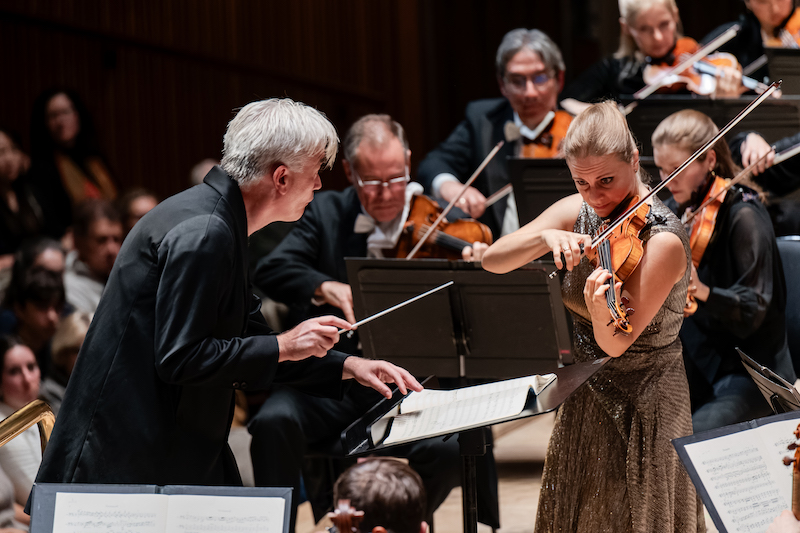
Conductor: Edward Gardner
Soloist: Julia Fischer
Julia Fischer’s performance of Brahms’ Violin Concerto with Edward Gardner and the London Philharmonic Orchestra is clear evidence of the delight which soloist, conductor and orchestra take in their collaboration, with tonight’s concert coming just a few days before their concert tour in Spain. Gardner, at his most exuberantly nimble, almost dances as he conducts and the LPO play with what feels like extra special energy.
Fischer herself is simply mesmerising, playing with extraordinary commitment, passion and nuance. It’s interesting to realise, as Jo Kirkbridge writes in the programme notes, that the initial response to this violin concerto was muted, critics in 1879 finding it ‘too modern… the violin part too difficult’. Fischer makes it sound effortless. But the thrill of being able to watch her play is being able to see the exceptional virtuosity the piece requires. You can’t take your eyes off her. Even in the moments when the orchestra plays alone, she is clearly enraptured by the music. It’s worth repeating what Fischer has stated about her beliefs about entering a musical career: it should all be about the music, not the career itself:
‘One should choose to become a musician because one believes that the world needs music and without music, the emotional life of human beings is going to die. Everything else will come with dedication and hard work.’
The Brahms Violin Concerto itself is a pleasurably lyrical work. The opening movement, Allegro non troppo, is full of exhilarating changes of mood – from the gentle woodwinds of the opening to the stormy intensity of passages that follow. The Adagio opens with the exquisite melody for the oboe before becoming an intense dialogue between woodwinds and the full orchestra.
The influence of Brahms’ friend, the Hungarian violinist Joseph Joachim, is powerfully evident in the Allegro giocoso with its celebratory gypsy dance, leading to a joyfully triumphant finale.
In the second half of the concert, the LPO tackle Tchaikovsky’s monumental Manfred Symphony. It’s a programmatic work, composed in 1885 and based on Byron’s gothic drama of the same name. Byron’s Manfred comes from that exceptionally monumental year, 1816 – the so-called Year Without a Summer and the summer in which Mary Shelley wrote Frankenstein. Tchaikovsky gives full rein to the dramatic Alpine setting of Byron’s work, as the melancholy and guilt-laden Manfred wanders the mountains in an effort to relieve his sufferings.
Tchaikovsky creates an intense, dark score which includes fierce, angry work for the strings, wonderfully braying brass and a rich range of percussion. Bassoons in the opening Lento lugubre evoke Manfred’s lonely brooding – he’s an archetypal Byronic hero, destined to be forever an outsider. In contrast, delicate melodies on harp and woodwinds suggest his ruined love, Astarte.
The second movement, Vivace on spirito, in contrast, sparkles with light. Valdimir Stasov’s original programme for the symphony describes it in these words: ‘The Alpine fairy appears to Manfred in the rainbow from a waterfall’s spray’. If it all sounds a bit too Disney fantasy, the beauty and depth of the music itself dispels this idea.
The Andante con moto brings further relief from melancholy, with the oboe suggesting a timeless pastoral idyll, but the movement again darkens when Manfred reappears.
Tchaikovsky brings all his forces to bear in the final passionate movement, marked Allegro con fuoco. Again, the specifics of the piece’s programme may not be to contemporary taste – it’s all about Manfred’s descent into the subterranean halls of a demonic spirit and the summoning of Astarte before Manfred himself dies. But the music itself is exhilarating and played with passionate intensity.
A thrilling programme, magnificently performed.
Reviewed on 21 October 2026
The Reviews Hub Star Rating
-
10
