

Cued by the faint hiss of a fog machine coming to life, the dimly lit stage fills with a mist whose tendrils slowly reach out into the audience as strong electronic club music fills the space.
In After After, presented by Dance Umbrella, Arno Schuitemaker explores what could come next, following the end of our era. Entirely filled with mist, the stage feels set for either a beginning or an end, as seven dancers emerge one by one, shadows whose jerky movements match the strident percussion of Aart Strootman’s composition.
The visual effect is impressive, as the dancers, lit from the back by a long hanging horizontal white light (designed by Jean Kalman), move in and out of the shadow, unsynchronised, yet coordinated in the disorder. Trance-like and filled with insistent tension, the dancers loosely gather into formations, before breaking apart. As the bass drum beats on, slowing from a pulse to an overpowering heartbeat and then to a painful throb, each drop is accompanied by a convulsion. Intentionally lengthy and laborious, the repetition stretches to its limits before the dancers awake and exit one by one, leaving only Paolo Yao underneath this searing light, which blinds us to leave nothing but darkness.
In the after, we are greeted by a dark stage, where we can faintly make out the slow and languid movements of Ashley Ho. As the dancers rejoin this new world, they also add their own voices to the scene. Though the obvious symbolism of an angelic choir is slightly cheesy, the added dimension to the performance is welcomed by the audience, already fatigued by the intensity of the first part and the lack of narrative.
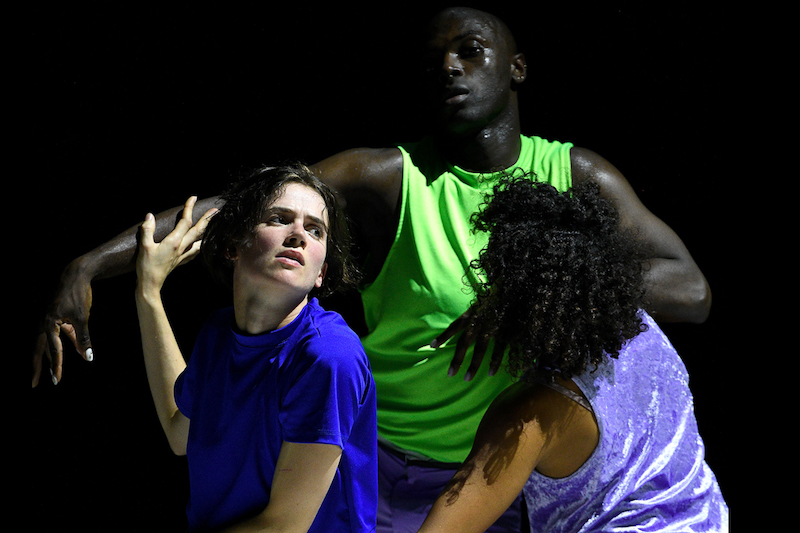
As the pace quickens, Kalman’s poignant lighting comes into play as a large square illuminates the ground, triggered by a purposeful misstep. Shadows return, though this time rightfully beneath the dancers, as the colourful neon costumes (by SADAK) and the dancers’ faces are finally revealed. After a brief moment of connection, each individual seems to find their voice once more, reviving their own visceral and sometimes sexualised movements. Here we are, back in the cycle: death, rebirth and chaos.
After After is visually stunning and physically intense, and although some of the drawn-out repetitions lose their effect, it is a powerful view on the intensity of life.
Reviewed on 21 October 2026
