

Writer: Samuel Beckett
Director: Stockard Channing
It was while in Vilnius, Lithuania, that actor David Westhead followed some random arrows on a street that led to a Soviet apartment block. Here, an actor performed Samuel Beckett’s Krapp’s Last Tape in his modest flat, an unexpected, moving performance that enthralled and inspired Westhead to put together his own production.
He contacted long-term friend and Broadway royalty, Stockard Channing, to see if she would direct, and she agreed. “Have play, will travel”, enthused the Emmy Award-winning actress at Norwood’s Stanley Arts at the Q&A after the magnetic performance at the South London Victorian arts centre, packed for the occasion.
First written and performed at the Royal Court in 1958, this existential novella of a play is less than an hour (43 minutes), hammering home the message that life is short. Small but perfectly formed, this one-man, one-act piece sees Krapp, an elderly man, listening back to a voice tape he made to himself, 30 years earlier.
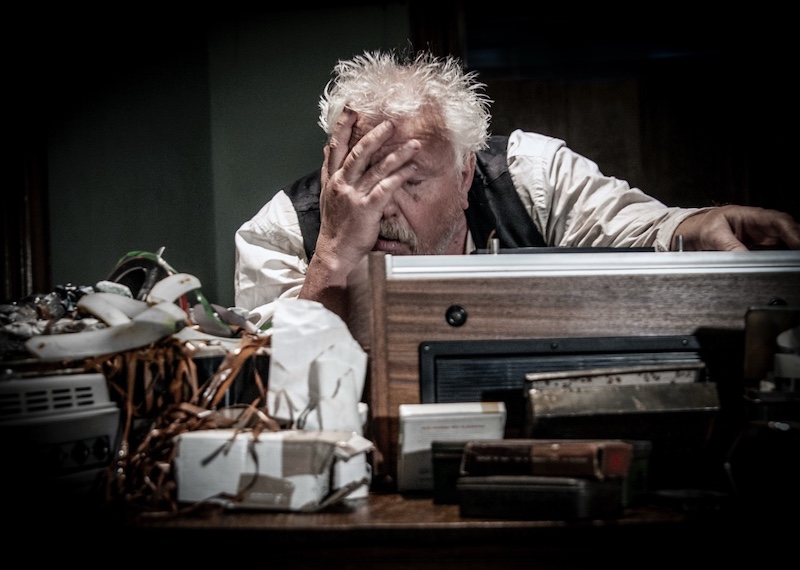
Westhead’s performance is mesmerising. The play opens with an entire seven minutes of silence and contemplation, which shows that Channing’s directing powers are spot on. Her choices give depth and meditative space for the audience. We forget we are at the theatre and believe we are witnessing a real person, perhaps a hoarder, surrounded by the detritus of their life as they reenact the past through the ghostly voice of a younger self.
The technical support, a reel-to-reel tape deck (with discreet Bluetooth) produced by Wilton Pictures by Alfred Westhead, acts as a second character. The older, solitary, reflective Krapp converses with his younger self, a stranger from a distant past full of pompous words and grand ambitions. Krapp reflects on who he once was, the passing of time, dead parents and lost loves, some consigned to history and one that lingers to revive an aching longing.
It is the simplicity of Krapp’s Last Tape that drew both Westhead and Channing to the project, and on the surface, it is simple: Old man remembers. But it’s also highly charged, resonant and as relevant now as when it was written, perhaps more so in the surfeit of memories with which we are routinely drenched through social media.
While there is plenty of contemplation about mortality, legacy and regret, there is also Beckett’s distinctive humour. Andy Warhol used a banana for his 1960s pop art, but the yellow fruit made it to art status here first with Krapp’s Last Tape. Never has a skid on a banana skin been more artful, entertaining or pleasing.
Westhead has now performed this production of Krapp’s Last Tape 44 times throughout 2025 in backrooms, wine bars, people’s houses, and on stages, large and small, both internationally and nationally. This is something special, a memorable artistic collaboration and cultural happening with all profits from ticket sales going to Westhead’s own charity that provides cameras for disadvantaged young people, so they can make their own memories. Next stop, Yvonne Arnaud Theatre, Guilford. If it arrives near you, you’d be crazy to miss it.
Reviewed on 6 February 2026 and continues to tour
