

Composer: Oliver Messiaen
Conductor: Vasily Petrenko
Piano soloist: Steven Osborne
Ondes Martenot soloist: Cécile Lartigau
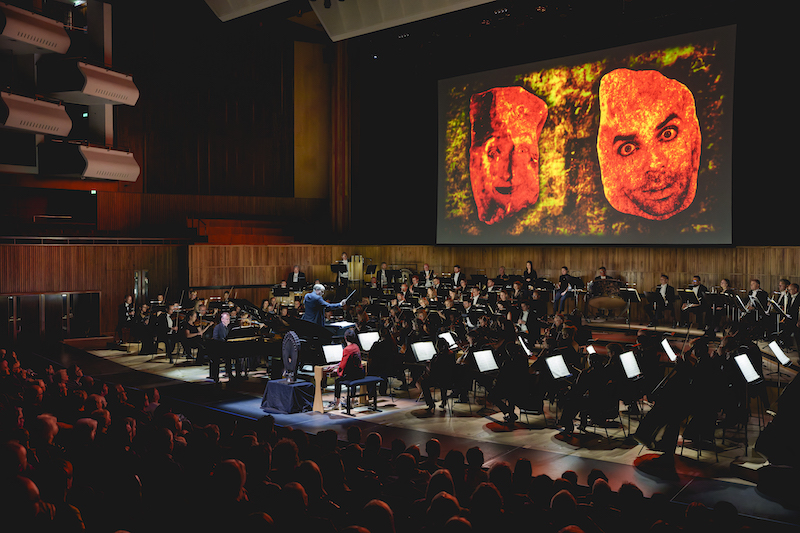
The Southbank Centre’s Multitudes festival aims to reimagine orchestral music for all the senses. The performance of Messiaen’s expansive Turangalîla symphony by the Royal Philharmonic Orchestra, which has been included in the festival’s programme, is accompanied by a striking visual element: a full-length silent film by the animators, 1927 Studios. The programmatic elements of Messiaen’s symphony lend it well to this treatment; however, the symphony feels slightly relegated to background music in the process, with the highly stylised film often giving a comic effect when we should be feeling something more spiritual.
We’re given some useful background information from conductor Vasily Petrenko before the performance starts. He tells us that the fiendishly difficult solo piano part was first written for someone whom Messiaen later married. As soloist Steven Osborne ably tackles its intricacies tonight, it’s amusing to think about whether the composer intended to impress or merely put to the test his future beloved. Based on this piece of information, we might have thought we were in for an accompanying film that depicts a more quotidian type of love; however, as Petrenko also tells us, Messiaen was heavily influenced by the tragic mythic tale of Tristan and Isolde, and it’s this which the film takes as its basis.
We’re told via captions about a lady who is due to marry a king but ends up taking a love potion by accident with the cavalier who was supposed to deliver her to the king. The two fall in love, and their forbidden affair and eventual death take up the rest of the film. It is only in death that they can truly be together. Their spirits drift up out of their bodies, and they frolic in the face of the angry king.
It’s an uncanny triumph how 1927 Studios manages to pastiche the style of early Hollywood silent films so faithfully. The over-exaggerated expressions are there, the font and olde-style spelling of the captions, the degraded film effect. There’s also an influence of 1960s psychedelia, with some scenes recalling the manic animation of Yellow Submarine. Whilst many of the scenes outline a clear narrative, there is also space for trippier drawn-out sequences, and it’s in these that the audience member is given more of a chance to use their own imagination, which comes as a welcome respite.
On paper, the marriage of a symphony with a film that depicts the very story that influenced the composer makes a lot of artistic sense. But the combination is perhaps too on the nose. The power of the music lies in the images and feelings it arouses in the listener’s mind. Calling the performance Infinite Love makes it quite the standard to meet, too. Though the love of two people who have been released into the afterlife to live together forever can be seen as infinite, watching a film of it gives the audience member a very finite field of images compared to what might be going through their head with just an orchestra to look at.
And the music itself is quite enough to inspire thoughts of the infinite. Messiaen’s normally janky modernist tonal world is softened with moments of cadence and lush, reassuring harmonies. There are clear melodic themes throughout, which make it feel very symphonic and also rather Wagnerian. The massive orchestra handles this difficult music with aplomb. One notable extra element is the ondes Martenot played by Cécile Lartigau. This is an early electronic instrument which gives swooping, spooky glissandos and slightly brash melodic moments. It cuts through the orchestral underpinning in a way that the more dainty piano playing sometimes struggles. It’s just a shame that the combination of musical and visual elements leaves a rather disappointing taste in the mouth.
Reviewed on 23 April 2026
Multitudes runs until 30 April 2026
The Reviews Hub Star Rating
-
Reviews Hub Score6
