

“I’ve lived that story”.
Inkbrew Productions presents The BBC’s First Homosexual a docufictional play based on a banned BBC documentary of an attempt to explore male homosexuality in early 1950’s England.
I had the pleasure of interviewing writer and drama archivist Stephen M. Hornby about the creation of this piece and its journey to the Wilde Stages, Queer Theatre Festival.
The concept was first presented to Hornby when researcher Marcus Collins was exploring the BBC Archives as a part of the BBC 100 History Fellowship. Collins discovered a file titled “Sexual Offences 1953-1954” and thought Hornby would take interest. Within this was a full transcript of an experimental programme the BBC attempted to produce on how male homosexuality was understood, discussed and ultimately suppressed. The programme was banned and then resurfaced a few years later where a highly edited version was aired. Hornby recognised they’d struck gold.
Initially, the idea of turning the manuscript into a radio drama was discussed but feared the manuscript would come across as deeply offensive to modern ears. So Hornby dived into what he thought was interesting about the file and came up with two perceptions – what would it feel like being a homosexual man listening to this at the time and what sort of environment did this create around the BBC and more explicitly on current immoral crimes?
This process resulted in a play of three stories, a young tailor from Manchester called Tom dealing with his homosexuality in the 1950s, two BBC producers in the process of making the documentary and parts of the verbatim manuscript.
“It’s sort of like a party punch, all things poured into a bowl that you hope comes out tasting alright at the end of it”.
In 2022 a 25 minute test piece was performed of the two BBC documentary producers and the start of finding the character of Tom and creating his story. From the response this received Hornby knew it had the legs to be developed further into a longer story, and in doing so tried to explore many more parts of the queer subculture of the 1950s. Hornby touched on how he had the benefit of his parent’s and grandparent’s point of views of that period as he looked through photos of his mum in the 50’s to get a clearer image of the time.
“Put together all the little bits of the jigsaw and you try to create something that feels very specific to the period”.
I was fascinated by the creation of Tom and how he fit into the story. Hornby explained how Tom was loosely inspired by one of his uncles who was a tailor and had been divorced through non-consummation. Another aspect of Tom’s character came from Hornby’s teenage experience living in Manchester during the AIDS crisis in England and how media representation of that had had a very negative impact on him. Hornby took literary inspiration from novels of the 50s; Peter Wildeblood’s “Against the Law” a middle class account of being a homosexual, Peter Park’s anthology “Some Men In London” and Patrick Higgins’ “Heterosexual Dictatorship”.
“I give very edited highlights, if you can call it that, probably lowlights of the kind of views that were expressed”.
When it came to the BBC producers and the experts within the original manuscript, Hornby had a decision to make. He didn’t want to reproduce “endless chunks of homophobic ranting” at risk of being offensive but also wanted to be authentic to the debates of the time. How was homosexuality thought about in public and what was the spectrum of opinion around the topic? You get a flavour of these within the piece and the basic logic of the positions of the different experts.
By changing the original documentary manuscript into something more theatrical, those endless chunks were heavily edited and so Hornby felt it fair to change the names of the original protagonists. “They’re just referred to as Expert 1, 2, 3, 4, 5.”
“Although I disagree profoundly with their views I would be doing them a disservice to say that was what they said”.
As a lecturer, one thing Hornby says to his students, that he hopes he’s not guilty of, is that what they’re writing in terms of dialogue is what he calls generic, not now. The process of taking out references to modern slang and it becoming this generic dialogue, that isn’t obviously modern but isn’t rooted in any period of the past.
“What I hope I’ve done is to know enough about the places, the manners, the social codes, the language, the way gender and sexuality were spoken about, to make sure the dialogue reflects all of that and feels specific to that period and point of view”.
Hornby was heartily passionate about this project. His hopes for the piece were that the themes around conversion therapy from the original documentary would be relevant enough (as such conversion based therapies are still occurring internationally) to raise enough awareness that these therapies could be banned.
After its 2022 tester, Hornby engaged in two years of reading and researching and with some funding, embarked on a national tour of England in February of this year hitting Brighton, London, Liverpool and more. Receiving five-star ratings and rave reviews The BBC’s First Homosexual received a successful launch! Hornby expressed how older male audience members who had lived through some of those experiences in the 50s approached him after the show and reassured him that that is exactly what happened and they had lived that story and had had that relationship and relayed their stories about loves and friends from that period.
“[They] came up to me and reassuringly said, you know, that’s exactly what happened. I’ve lived that story”.
From the tour in England, the script received a slight trim coming down to 70 minutes and with more funding they were able to bring it to Teachers’ Club Main Hall as a part of the Wilde Stages: Queer Theatre Festival. Hornby was very curious at how it would be received by an Irish audience.
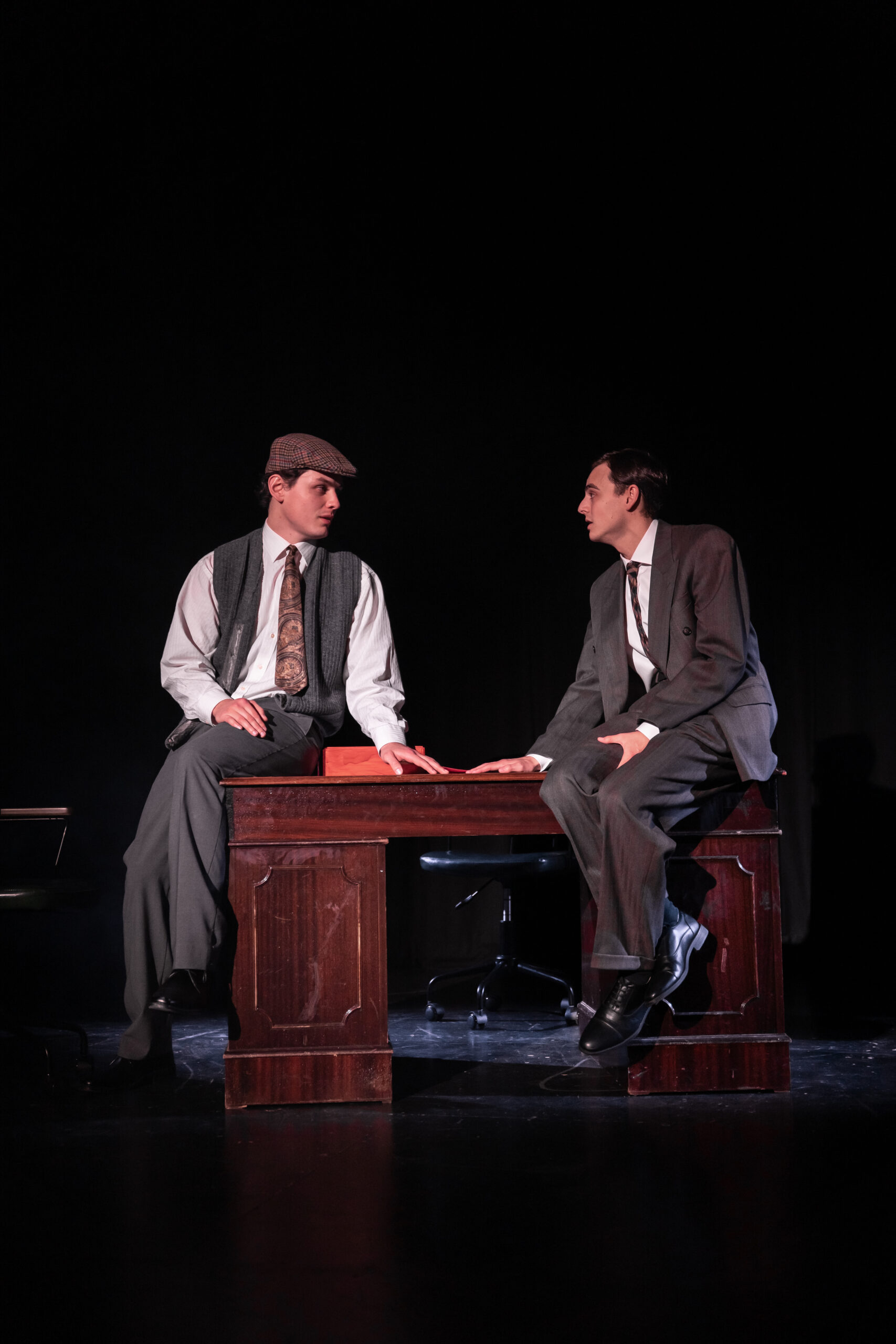
The performance itself was a vivid transportation back to the 1950’s. Aided by authentic scenic design, one truly felt like you were looking through a porthole to the past and receiving exclusive access to the creation of this controversial topic that was the BBC documentary.
The play opens with the two BBC producers (performed by Barry McStay and Max Lohan) discussing the potential creation of the documentary and what it would mean for the BBC to produce such a programme. They explore the prospect of the documentary being used as a tool to persuade hidden homosexuals to seek conversion therapy.
We’re then introduced to Tom (Mitchell Wilson), a tailor from Manchester, falling to the pressures from his mother and society to marry and have kids while at the same time he creates very close relationships with his clientele at the Barton Tailors. We go between these two worlds, McStay and Lohan flawlessly portraying multiple characters as producers and experts, interspersed with Tom’s life managing romantic encounters with both men and women, seeking refuge in London and his heartbreaking relationship with Jack the gardener.
The casting was brilliant, with committed artistry given to every character. Mitchell’s performance of Tom was dynamic and demanding, having fully mastered the tone, physicality and quirks of this character. McStay was a new addition to the cast having joined for the Irish performances, but the audience were none the wiser as he effortlessly fit into the groove with Mitchell and Lohan.
Hornby’s passion for the project beamed bright in the script with flourishes of creativity solidly fixed with historical literacy. One can only sit in shock at this hidden piece of history brought to life. He is rightfully very proud of this product after a 4 year journey, and feels this Dublin run is the gold standard of the production. He is very excited to be continuing the journey by bringing The BBC’s First Homosexual to the Edinburgh Fringe Festival in 2026 with Assembly.
The BBC’s First Homosexual is a bold, disruptive and heart wrenching presentation of queer representation of the times. A solid four star production, it is playing in the Main Hall of the Teachers’ Club until Saturday 16th May.
