

Writer: Anna Ticehurst
Director: Lilly Butcher
When we first meet Bea, she is moping around her flat, unable or unwilling to leave and letting the mail pile up. When her childhood friend and former flatmate, Frank, arrives to check on her, he discovers that Bea has split up with her girlfriend and is clearly not coping.
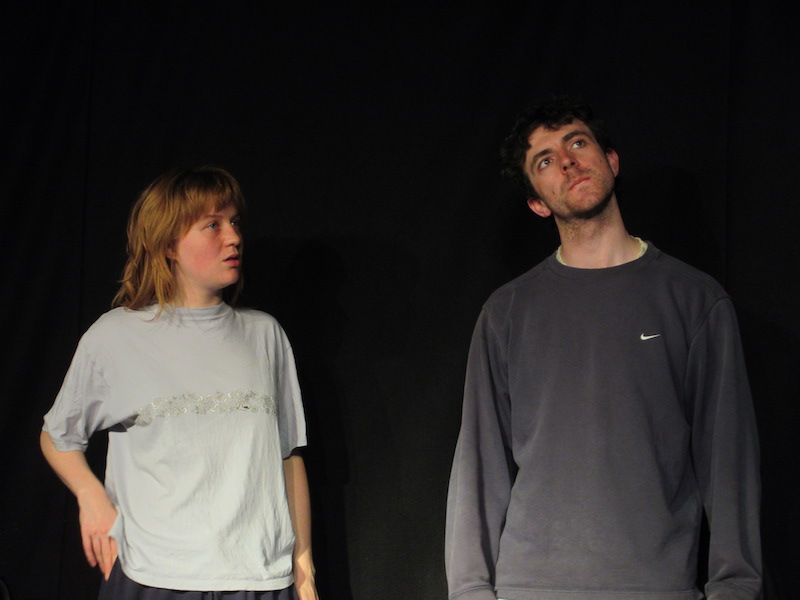
Anna Ticehurst’s short one-act play relies upon the chemistry between Bea and Frank. Anna Ticehurst (who also wrote the piece) gives Bea a measure of likeable ineptitude, confident in her own sense of humour to announce she should be a stand-up comic, but forever giving the impression that such grand statements are a form of hiding from the reality of her own life. Gregor Roach’s Frank shows us a man who is aware of Bea’s foibles and how to circumvent them, who is not afraid to call out her behaviour in a way that never feels censorious or intimidating.
Gradually, we learn more about Bea’s inability to accept the end of her relationship, from smelling her ex-girlfriend’s property that she is half-heartedly packing away to plotting a way to get her back. Throughout, Ticehurst’s writing affords Frank a sense of supportive incredulity, played well by Roach. One truly believes that these are lifelong friends whose mutual shorthand is apparent without ever alienating the audience.
Gradually, we are also fed hints that Frank has not been without his troubles. References to his own mental health struggles are laced through the script, at first obliquely. Ticehurst writes the pair’s relationship sufficiently well that the initial reluctance to talk about Frank’s depression comes across believably – two friends who know enough about the past to never have to face it.
Gradually, though, Ticehurst reveals the play’s full intent. Far from being Bea’s story, this is Frank’s. Bea’s behaviour that precipitated her relationship break-up, which sees her unable to leave her flat, and which has prevented her from finding a new flatmate, is all tied up with Frank.
The show’s turn into the conversation about male mental health and suicidal ideation is handled sensitively. There’s no big twist to the change in direction, but instead the sense that two friends are finally being honest with each other. Discussions around how friends often don’t talk with each other about their mental health until it’s too late, and the guilt that comes with wanting to have done more, are thought-provoking without being preachy.
Imitations also does not outstay its welcome, coming in at well under an hour. But it achieves as much in its short running time that longer pieces on the same topic struggle to get anywhere near. It shows that Anna Ticehurst is a writing talent to watch.
Runs until 22 May 2026
