

Writer: Taylor Mac
Director: Steven Kunis
A staple of American theatre, the dysfunctional family drama is given new resonance in Taylor Mac’s Hir, a play begun in 1996 but first staged in 2015 which examines the places where a traditional and more certain past meets a less fixed but perhaps more equal future. With its contemplation of gender identity, patriarchy, war service and PTSD, Hir’s small domestic setting strains against the demands of order and control when a freeing chaos beckons.
Returning from overseas service, Isaac comes home to find his home is not the welcoming, ordered space it once was, that his sibling Max has changed gender and his father is a shadow of himself following a stroke. Fighting against the new regime created by his mother Paige, Isaac also has to face his own addiction and the trauma of his conflict experience.
Directed by Steven Kunis at Park Theatre, this revival is an engaging study of urban loneliness and concepts of belonging in which gender, family and notions of ‘home’ contend, displacing or comforting characters whose boundaries shift as the story unfolds. It becomes a battleground between contained conformity and openness to alternative forms of being in which members of the household impose designs for living on each other, riding roughshod over feelings, boundaries and even consensual co-existence.
One of the strongest elements of Kunis’ production is this emphasis on heteronormative behaviours and inheritance, particularly on what domestic masculinity looks like, and it is clear in Mac’s play that none of the characters are entirely sympathetic So while Isaac’s return attempts to instil a military authority in the home – for which the audience judge him – and we learn more about dad Arnold’s (Simon Startin) previous violence and demanding behaviour, both Max (Thalía Dudek) and Paige exhibit poor, selfish and even cruel traits in their treatment of Arnold and each other. In her determined search for liberty, there is another form of tyranny in Paige’s dominance of the household and all the pressure she puts on Max especially to lead her to the ‘radical fairy commune’ they dream about.
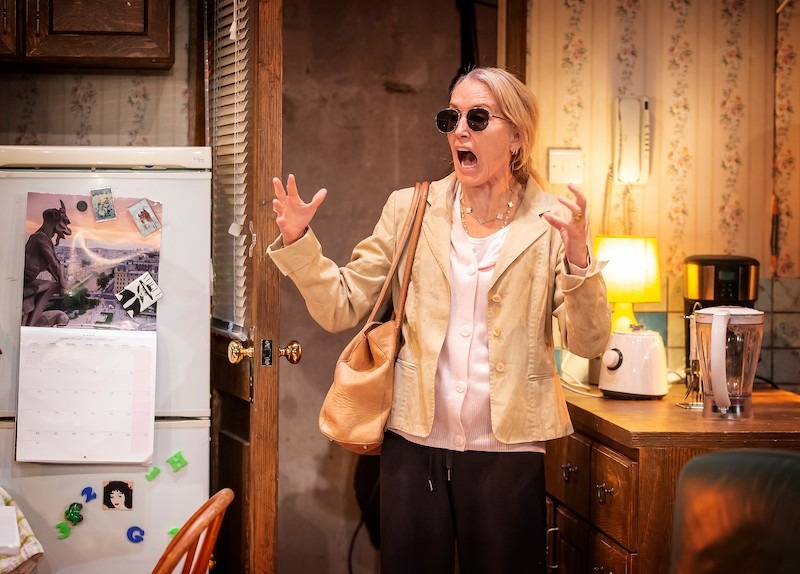
In her London debut, Felicity Huffman delivers quite the performance as Paige, a woman enlightened and liberated from an abusive marriage and the constraints of traditionalism. But she is dictatorial in her command of chaos and Huffman delights in those contradictions through sudden changes of tone. Steffan Cennydd as Isaac takes a more straightforward path through the play, trying to reinstate an order that brings him comfort. He is unyielding at times but also finds moments of tenderness for his father and sibling, even if the play too lightly approaches (and then forgets) his drug use and combat trauma.
The play and the production become a little wayward in the final third and a haste to conclude the story with a dramatic flourish loses some of the character work, exaggerating the speed and scale of the fallout to incorporate revelations and too tidily explain behaviours. But Hir is at its best when it lets the characters be, lets them contemplate what a home is, how a temporary place can stifle even the most vibrant hope for life and the tragedy of standing still while it all changes around you.
Runs until 16 March 2024
