

Director: Tim Etchells
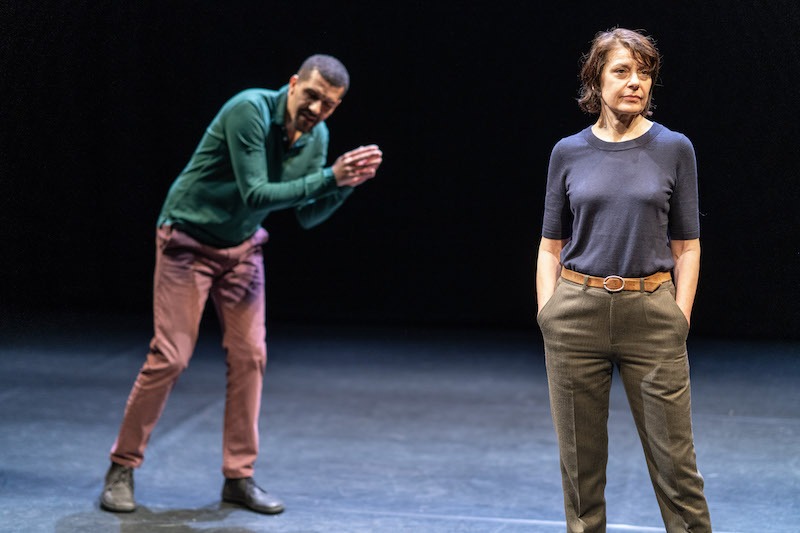
Two humans stand on a stage in front of many rows of other humans. Seke Chimutengwende has his long arms in front of him. Cathy Naden, slighter in build, has her hands in her trouser pockets. They face the audience and say stuff, a lot of stuff, for 85 minutes. He says something, then she says something, then he says something. Sometimes, the sentences are repeated, and sometimes, they are modified with a different inflexion or shift of pronoun.
Experimental, improvisational, deconstructed, this is theatre as art and the final series of shows at Battersea Arts Centre from Sheffield-based Forced Entertainment in collaboration with Chimutengwende and Naden, one of the founder members of the group. This year, Forced Entertainment celebrate 40 years of confounding, baffling, intriguing and infuriating audiences with their avant-garde approaches to devised, improvised and collaborative performance.
In If All Else Fails, there are constant references to a test, but who is being tested? Is it the performers or the audience? And do the ones who walk out – three at this performance – fail the test? After four decades of resolutely not giving audiences what they want and setting up the stage as a challenging forum to question all aspects of the staged performance, the walker-outers are something of a badge of honour for Forced Entertainment, who must be doing something right, upsetting someone’s evening or messing with their sense of order, right and wrong, good and bad. Within the aisles are numerous tapping feet and jigging knees as the humans in rows listen and try to make sense of what they are hearing. Is there a pattern? Is there a meaning? Will something happen? How much longer? Check watch. Wow. Another 55 minutes.
Not for those who enjoy musicals, classics, or theatre in any conventional sense, this is more for those who revel in Mark Rothko, John Cage, Noam Chomsky or Ezra Pound. This performance, all about language and communication, offers a meditation of sorts around how we infer meaning from words and sentences, how sentences can be constructed from concrete nouns, verbs, adjectives, etc. and how emotion can be emitted by the arrangement of words. There’s a playfulness to the torture and the verbiage, which changes with each performance. The litany of endless statements, truisms, contradictions, and dichotomies isn’t really a dialogue or conversation, more a rhythmic game, some parts imbued with ascending action or mounting stakes and some meaningless as random numbers flung from a lottery machine.
When something breaks the verbal monotony, it’s like a tall glass of water at the end of a desert trek. The lighting design by Jim Harrison creates shifting prisms on the performers’ faces and gives the impression of night turning to day and the sun rising and setting at fast speed. The music and sound design by director Tim Etchells, supported by John Avery, cuts in every so often with the mechanised sound of photo-copier machines, whirring bobbins, beeps, and whirrs. So starved is the audience of visual or performative stimulation that when one performer uses a hand gesture or raised eyebrow, it’s a relief. And in the moments that choreographer and devisor Seke Chimutengwende breaks into one of his long-legged random gambols across the stage in a series of erratic and amusing movements, it comes as respite from the marathon of words.
When asked to close their eyes for the next bit of the test, the audience does, and when asked to open them, they do so again and respond to the instruction several times until they realise this is a trick. Nothing is going to happen. There is no surprise. They have been “used” and manipulated to make a point about compliance, not only within a theatre context but perhaps in a broader societal sense. How easily and unquestioningly we do as we are told.
Likewise, when we listen to words from one human addressing another, we seek sense, meaning and connection, but in this performance, this is upended, scrambled and instead, the audience is confronted by life’s randomness and lack of logic, perhaps reflecting the outside world where words have been debased and weaponised in the war on truth. The performers also suggest chatbots, AI-generated content and weirdly disconnected, non-human exchanges we are likely to have most days in an online world.
There’s probably an argument for this form of work generating its very own kind of category of trigger warnings: likely to cause discombobulation, disorientation, and profound feelings of existential despair. Not suitable for the impatient or those with attention deficit disorder. No dictionaries were harmed in the making of this production. Agree or disagree? Agree or disagree?
Runs until 23 November 2024
