

Writers: Haruki Murakami, Ryûsuke Hamaguchi and Takamasa Oe
Director: Ryûsuke Hamaguchi
Haruki Murakami’s slight short story Drive My Car is transformed by Ryûsuke Hamaguchi (writer and director) and Takamasa Oe (co-writer) into a powerfully compelling film. In Murakami’s story, Kafuku, an actor, has been a widower for ten years. The film, however, begins with the strange dynamics of Kafuku’s marriage to beautiful screen-writer Oto. Its erotic intensity appears to derive from something deeper and more troubling. Hidetoshi Nishijima is compelling as Kafuku, his melancholy, mask-like face strangely expressive, while Reika Kirishima dazzles as Oto.
The writers add a potent subtext: Chekhov’s Uncle Vanya. Its exploration of spiritual emptiness resonates with Kafuku’s own feelings of meaninglessness. When the film begins, Kafuku is preparing to play Vanya in a new production. To help him, Oto records herself reading all the parts onto cassette tapes, which now, after her death, Kafuku plays in his car. Reading aloud Vanya’s bleak lines (‘My life has been irretrievably lost’, ‘I’ve annihilated the best years of my life!’) it is suggested that Kafuku is aware of his own frozen existence. But even when he breaks down mid-way through a performance, nothing more is said. Such taut, spare writing and Hamaguchi’s finely judged direction contribute to the film’s sense of deep loneliness and unknowability.
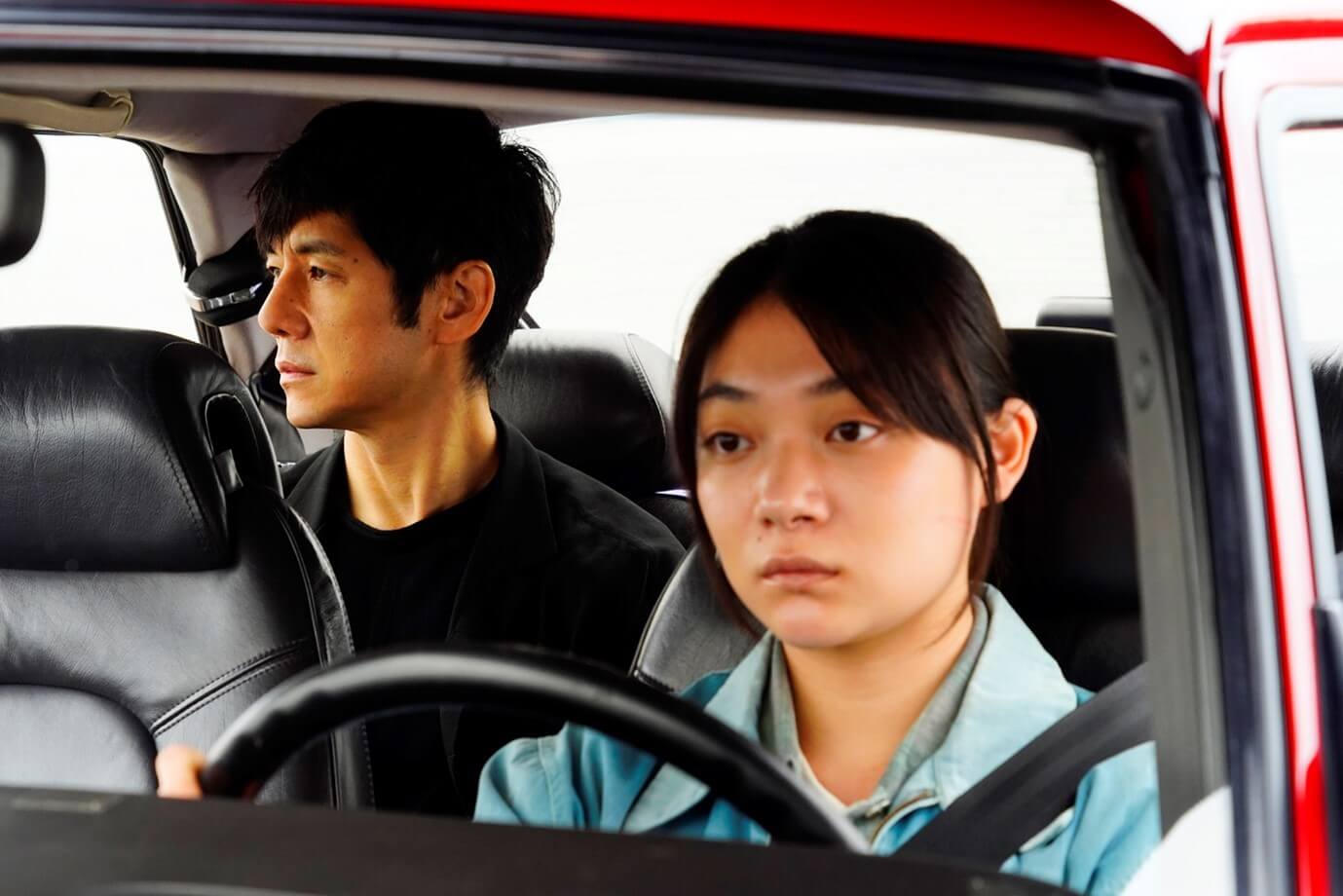
Dramatic scenes alternate with meditative sequences in which, two years after Oto’s death, Kafuku is driven through unfamiliar countryside around Hiroshima, where he has taken up an artistic residency. He has accepted as a driver a quiet young woman, Misari Wateri. Tôko Miura’s powerfully controlled performance as Misari helps us to see the extent of Kafuku’s still raw grief, the silences between them as evocative as dialogue. What is her story? Will Kafuku’s unmoving expression remain unchanged? Only after long periods of pain and withdrawal will their individual mysteries be satisfyingly explained.
At the same time Kafuku auditions actors for a new production of Uncle Vanya. More buttoned up than ever, he forces the cast through endless readings of the script, insisting they read in unnaturally expressionless voices. He offers little else by way of direction and will abruptly end a rehearsal without explanation. His cast are ethnically diverse, not all of them speaking Japanese. Slowly he comes to trust two Koreans, Gong (Jin Dae-yeon) and his wife Lee (Park Yu-rim), cast as Uncle Vanya’s niece Sonia, who communicates in extraordinarily expressive sign language.
Young good-looking actor Kôshi Takatsuki (Masadi Okada) auditions for the part of the doctor, Astrov. Unknown to him, Kafuku is haunted by having once spied Tatasuki having sex with his wife. His decision to cast Tatasuki as the ageing Vanya is puzzling. But as the young man takes the role and seems eager to build a relationship with the older actor, another mysterious thread starts to develop.
There are moments of high drama: a sudden death and a scene of unexpected off-screen violence. But the real interest of the film lies in the internal struggles of the characters, the misunderstandings between them. The deliberately slow build-up to individual revelations creates a profound sense that understanding will always be hard-won.
Put like this, Drive My Car sounds uneventful. But the film has the same poetic power which Stanislavsky detected in Chekhov. After reading one of his plays, he wrote, you might think: ‘This is good, but … it’s nothing special’. And yet certain phrases and scenes make you want to think more about the play. Finally you want to reread it: ‘– and then you realize the depths hidden under the surface.’ Chekhov’s ability to use everyday details of existence to explore ‘the most secret corners of the human heart’ is an understanding deeply embedded in Drive My Car. A masterpiece.
Drive My Car is available now available On Demand from Modern Films.
