

Writer: Haruki Murakami, adapted by Ako Takahashi
Director: Philippe Decouflé
If any production warrants reading up in advance, it is Ako Takahashi’s Japanese-language stage adaptation of Haruki Murakami’s 1985 novel, Hard-Boiled Wonderland and the End of the World, here confusingly rearranged as End of the World and Hard Boiled Wonderland. Visually and choreographically, the production is an absolute triumph. Narratively, however, its split storylines make for an almighty tangle. Director Philippe Decouflé dials up the atmosphere, making physical theatre and dance the connective tissue between the twin narratives. But only towards the end, when they converge, does the piece land an emotional punch.
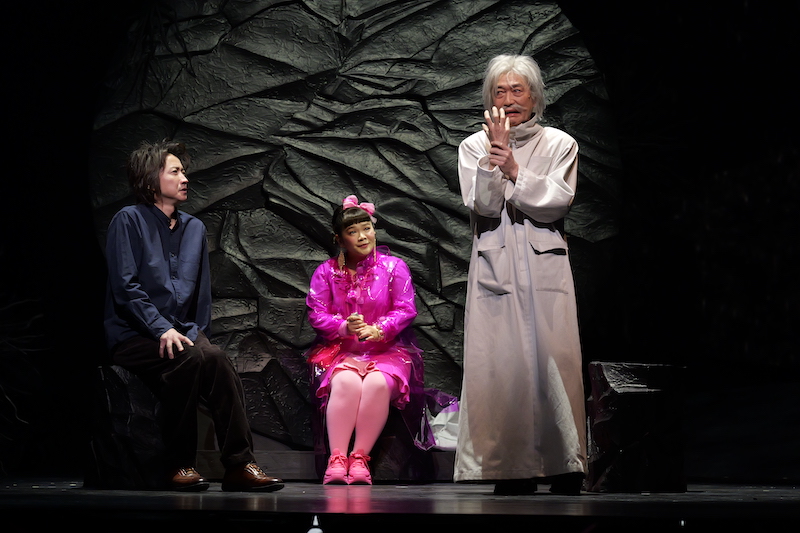
Watashi (Tatsuya Fujiwara demonstrates an unexpected gift for comedy) works as a data-encryption specialist called a Calcutec in a dystopian Tokyo, rendered in a stark palette of noirish monochrome, impressionistic back projections, and gloomy shadows by set designer K Ishihara and lighting designer Yukiko Yoshimoto. Jazz from composer Umitaro Abe, heavy on piano and cello, evokes busy streets.
This Tokyo is a mashup of classic cyberpunk tropes: data wars between warring corporations, complex brain-engineering, and encryption algorithms called “shifting”. Beneath the city, a subterranean world is stalked by garbage-eating creatures called “Murks”, imagined as spiky, human-shaped sea urchins by costume designer Ayako Maeda.
Watashi, a divorced, whisky-drinking, mostly sexually impotent cynic straight out of Raymond Chandler, takes an illicit encryption assignment from an eccentric Professor (Narushi Ikeda) who studies the sounds bones make and lives beneath an underground Tokyo waterfall with his granddaughter, the permanently horny Hello Kitty-clad Woman in Pink (a gloriously coquettish Miu Tomita). Rogue data thieves called “Semiotecs” are on Watashi’s trail for some reason. “If the Semiotecs join forces with the Murks, there’ll be no hope for us”, the English surtitles tell us, which is probably more than you need to remember.
The Calcutec discovers that the professor has inserted an irreversible biological time bomb inside his brain that will lock him inside his own subconscious in 48 hours. If he cannot disarm the time bomb, his real-world existence will end. Understandably miffed and seemingly with no way out, he decides to spend his last hours in the company of a permanently hungry Librarian (Misato Morita) he met while researching unicorn skulls in the city library. Decouflé delivers a neat slice of comedic physical theatre as the duo eat their way through the entire menu at an Italian restaurant.
The second plot strand exchanges hard-boiled cyberpunk noir for pastoral high fantasy. In a dreamlike, walled fantasy town cut off from the outside world – sepia browns, golds and greens and trees that look like they are linocuts – a newcomer called Boku (Kiita Komagine on press night) arrives. The burly Gatekeeper (Shinya Matsuda) severs his Shadow (Shuntaro Miyao), who remains outside the walls, then scars Boku’s eyes and tasks him with reading dreams from glowing skulls in the town library.
Unicorn ballet dancers, stunningly rendered in tight-fitting gold bodysuits and snow-white hair, roam the town and the forest beyond. The place offers Boku harmony and immortality, but he soon learns, at the cost of excising his humanity by eliminating pain, sorrow and love. Boku’s shadow urges him to escape.
The plotlines merge when we learn that the town is in fact a production of Watashi’s subconscious, and his destination when the time bomb goes off. He is Boku. Will Watashi meekly accept his unavoidable fate? Will Boku choose escape and reunite with his own shadow? He faces a conundrum. He himself has created this world and bears responsibility for it and the beings who inhabit it. Should he leave, what will become of them?
This production is infused with Western influences. A wistful, repeated piano rendition of Danny Boy serves as a motif for the pain of losing one’s heart. As Time Goes By, sung in Japanese, accompanies Watashi as his last moments beckon. At one point, we get an umbrella-heavy, honky-tonk musical ensemble dance number that seems to nod to Singin’ in the Rain and nearly gets a round of applause.
One can enjoy End of the World and Hard Boiled Wonderland purely visually. Decouflé’s ballet-heavy choreography is stunning, delivered by a tremendous dance ensemble. Taiki Ueda’s projections – grimy city streets, bird-like clouds, a murky underworld – are perfectly executed. The final snow-filled scenes carry immense pathos, though those who expect a climactic gun battle to dismantle dystopia, or an epic magical rebellion against the Gatekeeper, are likely to be disappointed. There is enough spectacle here to eschew paying as much attention to surtitles and plot as this review does. Those who actually want to keep up with what is going on have their work cut out.
Runs until 11 October 2026
