


As winter sets in and everything goes grey, The Photographers’ Gallery is keeping dopamine levels high with an exuberant blast of colour photography from two masters of the craft. From the deep south of the US, William Eggleston offers small-time Americana in All That Goes Unnoticed. Suburbs, streets and signage intersect with ordinary people doing everyday things. His work is pleasingly bookended by West African photographer, Sanlé Sory. Colour Years depicts the proud inhabitants of Burkina Faso, whose style, dignity and individuality burst through the formality and restrictions of identity and studio photography.
Despite being on different continents, working in contrasting contexts, with different subjects and resources, bold approaches to colour photography unite both artists. Eggleston’s work—cinematic, strikingly framed and saturated in rich hues—has been a significant cultural influence. Sofia Coppola and Wim Wenders are fans, and his work is a key influence on David Lynch’s visual approach to Blue Velvet. Eggleston was once a contentious figure, whose landmark Museum of Modern Art (MoMA) exhibition, William Eggleston’s Guide in 1976, redefined colour photography and divided critics. How could colour photography be considered art? Surely it was closer to advertising? How could art photography be so banal?

(Woman and Children in Car) from the series Dust Bells, c. 1970-74, from the Wilson Centre for Photography © Eggleston Artistic Trust, courtesy of the Eggleston Artistic Trust and David Zwirner.jpg
Curated by José Neves and Julia Bunnerman and organised in partnership with the Wilson Centre for Photography, 110 of these genre-busting original images can now be seen. Perhaps more than the use of colour in these considered compositions, reviewers didn’t much care for the reflections they saw. Pre-dating the gritty realism of the 1990s, this unaspirational version of the American Dream of cracked ceilings and beaten-up Cadillacs must have been the photographic equivalent of Duchamp’s urinal in the glossy disco days of 1976.

The flat planes and art-directed compositions of advertising are wryly subverted, and Eggleston invites us to look behind, beneath and beyond the subject in the frame. It’s Revlon Red for sure – but not as we know it. There’s a pleasing circularity in the fact that Eggleston was eventually commissioned to advertise products, notably by Coca-Cola in 1995, and a section of All That Goes Unnoticed is devoted to this.
What isn’t obvious to the casual observer is the sheer amount of technical work that Eggleston put into achieving the depth of colour on show. Colour dye transfer printing, a complex, multi-layered, time-consuming method, builds the colour in stages, giving a distinctive richness. The labour-intensive processing means that, if stored in the correct conditions, these Eggleston prints will last for 300 years or more. Passing references to American life they may be, but their substance makes them enduring visual testimonies; from decisive moments to decisive monuments.
While Eggleston was never one for explaining or saying too much about his work, which battles the obvious, challenges conventional views and offers the viewer a rewarding strand of narrative subtext, Sory’s Colour Years, by contrast, curated by Taous Dahmani, presents an unequivocal approach that foregrounds character, colour and culture. While the characters that Eggleston catches in his lens often seem unaware, caught off guard or in their own worlds, Sory’s subjects are wholly conscious of the image they project and are active participants in this mutual staging.

Like Richard Avedon, who started his photographic journey taking ID photos in the Marines, Sanlé Sory started with a similar discipline, taking identity photographs. From there, his reputation and output grew. One of West Africa’s most prolific photographers, he took more than a million portraits across seven decades. Best known for his black-and-white photos, in the mid- 1980s he began taking colour portraits in his Volta Photo studio. All the photographs on show, printed from original colour negatives, had been kept in boxes for decades and can now be seen for the first time. Colour Years is not only a cavalcade of striking, stylish individuals in a riotous fusion of colour and print, but also a story of social independence.
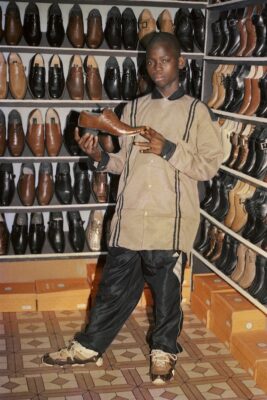
The positivity and aspiration that come from the freedom of self-representation through body, dress and self-expression mark a break from colonial and post-colonial rule and expectations. Burkina Faso gained independence from France in 1960, and these portraits capture the daily life, youth culture and style of individuals and communities with energy, optimism and verve.
Sory’s African Dream feels fresher and less faded than Eggleston’s ironic American Dream – it is younger, after all – and here everything is larger than life; no inverted commas necessary. But whether it’s Eggleston’s half-empty glass or Sory’s half-full, their photographic cartwheels across the colour spectrum will bring joy and some much-needed Vitamin D to photography lovers this winter.
Runs until 21 January 2027
