

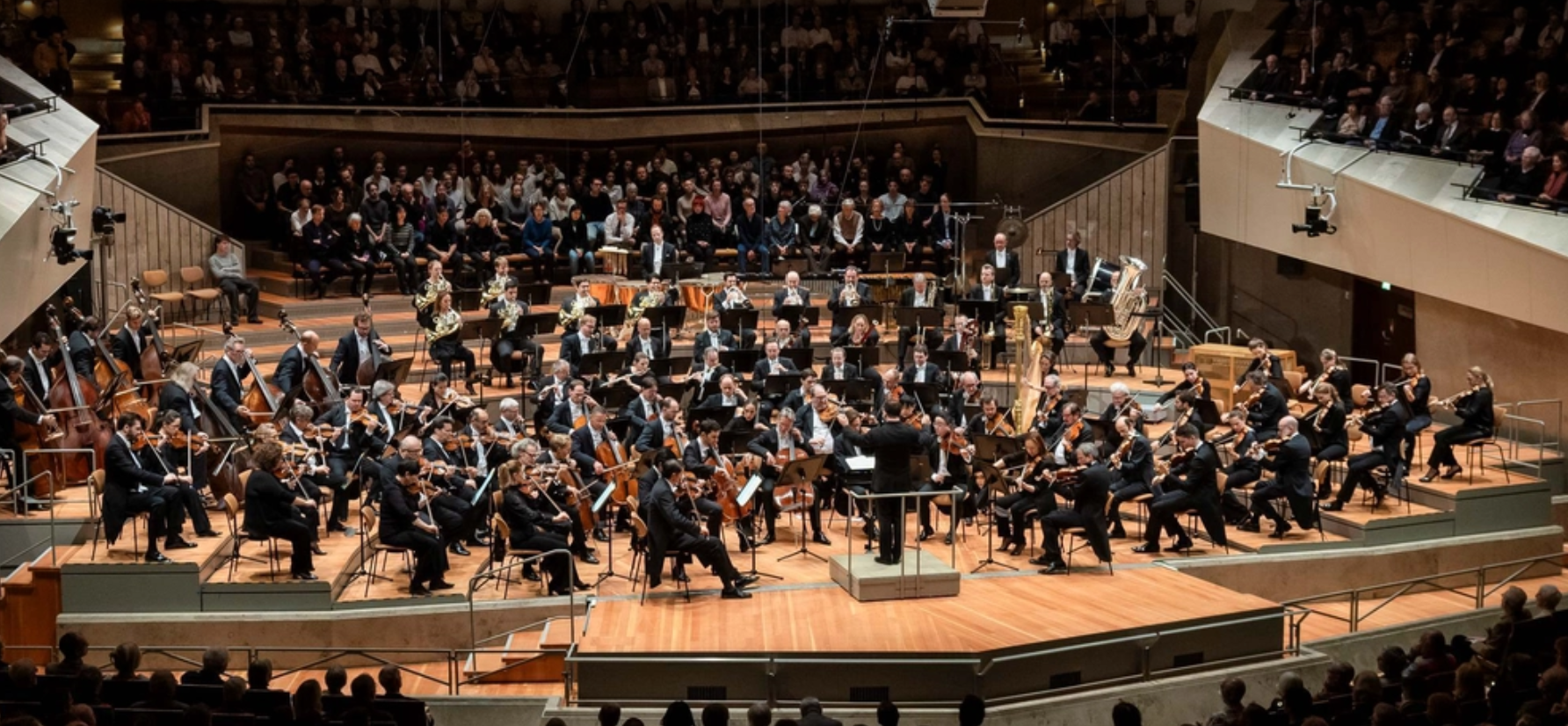
Conductor: Kirill Petrenko
Violin: Augustin Hadelich
I come from a place where classical music is a luxury, and the Berliner Philharmoniker was one of the first symphony orchestras I ever knew, thanks to Todd Field’s 2022 film Tár. And it really is a magical moment to witness them playing at the Usher Hall as they close this year’s EIF.
Led by conductor Kirill Petrenko, the first half of the evening is Beethoven’s Violin Concerto, performed with violinist Augustin Hadelich. Originally written for Franz Clement, the piece was not an immediate classic. It was later revived by Joseph Joachim, whose 1844 performance in London, conducted by Felix Mendelssohn, is widely regarded as a crucial moment in its revival.
Hadelich enters the piece gently, almost deceptively so, before revealing the exquisite control he holds until the very end. His playing is technically astonishing without becoming merely showy, while his powerful performance remains in perfect harmony with Petrenko and the orchestra. The music flowing down from Hadelich’s strings feels like a solitary swan dancing in the pool that is the Berliner Philharmoniker. His encore, a solo violin arrangement of Schumann’s Träumerei, is just as striking, transforming what was originally written for piano and expanding our sense of what the violin can do.
A surprising follow-up to Beethoven’s monumental and rigorously structured concerto is Alexander Scriabin’s Symphony No. 3, Le poème divin. Divided into “Struggles”, “Delights” and “Divine Play”, the three sections trace a movement from conflict to pleasure and finally to transcendence. As their names suggest, it is a piece that can feel paradoxical, fighting within its own form, as its formal structure serves the ideas underneath the music. Its dense chromatic writing, constantly shifting harmonies and blurred tonality reflect Scriabin’s fascination with philosophy, theosophy and symbolism at the time. In the hall, the eight horns, powerful and intoxicating strings, and monumental timpani turn Scriabin’s philosophy into something you feel in your body.
Perhaps that is also what makes this evening feel so spectacular to me. The Berliner Philharmoniker first entered my imagination through Tár, a film in which the orchestra represents the heights of the classical music world. Now they are here, closing the EIF, and I am in the room. And within Scriabin’s three monumental chords, the festival reaches its own finale, leaving us to “All Rise” and look forward to next year’s EIF.
The Reviews Hub Star Rating
