

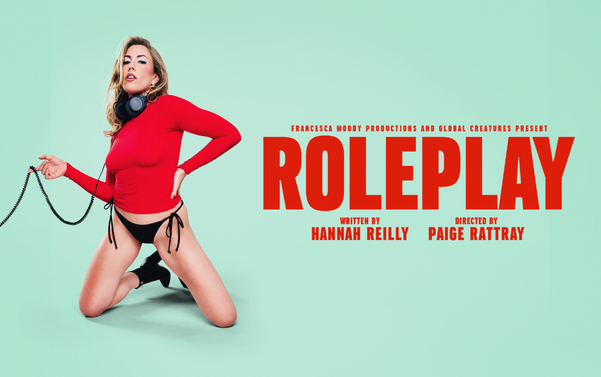
The name Roleplay the new work by Australian writer, director and performer Hannah Reilly, captures the central idea of the show. The idea of playing other people is at the centre of performance, so much so that quite a few performers call themselves “professional pretenders” on social media. Reilly also claims before the show starts that some of what we are about to see is real, while other parts are not.
Roleplay begins with Danielle, or Danni, a feminist podcaster trying to find her way to success. Her podcast uses “hey slut” as its tagline, and she initially presents herself as a serious researcher into young women’s relationship with sex in the modern world. Yet when a male producer from a major media company approaches her and promises her fame and wealth if she makes the podcast more, well, “sex positive”, she gradually slips into the role of an empowering sexual influencer, distancing herself from her friends and family while becoming increasingly unsure of who she is.
The heart of Roleplay lies in its critique of online sex-positive feminism and the way it can be harvested by capitalism. Danni begins to speak in the language of influencers, filled with feminist buzzwords that become increasingly detached from the ideas behind them. This becomes especially clear when she tries to justify herself to her mother, a feminist from another generation for whom empowerment is more closely tied to economic independence. The show explores how feminist concepts can be economically manipulated by men, while asking what liberation should actually mean within feminism.
As a one-woman show, Roleplay depends heavily on Reilly’s ability to move between characters. She can play Danni, her mother, or an insecure dungeon master, shifting between their voices, mannerisms and attitudes as the story moves from a podcast studio to a sex party.
Produced by Francesca Moody, the producer behind Baby Reindeer and Fleabag, Roleplay is a powerhouse that is smart, sharp and hilarious. It is not hard to imagine the material becoming another successful TV series. Perhaps this is also why some of the transitions feel confusing, such as the moment when Danni decides to betray her partner, who has mortgaged his house for the chance of their shared success. While the decision makes sense in showing how far she is willing to go to succeed, it feels more like a subplot from a television drama than something fully developed within a Fringe show.
Run ended | Image: Contributed
