

Writer and Director: Rickerby Hinds
Tyisha Miller was just 19 when she was shot and killed by Los Angeles Police on December 28, 1998.
Tyisha was driving her aunt’s car when it got a flat tyre, and the spare was also flat. She called her aunt to get some help, but when relatives arrived, the car was locked, Tyisha was unconscious, and the gun she had for protection was visible on her lap. Although her relatives called 911 for an ambulance, four police officers showed up. In an attempt to access the car and secure the gun, a firefight broke out in which Miller was shot 12 times. While it was claimed at the time that she had fired first, events are still unclear – other than that, a teenager was dead. That much was certain.
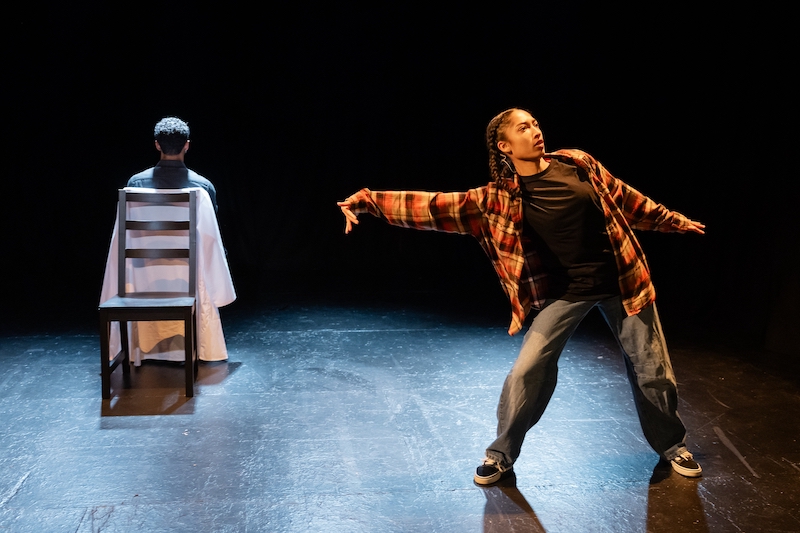
Writer/director Rickerby Hinds takes the events of this tragedy and, around it, forms a two-person piece of hip-hop theatre that imagines the teenager’s internal monologue before, during and after her killing. The protagonist of this retelling is now Myeisha Mills (Jade Evelyn Ramsey), the name change and apparent fictionalisation allowing Hinds the freedom to speculate about a teenager’s inner thoughts while still adhering to the murky truth of what happened.
Ramsey talks, rhymes, and dances as Myeisha, reciting her life in the Inland Empire region of California, east of LA, and her hopes and dreams. Hinds’s poetry is full of repeated lines and phrases, the subtleties of each repetition always hinting at layers beneath layers.
Ramsey is accompanied by a beatboxing MC, Josiah Alpher, whose soundtrack of music clips, beats, and effects supplements his performances in other roles. He is the officer whose actions kill Myeisha, but he is also the dispassionate voice of a coroner describing the trajectory of each of the twelve bullets that ran through her body. Each description triggers a memory and a new train of thought for Ramsey to explore. The bullet that fractured her arm prompts recollections of the dance moves she was choreographing with friends. The shattering of her jaw prompts her to recall that dreaming of losing teeth is a portent of great change. The bullet that grazes her scalp turns the topic to Black women’s relationship with their hair, while one that went through her breast tissue prompts recollections of puberty and boys.
The structure of the play, particularly the ping-pong between the clinical description of her wounds (starting with non-fatal, to non-fatal but serious, and ultimately to the bullets that definitively killed her) and Myeisha’s generally happy and optimistic take on life, ensures a healthy sense of momentum. There is a sense of quiet rage, too, not just for Myeisha or her real-life counterpart, but for every Black victim of violence before and since. Midway through the piece, in an almost throwaway line, Ramsey’s Myeisha wishes she were white – not for any imagined superiority in physical attractiveness, but because her interactions with police would be more likely to be positive.
As Alpher’s coroner reaches the report conclusion, he ends with a description of the weight and appearance of each of Myeisha’s organs as they are extracted and weighed from her body. There is an observation, taken from Tyisha Miller’s own autopsy, that the surface of her heart is smooth and glistening. It’s a surprisingly poetic line in an otherwise dispassionate report. And that sums up Hinds’s work, too – a piece that has taken a moment of great tragedy and turned it into something unexpectedly beautiful. Like Myeisha, like Tyisha, Dreamscape’s heart is glistening.
Runs until 28 February 2026
