


The Deutsche Börse Photography Foundation Prize 2026 exhibition presents an eclectic array of contemporary photography across generations and geographies. The four shortlisted artists—from Poland, Iran, the UK and the United States—each occupy their own room, producing sharply contrasting atmospheres and visual languages. Guided tours at the press viewing helped frame the works, distilling these complex projects into concise summaries. One guide stresses that all the photographers are active today, underlining the exhibition’s emphasis on immediacy and on photography’s engagement with current social and political realities. The rooms may be small, but they are dense with ideas.
The first room introduces Polish artist Weronika Gęsicka and her project Encyclopaedia. The work draws on the little-known practice of inserting fake entries into printed encyclopedias to detect plagiarism—“trap streets” of the publishing world. Interestingly, these were hard to find in Gęsicka’s native Poland, much more common in the UK, USA and Germany. The exhibition is about trust, and it’s interesting that some countries view the threat of being plagiarised as more important than spreading misinformation. In response, she creates AI-generated images illustrating imaginary subjects such as invented sports or animals. The use of AI in a photography competition inevitably provokes debate. While the compositions mimic historical imagery, the telltale smooth lighting and uncanny facial expressions are vaguely detectable. Gęsicka’s work is both educational and unsettling, linking a historical publishing tactic with contemporary anxieties about fake images and digital truth.

One Hundred and Twenty Minutes, 2019-2024.
Courtesy of the artist
In contrast, Iranian photographer Amak Mahmoodian presents a quiet and introspective installation with One Hundred and Twenty Minutes. The title refers to the approximate duration of REM sleep, the phase in which we dream. Living in exile since 2010 and unable to return to Iran, Mahmoodian uses the metaphor of dreaming to explore the liminal space between memory and displacement. The installation combines photographs, poetry and drawings, arranged in a flowing wave formation that differs from its original presentation at the Bristol Photo Festival. A monochrome palette, translucent fabrics and fragmented body parts create a delicate visual language in which skin, mist and cloth appear almost weightless. The work is deeply atmospheric; its narratives remain more ambiguous than those of the other shortlisted artists, with feeling placed firmly in the foreground—perhaps making it the most contemplative of the four exhibitions.
Energy replaces introspection in the work of the youngest nominee, Rene Matić, whose exhibition As Opposed to the Truth explores identity and resistance in the context of rising global right-wing populism. Bright, high-contrast images are laminated and presented in glossy frames, producing a reflective, almost electric surface. Photographs overlap across the walls in a dense visual collage of friends, family and personal environments. The work is intensely autobiographical yet politically charged, suggesting how identity and culture are shaped through everyday experience. A large flag emblazoned with the words “NO PLACE” hangs limply at the centre of the room, encapsulating the tension between belonging and exclusion. Despite its political backdrop, the exhibition carries a strong sense of optimism: resistance, here, is shown as a force that fuels culture and community.
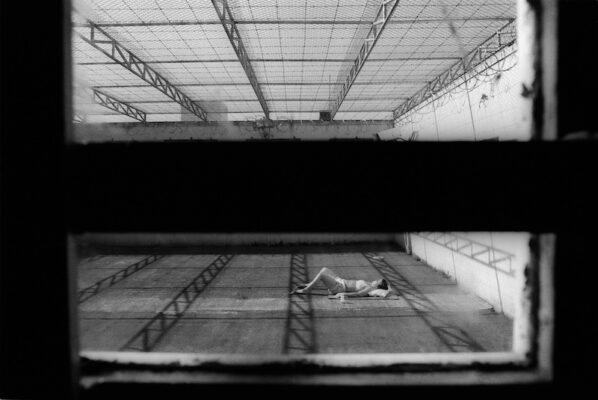
© Jane Evelyn Atwood
The final room belongs to veteran photographer Jane Evelyn Atwood, whose documentary work Too Much Time: Women in Prison focuses on women’s prisons in Russia, France and the United States. Atwood gained rare access to these institutions during the 1990s, producing images that reveal a world usually hidden from public view. The photographs are intensely narrative: prisoners exercising in open yards, women gazing beyond prison walls toward distant trees. Atwood’s work is compelling precisely because of this access. The images expose a reality that most people are forbidden to witness, making photography a powerful tool for confronting uncomfortable truths about incarceration and visibility.
Although visually and conceptually distinct, the four exhibitions are united by a shared concern with truth and reality. Photography traditionally carries the authority of documentation—an assumption that what we see in an image must be real. Yet each artist destabilises this expectation. From AI-generated fictions to dreamlike memories, political self-representation and rare documentary access, the shortlisted photographers collectively challenge the idea that the camera simply records the world. Instead, the exhibition reveals photography as something more complex: a medium capable of questioning truth as much as capturing it.
Also showing at the Photographers’ Gallery is We Others, a collaboration between writer Hélène Giannecchini and photographer Donna Gottschalk. While researching queer communities and the concept of chosen family, Giannecchini came across Gottschalk’s photographs and arranged to meet her. From that encounter, the project began to unfold: Giannecchini was taken on a tour of the locations where many of the original photographs were shot, later writing accompanying texts that sit alongside the images.
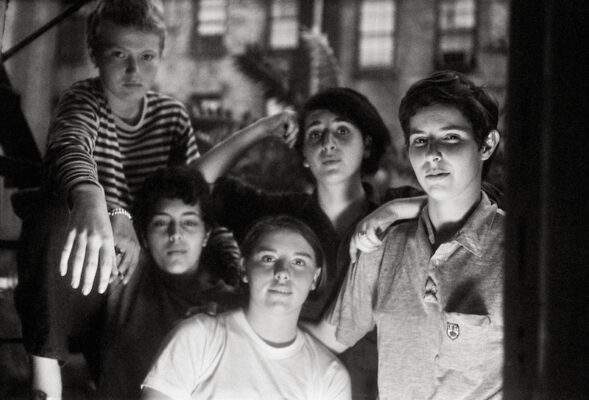
Courtesy of the artist and Marcelle Alix, Paris © Donna
Gottschalk
There is a clear warmth between the two collaborators. Giannecchini speaks about Gottschalk’s work with visible enthusiasm, smiling broadly as she describes the photographs and their histories, while Gottschalk herself is noticeably more reserved. After Giannecchini finishes speaking, Gottschalk jokes, “Oh, do I have to talk?”, before encouraging the audience to “just look at the pictures.” The moment captures the dynamic between the pair: two creatives deeply confident in their respective mediums.
The exhibition centres on queer friendship and chosen family. Comprised largely of portraits accompanied by minimal captions, the photographs document intimate social worlds shaped as much by affection as by political urgency. Like the work of Matić, which also blurred the lines between personal connection and political presence in queer life, these images sit somewhere between documentation and activism. Many of the friendships depicted were tied to the shared goal of gay liberation, yet the photographs foreground human closeness rather than overt protest. Photographs of activist meetings appear, at first glance, more like friends curled together on a sofa.
Both run until 7 June 2026
