

Writer: Arthur Miller
Director: Andy Arnold
Death of a Salesman captures audiences with its relentless drama, which makes it impossible to leave the theatre without a racing heart and a lump in your throat.
On seeing this play, prepare for exhilarating dialogue, explosive emotion, and something you’ll be picking apart on your way home from the theatre. Best for those who want a thrill and a think, but can be appreciated by anyone who is aware of the timeless classic and has an interest in drama.
Set in 1940s Brooklyn, the story follows an ordinary man, Willy Loman, and how he and his family experience his succumbing to the loss of his career and reputation as a successful salesman. Slipping in and out of lucid memories of the scenes of his life which led him to this moment, Willy stumbles on by attempting to create a good life for himself, his wife, and his sons, but desperation is never far behind.
David Hayman’s portrayal of Willy Loman is of a man who is quietly drowning in the turmoil of his life. Being phased out of business as a salesman, coming to terms with his disappearing prospects due to his old age, and experiencing slowly progressing dementia. His mantra as a salesman, “It’s not what you say, it’s the way you say it.”, and a need to be well-liked by all to make a sale, is a problematic life lesson he imparts upon his children. Causing them to have little regard for the harsh realities of working life when they grow up believing they can depend upon the same outdated principles which made their father a briefly successful salesman. Hayman skillfully used emotional peaks and troughs to his advantage. When the rising pressure of emotion is finally released, he is heart-wrenching to watch. His desperation is tangible and oozes from the stage, making it nearly impossible to feel anything but sympathy for the morally dubious character.
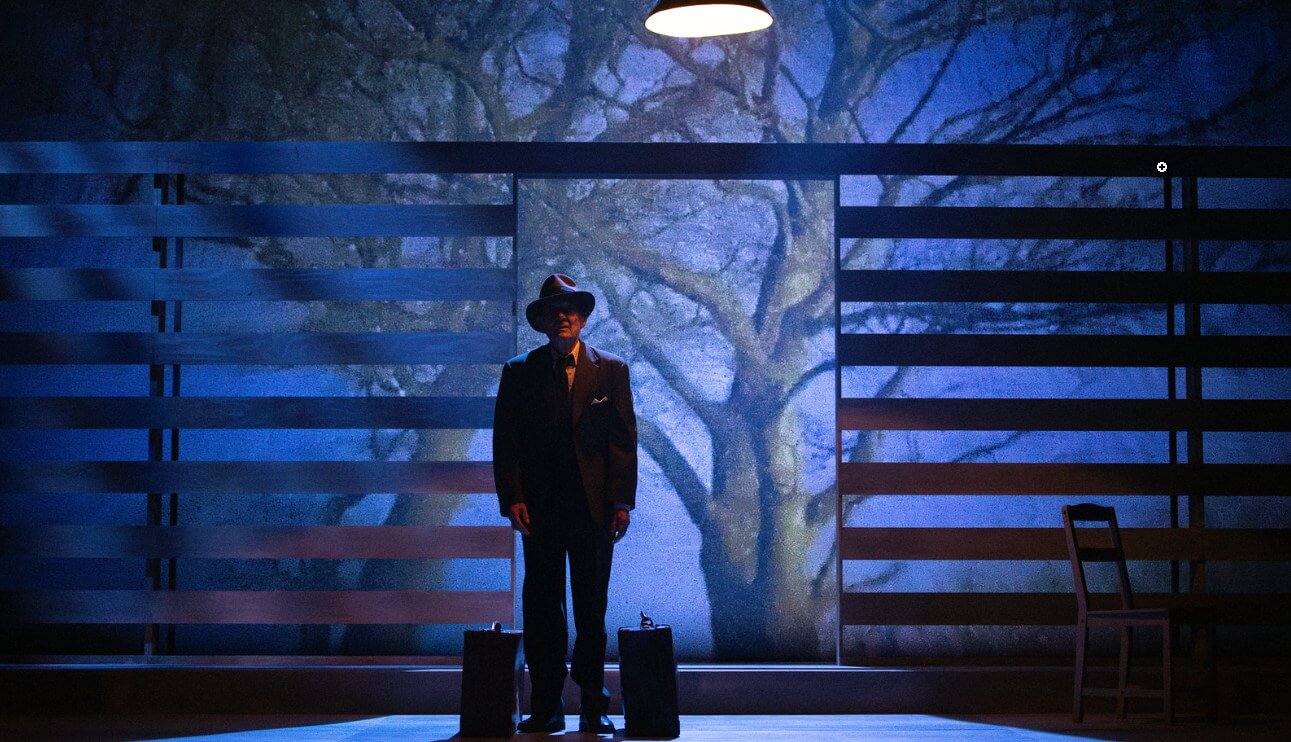
The darkened lighting reflected the cold and isolated world of the characters as they questioned ‘what in life is worth working for?’ and ‘what is the legacy of an ordinary man?’ The set looks like a wooden fence which wraps around the stage with two windows and a door opening was a versatile space for the varied settings of the play. The minimal tables and chairs would become an office, a home, and a restaurant. Its penned in look appeared to trap the characters in place as they were forced to enact their cyclical struggles. The backdrop showed a garden with a large tree which changed with each scene, springing to life against a daylit sky to accent flashback sequences, and a winter tree against a darkened sky to demonstrate the rundown reality which had been returned to. At times, these scenes felt a little too dark, hiding the expressions of the actors and becoming problematic for those not sitting on the front row. However, the expression in the voices and body language of each character left nothing to the imagination- each character’s stage presence was deeply felt by the audience.
Miller wins over the audience by calling out how quickly life can become entropic for us all. Flashback sequences have a dual role: to show how Willy’s state of mind is deteriorating, vivid memories seeping into his day-to-day life, but also to display how things used to be for him and how the chaos of his current situation has come about.
The message behind Biff’s struggle to find his own life’s purpose while remaining truthful to a family he learns to resent his role in is poignant. Daniel Cahill plays an impeccable performance as Willy’s son- his ability to turn a scene on its head with desperate cries or bellowing anger was mesmerising. Each time he was on stage, you could feel the gravitational pull of his presence, impossible to look away from what he was about to do next.
An utterly believable family dynamic is present between the four actors, with Beth Marshall beautifully portraying Willy’s loyal wife, Linda Loman, who has a quiet fervour for defending her husband’s wellbeing at all costs. Michael Wallace as Happy also provides an interesting counterpoint to his ‘in touch with reality’ brother, Biff. Happy is a dedicated but deeply flawed son who seems oblivious to the severity of life’s consequences.
The play is just as relevant now as it was when it was first performed in 1949, unpacking the plight of the working man and questioning what we become when we’ve spent our lives dedicating ourselves to our work, which can all be taken away in a moment.
“You can’t eat the orange and throw the peel away- a man is not a piece of fruit”
Since its first performance, the play has earned a Pulitzer Prize for drama and 13 Tony awards—this performance is no exception to a long line of greatness. The actors’ ability to capture the desperation of maintaining a reputation, crumbling family relationships, and seeking ever-out-of-reach stability in life is astounding.
Overall, Death of a Salesman continues to be a play which has earned its place in the hall of fame. If you want to see gut wrenching performances, be gripped to the stage for every minute, and watch a play which stays with you long after it’s over, then this is the play for you.
Runs until 3 May 2025
