

Writers: Bush Moukarzel, Ben Kidd and Zoë McWhinney, adapted from the book by Ilya Kaminsky
Directors: Bush Moukarzel and Ben Kidd
It starts relatively lightly. It didn’t have to: Deaf Republic’s source material, Ilya Kaminsky’s sweeping epic story told in a series of poems, begins with devastating lines: “And when they bombed other people’s houses, we protested but not enough, we opposed them but not enough.”
In Ukrainian-American Kaminsky’s 2017 book, a young deaf boy is shot and killed because he does not hear, and cannot understand, an order to disperse. The following morning, the townsfolk wake up and cannot hear the soldiers. Deafness, for so long regarded by the world as a problem to be solved, instead becomes an act of defiance, of revolution.
Dead Centre and Zoë McWhinney’s adaptation eases us into this scenario with humour. Actor Romel Belcher takes centre stage and, communicating in British Sign Language, explains that for the play to be more accessible, someone will be standing at the side to translate into English for hearing audiences, a “worder” standing where other plays may position a signer. It’s a fun little inversion that also plays on many theatres’ tendency to say sorry to those who do not need such affordances; Belcher here apologises to any deaf audience members for the distraction.
The playfulness continues as Belcher creates an onstage scenario for us: he is taking us into the fictional town of Vasenka. He and the worder are to play a husband and wife couple, Alfonso and Sonya, who put on a puppet show in the town square that attracts audiences even though the military has outlawed assembly. Just as the town square is assembled on the stage, a video camera trained on the puppet theatre transmits a full-scale image to us: the marionettes and staging are creating a replica of Vasenka, complete with a miniature puppet theatre inside the larger one.
The amusement inherent in this Russian doll-like recursive structure is soon shattered as Sonya’s young cousin, the deaf Petya, is shot in the head by a soldier. The effect is no less startling or upsetting because it is portrayed by puppets, particularly when the aftermath is played out within the human-sized stage.
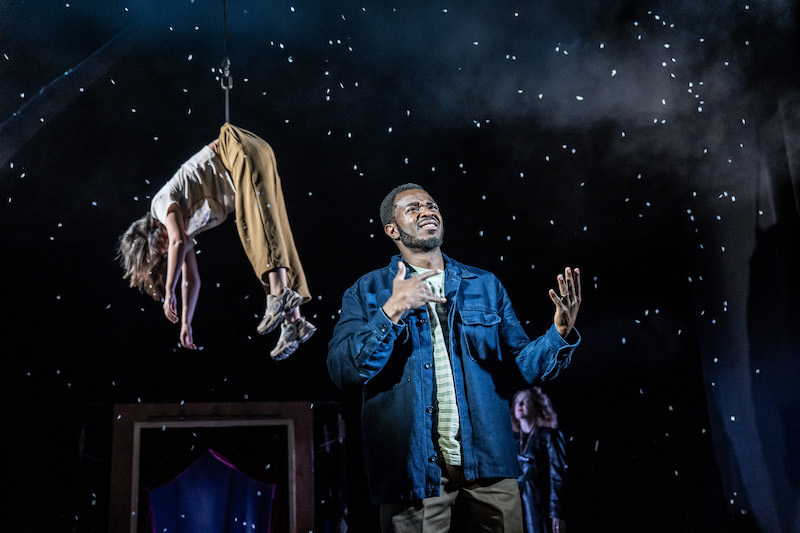
As the play progresses, we process through scenes inspired by Kaminsky’s poems, as the townsfolk adjust to their lives. The puppetry becomes a recurrent theme, not just in practical terms but in the metaphorical; these are actors whose strings are being pulled to tell the story, but the townsfolk are themselves playing out a tale in which other forces seem to be in control. When anyone is killed – and there is a lot of explosive gunfire and blood spatter – their body is hauled up into the air on wires, like mannequins returning to storage.
The concept of puppetry also infuses discussions about sign language. There is mention of how, when signing about people and their interactions, the signer places their signs within an imaginary scene, puppeteering names and feelings with their hands as they converse.
As life in the town of Vasenka continues, there are little moments of joy – a shared bath between Alfonso and Sonya shows the strength of their love even as the shelling continues outside their taped-up window – but the overall message is one of resistance. Women lure a soldier (Dylan Tonge Jones) to his execution, only for the next soldier – Tonge Jones again – to appear identical, but unharmed.
But resistance is never futile. The use of sign language, which the hearing soldiers cannot understand, becomes a weapon. It also hides things from hearing audiences who don’t sign, too: sections of the play are communicated solely in BSL, with no audio translation or surtitles. There are depths in there to which not everyone is privy: a further reminder of the inverted norm, where theatre excludes by default.
In a coda, we are reminded that this is not real, there is no such city as Vasenka, and nobody has really died. But McWhinney and Dead Centre are so effective at pulling us into the story that it feels more real than we care to admit.
And of course, across the world right now, there are real cities out there with townsfolk being subjected to the most awful militaristic cruelty – places that we find too easy to put out of our minds, to pretend that they’re fictional. That’s an inversion far more cruel than the BSL-English swap from which Deaf Republic finds that initial amusement. When they bomb other people’s houses, we protest – but not enough.
Runs until 13 September 2025
