

Artistic Director: Carlos Acosta
Choreographer: Pearls by Andonis Foniadakis and Chacona by Goyo Montero
Composer: Pearls by Julien Tarride and Chacona by J.S.Bach
Cuban Baroque is a mesmerising tale of contrasts. Andonis Foniadakis’ Pearls is freeing, practically buoyant interpretation of lush Baroque artistry, mixing the historic and the current to create an evolving, sensuous movement language. The restaging of Goyo Montero’s Chacona is controlled and stripped back, exposing the purity of the ‘instrument’, both musical and physical. The works are brought together by the depth of the relationship between dancer and music, the fusion of contrasting styles and the clear unity of the ensemble.
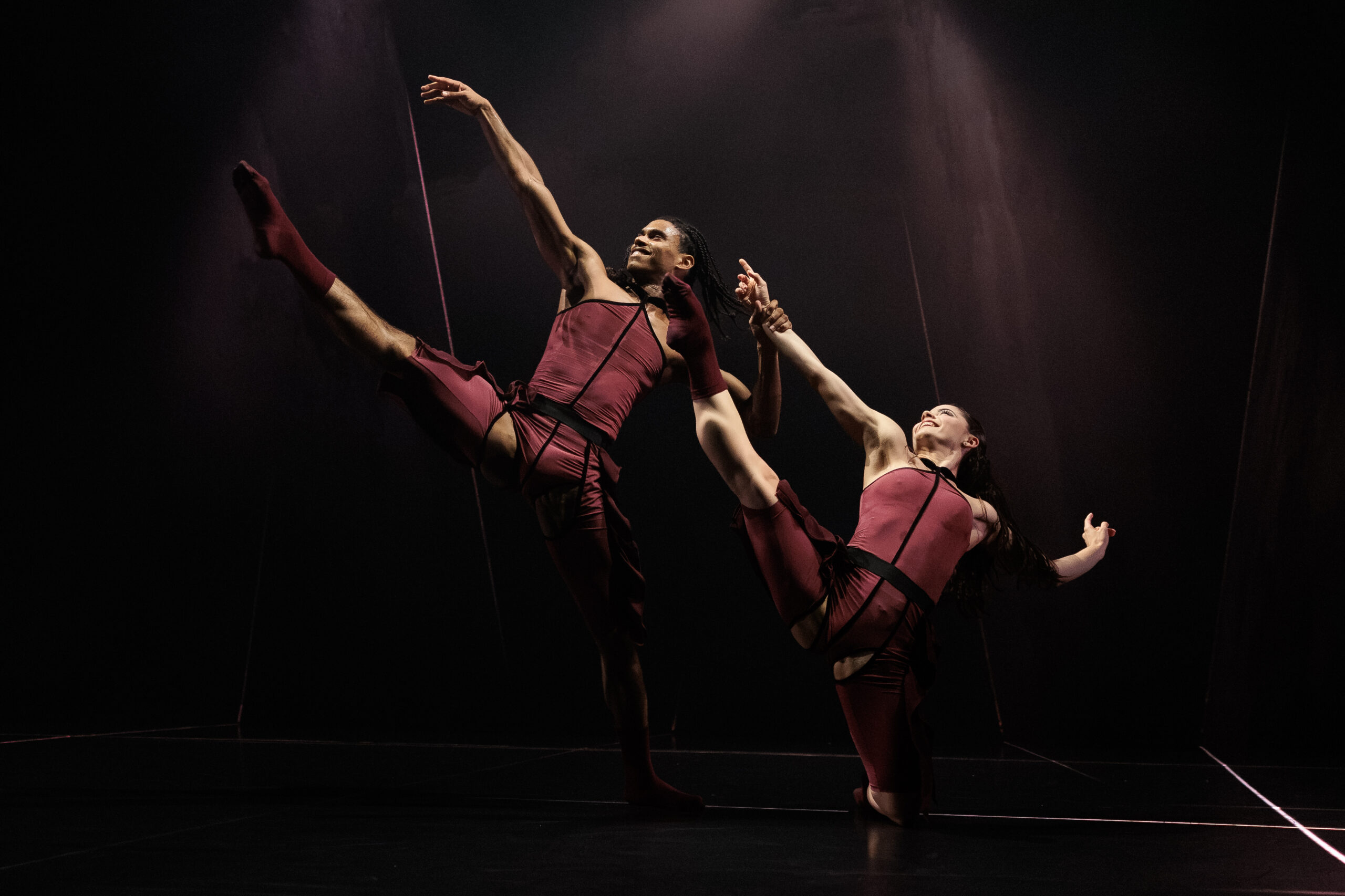
In Pearls, Nicolas Fischtel has designed the lighting with thin projected lines that form shifting geometric patterns on the ground, that cross and compliment the clarity of the dancing lines. Anastasios Tassos Sofroniou’s costumes are a deep burgundy, sometimes with skirts overlaid, or ruffled chaps, or with different elements removed. The overall effect is subtle and harmonious change, something one’s unconscious might notice before the conscious mind does.
Foniadakis’ movement vocabulary expands rapidly from courtly presentation, to include balletic 180 degree leg extensions, street dance split drops, hairography, Cuban folk steps, floorwork, gymnastic transitions and some Voguing influences in the hand placement especially. Additionally, the score by Julien Tarride helps to blur the lyricism of Esteban Sallas’ Salve Regina with the kinetic drive of Cuban guitar and eventually electronic rhythms.
This might sound excessive, but the ten dancers embody the movement deeply and joyfully, showing the typical Acosta Danza technical flair built on training in classical ballet, Cuban folk and contemporary dance. A highlight is a sequence featuring seven dancers in a shifting tableaux of mirrored movements. The interlocked intricacy of this gives the visual impression of a Rorschach test made of bodies that flow like ink in water.
Montero’s Chacona opens with a more somber tone. Pepe Gavilondo is playing piano at the back of the stage, with two walls of dancers lit from an overhead corridor of bright white light, casting shadows over their faces. As one dancer on pointe walks forward slowly, J.S.Bach’s score intoning, it is clear this is a return to a more classically controlled style.
Clad in black unitards with flashes of mesh, Verena Hemmerlein and Montero’s costumes highlight every angle of the dancing body, echoing the knife-like precision of the movement. The partner work is confident, sensitive and seamless and the ensemble really shines in rippling canons that highlight every note.
It is a privilege to have the musicians of Gavilondo on piano, Maria Lusson on violin and Adrian Aguiar on guitar performing the score onstage. Their solos are an engaging performance alone, and they encourage an attentiveness to Bach that exposes the responsiveness of Montero’s choreography to the music and the faithfulness of the company in dancing to it. Montero and Fischtel shift the lighting with the change of instruments; cold white for the piano, darker blue for the violin and a soft orange for the guitar, bringing the audio tone of the instruments into visual colour.
That is the strength of Cuban Baroque – it is bringing music to life with human effort. Dance styles fuse together, individuals become a company and pieces of music are given human form.
Runs until 3 October 2026
The Reviews Hub Star Rating
-
9
