

Writer: Dongmeng Chen
Director: Zhaoyi Ying
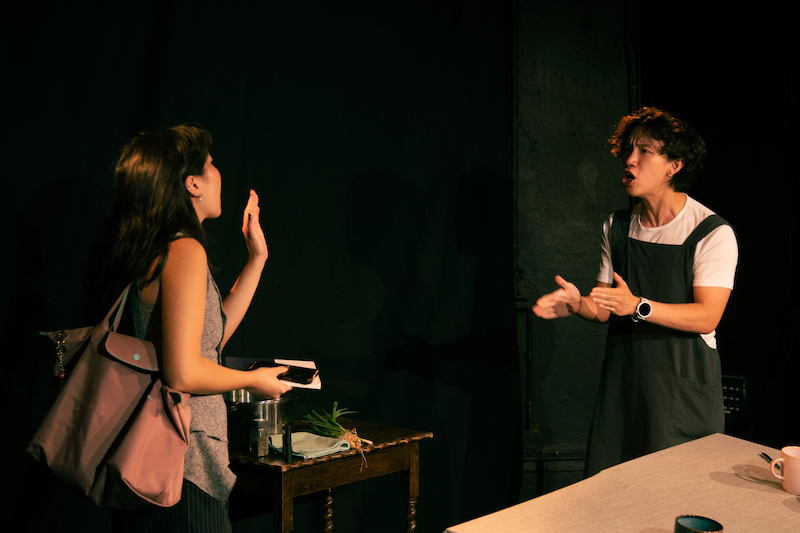
Ming and Yifei have a beautiful house with an ocean view. Their happy life, where schoolteacher Ming loves to cook breakfast for the couple before Yifei heads off to her financial job, is threatened when the neighbour’s chickens get increasingly aggressive towards each other. As the bird noise escalates, the couple’s reaction forms the basis of writer Dongmen Chen’s tale.
To begin with, the annoyance is a distraction for the couple, especially as Clarissa Liaw’s Yifei stresses about the possibility of promotion. But as the chickens encroach on the couple’s space and the hens’ eggs start turning up on their property, her attitude shifts. Complaints about the noise turn into a scheme to prolong the war, even bringing it closer to their property so they can profit from it.
There is an element of political satire at play here, one supposes, about how people, and governments, who should detest all wars can change when a conflict becomes a revenue opportunity. Ming’s laissez-faire position, meanwhile, could be taken as a pastiche of those who refuse to engage at all. But as the darkly comic tale takes on an ever blacker, less humorous tone, the satire fades, and attention turns inwards, to the couple’s relationship.
Tristen ZiJuin’s Ming starts out as a cheerful soul, buoying up his wife’s spirits even though her long hours and need to spend evenings schmoozing with bosses leave little time for affection. As the battle with the neighbour’s poultry intensifies, cracks in the marriage begin to show. Liaw captures Yifei’s insecurities well: she comes from a much poorer Chinese province and feels she has to work much harder than others in her firm, but is also reliant on her marriage to Ming for the residence permit to stay living and working. The play’s later moments pivot on that latter point, as the couple’s relationship finally self-destructs and it appears that whatever love there was at the time of their wedding has evaporated.
Chen’s script stutters and falters in its descent into chaotic darkness, with character turns that don’t always feel earned. Going from a domestic idyll to a scene of violent recrimination in the space of three-quarters of an hour is never easy, but it requires a little more polish than is evident here to be fully convincing. ZiJuin handles his transition from happy-go-lucky husband to an abusive, controlling soul well, even if the script struggles to explain that path.
Nonetheless, the simple story holds the attention for its duration, with two central performances that elevate the whole work. Chicken Dropping is not quite absurdly comedic enough to work as a satire either of geopolitics or marital strife. But like the chicken war that gives the couple the occasional breakfast egg, it still offers occasional delicious morsels.
Runs until 30 September 2026
