

Writers: Jean Syamali-Harris and Stanley McElligott
Director: Stanley McElligott
We’ve all sat through presentations given by people who weren’t really engaged with their topic. Whether that’s bored schoolchildren working on an assignment in which they have no interest, or work colleagues who just want to get through something so that they can get to the pub, there’s a particular twang to the disengaged speaker’s voice that is as recognisable as it can be excruciating.
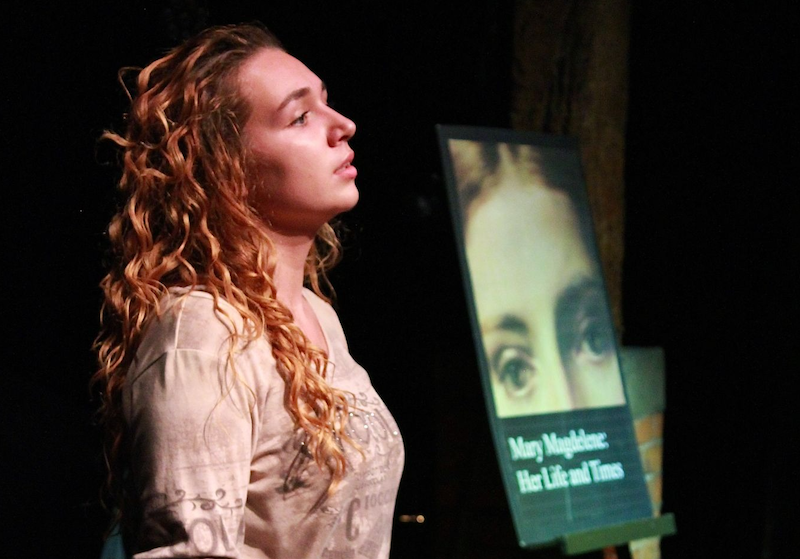
That’s exactly the tone that Jean Syamali-Harris’s unnamed character adopts at the top of Mary Had It Easy. A teenager in a red Adidas hoodie and calf-length cargo pants, it’s clear that she’s less than impressed at being asked to deliver a presentation on the life and times of Mary Magdalene. Helping feed into the character’s annoyance is a delayed start to the show: Syamali-Harris’s evident frustration at audience members still taking their time to take their seats some 20 minutes after the performance was due to start may be genuine, but it certainly helps play into her role as a young woman who just wants to get the presentation over with.
As her talk gets underway, some interesting facts about Mary Magdalene’s place in the Bible emerge. Although theologians and historians agree she was a historical figure, her role in the Gospels may be conflated with other women, while her reputation as a repentant prostitute stems not from the Bible itself, but from a 6th-century sermon by Pope Gregory I. All of this is, the character suggests, cribbed from Wikipedia, as any teenager’s presentation might be.
The fun comes from when Syamali-Harris takes her character off script. Both Jesus and Mary Magdalene are described in very 21st century terms, and as the speaker fixates on the symbolic washing of feet (“I’m not saying she was a foot fetishist,” she explains multiple times, but she’s not not saying it either) we get a sense of a young woman who both regards some of the Bible stories as a bit suspect, and knows and respects them.
The diversionary side topics begin to explore elements of the young woman’s own story, her friendships and fallings out with other girls, her repeated protestations of “I’m not gay” and the gradual emergence of her attraction to another girl. Amid all the jokes – Syamali-Harris and director Stanley McElligott ensure the script is laden with many – we get a sense of a girl who is at sea, whose anger issues and struggles are eating her up from the inside.
That combination of irreverence and pain makes for a powerful mix. As the girl diverges from her story once again to talk about the Old Testament figure of Job, we sense the affinity she finds with him as well as with Mary Magdalene – both figures who offer different portrayals of pain and suffering, combined with devotion to their God.
As the girl struggles to fill the time allotted for her talk, she diverges again into dance, firing up Otis Redding’s Try a Little Tenderness on her iPod and moving to the music. Once again, there is a sense of internal struggle and rage erupting from her, as if the seven demons that were said to have been expelled from Mary Magdalene have found a new home in her.
Syamali-Harris offers a powerful portrait of a lost young woman struggling to reconcile her life with what a religious view suggests she should have. By the end, as she collapses on stage and is joined by other people – possibly members of the same congregation, the church that has encouraged her to give the presentation in the first place, perhaps – one is fully invested in how this damaged young woman’s life is going to proceed.
It is frustrating, then, that the piece ends on a hymn, with all the doubt and conflict forgotten. Is this a suggestion that being a member of a church resolves everything? Given the numerous prior references to sexuality and dating girls, is this a conversion therapy session? Is the happiness that seems to engulf the character going to last, or is it merely a transient mask? While the ambiguity is not unwelcome, it also feels as if all the careful, hilarious, heartbreaking character work that precedes the show’s closing moments has come to an abrupt, premature end.
It’s not an entirely inappropriate parallel with Mary Magdalene, whose own story is incomplete and misunderstood. But the finale denies Mary Had It Easy’s protagonist the sort of ending that is as strong, as stirring and as complex as its beginning and middle.
Reviewed on 20 August 2026
Camden Fringe 2026 runs until 30 August
