

Writers: Małgorzata Szumowska, Michał Englert, Kasper Bajon and Brid Arnstein
Directors: Małgorzata Szumowska and Michał Englert
At the end of this film about Dostoevsky living in Germany to escape his debts and write The Idiot, the on-screen text suggests that his novel is now thought to be one of the finest in literary history. Does anyone really think this is true? The Idiot, published serially between 1868 and 1869, follows the annoyingly honest and good Prince Lev Nikolayevich Myshkin, who causes chaos everywhere he goes. It’s not one of Dostoevsky’s best. However, Małgorzata Szumowska and Michał Englert’s The Idiot(s) is not about The Prince, but about two other idiots, Dostoevsky and his long-suffering wife Anna.
The directors have turned the Dostoevskys’ life in exile into a broad, scatological comedy, so extreme in places it seems incredible that Fyodor had the nous to go on and write The Brothers Karamazov. But there are enough Easter eggs in The Idiot(s) to keep fans of the precocious Prince happy. The Idiot begins on a train, and so does The Idiot(s), with Fyodor and Anna arriving in Germany (in real life, they went to Switzerland).
Only those who know the novel will be delighted when Fyodor faints in an ecstatic swoon after spying Holbein the Younger’s Dead Christ on the wall of the local church. It’s a painting that causes The Prince to exclaim, “A man’s faith might be ruined by looking at the picture!” The Dostoevskys actually saw the painting in Basel, and it’s thought that the sight of the hopeless Christ, in which salvation seems to be an impossibility, triggered Fyodor’s epilepsy, which in the film is played for comedy.
In the novel, there is talk of a duel, but one never occurs. However, in The Idiot(s) we do have an entirely imagined duel between Dostoevsky and his rival in letters and love, Ivan Turgenev, who delights in life outside Mother Russia and dresses like the Child Catcher in Chitty Chitty Bang Bang. Of course, both are awful shots.
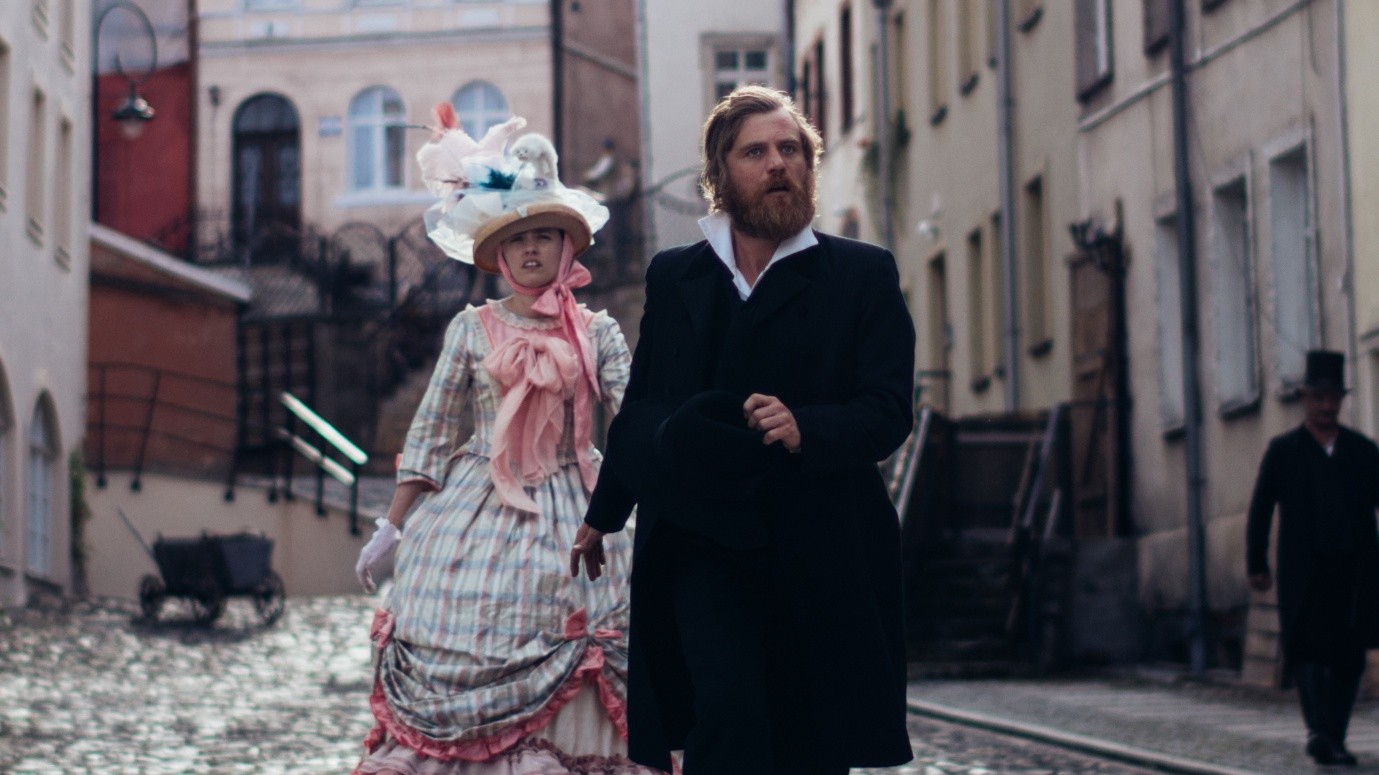
Johnny Flynn plays Fyodor with gusto. Addicted to the roulette wheel and usually losing, he can’t write the new novel he’s started. He’d rather be in Russia, but he needs to pay off the gambling debts he accrued there. Each night he begs Anna for a few coins so he can return to the casino. He comes home in the early hours empty-handed.
Aimee Lou Wood’s Anna despairs of his antics, but manages to control him by indulging in his masochistic sexual proclivities. Her husband’s a sucker – literally – for a pretty feminine foot, and he likes to be punished loudly, much to the glee of their landlady, who nevertheless throws them out when they fail to pay the rent. But Anna is resourceful in other ways too; she borrows money from the deliciously camp Turgenev (a fine performance from Christian Friedel, who played Rudolf Höss in The Zone of Interest) and begins to write the novel that Fyodor can’t.
The garden scenes at Turgenev’s fancy house are reminiscent of Peter Greenaway’s The Draughtsman’s Contract, and later Michael Nyman’s music appears to solidify the connections. The overused Spiegel im Spiegel by Pärt makes an appearance when the husband and wife are at their lowest, while the oddest choice of music is A-ha’s Take On Me, sung by Turgenev. It’s the one obvious anachronism, but it sticks out as the only one when Szumowska and Englert might have inserted more to lend the film even further strangeness.
The Idiot(s) is a finely shot period romp, and Flynn and Wood are perfectly paired as Fyodor and Anna. It’s certainly a unique take on the Russians.
The Idiot(s) is screening at the BFI London Film Festival 2026 from 7-18 October.
