

Writer: Chuko Esiri
Directors: Arie and Chuko Esiri
Mrs Dalloway will never die. Most famously, Virginia Woolf’s 1925 novel was adapted into Stephen Daldry’s The Hours, based on Michael Cunningham’s book of the same name. In this year’s BFI London Film Festival, we have two Dalloways: The Last Day, featuring Alicia Vikander, and Clarissa with Sophie Okonedo, the latter film more faithful to the original. Here, the action has been transported to modern-day Nigeria, and the story of a married woman organising a party while full of regret for past choices suits the new location perfectly.
Okonedo’s Clarissa goes to buy the flowers herself, but unlike her London version, she doesn’t walk into town. Instead, she’s driven there by her chauffeur. We see a great deal of the Lagos traffic in this film directed by twin brothers Arie and Chuko Esiri. There are chaotic, honking queues everywhere you look. Across the city, Septimus and his wife Aisha (one of the few name changes; Woolf calls her Lucrezia) find themselves at a complete standstill as they travel to the doctor’s to discuss Septimus’s PTSD. A cavalcade of police cars, possibly escorting Government officials, speeds through the streets in a blaze of sirens.
Clarissa is back in her house, haranguing her many servants by the time Septimus jumps out of the taxi to argue with the man unloading his van, which is causing so much traffic. In a rage, Septimus hits him. Later, after his diagnosis and in a change to the original, Septimus and Aisha visit Clarissa’s house, as Aisha is a tailor, one of the best in Lagos, according to Clarissa, and is tasked with fixing a zip on one of Clarissa’s dresses. Septimus and Clarissa talk politely about the army.
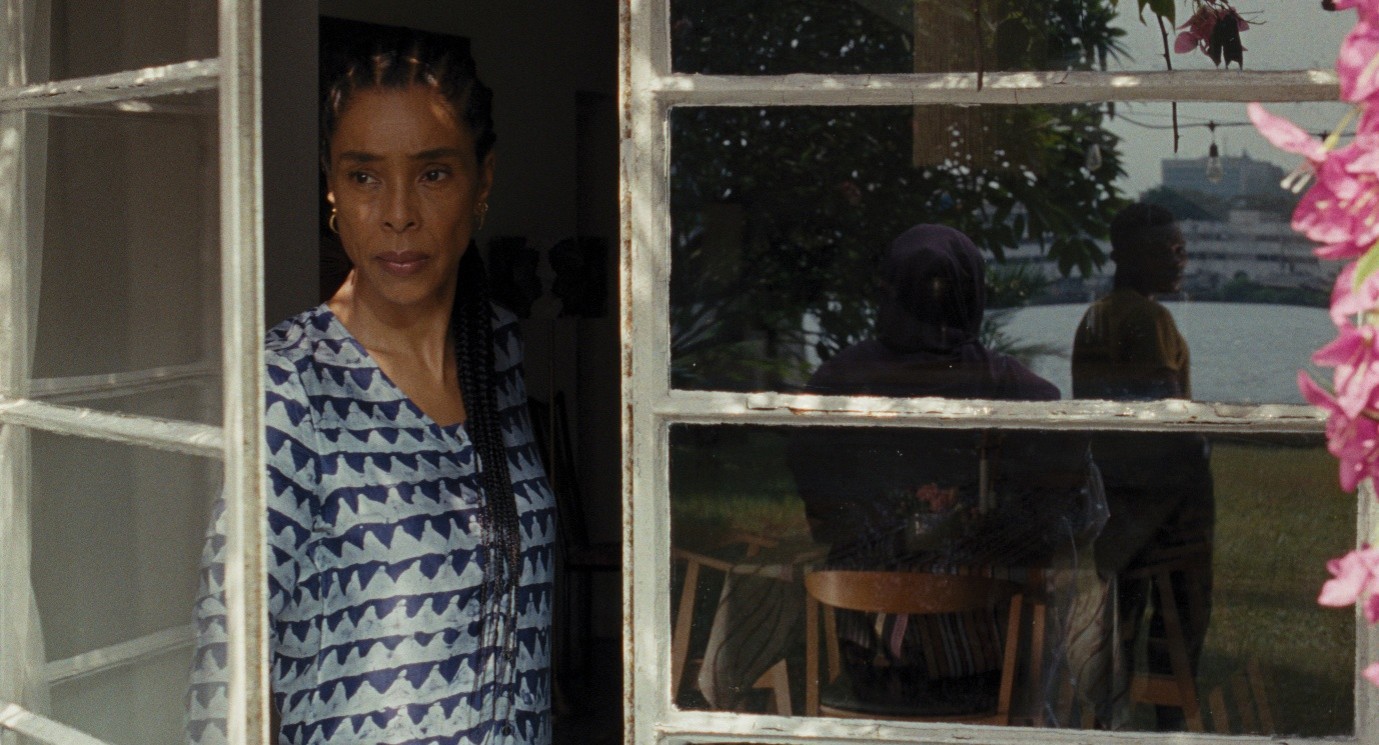
In her fluid stream-of-consciousness writing, Woolf was able to dive into the minds of her characters, but in Clarissa, the actors have to do most of the heavy lifting with their faces and their mannerisms. At first, Okonedo’s Clarissa appears too shallow to have hidden regrets as she arranges and micromanages the upcoming party, fussing about her furniture, the straightness of a mosaic hanging on the wall, the right pattern on the plates. But, with the help of flashbacks of a weekend in a country house, her pangs of remorse for a different kind of life she could have had become apparent.
As the young Clarissa, India Amarteifio (recently seen in the BBC’s The Rapture) gives the young woman a world of possibility as she hangs out with Peter, a poet, and chain-smoking Sally. But when she meets Richard, her future husband, she knows that she will have to swap the Bohemian lifestyle for respectability. Okenedo remembers these days while she sits by the river at the end of her garden, and it’s palpable in her face that she misses her old freedoms.
David Oyelowo’s Peter has also changed, wearing fancy suits as he visits Lagos for a week. There’s nothing left of his former free-spirited self. He walks around almost grumpily, playing with the penknife that is always in his hand. His tailored clothes, however, are nothing more than a façade for failure. Nikki Amuka-Bird’s Sally has settled down, too, but has somehow retained her vivacity for life that the others have left behind.
As this group of friends play out their expected lives, Fortune Nwafor’s Septimus recalls his time in the Nigerian Army and the bloody and unexpected incident that he witnessed and which has led to his PTSD. Newcomer Nwafor is excellent as the soldier, happy in the barracks, but now haunted by the past which won’t leave him.
Like Woolf’s original, Clarissa isn’t only about the loneliness of Mrs Dalloway and the ghosts that come to visit a shell-shocked Septimus, but about a postwar society too. The divide between the rich and poor is made plain with images of ordinary Lagosians on the street, struggling to make a living. These people look very different from those who come to Clarissa’s party, talking of post-colonial politics in general terms. It’s unlikely that any of Clarissa’s friends were involved in the fight against Boko Haram in the same ways that Septimus was.
Mrs Dalloway will never die because Woolf’s text continually opens up, yielding more meanings. With a stellar cast, the Esiris have effortlessly transported Mrs Dalloway through space and time. Clarissa seems right at home in Nigeria, where, instead of Big Ben tolling the passage of the day, the Islamic call to prayer reverberates in the air.
Clarissa is screening at the BFI London Film Festival 2026 from 7-18 October.
