

Writer and Director: Kleber Mendonça Filho
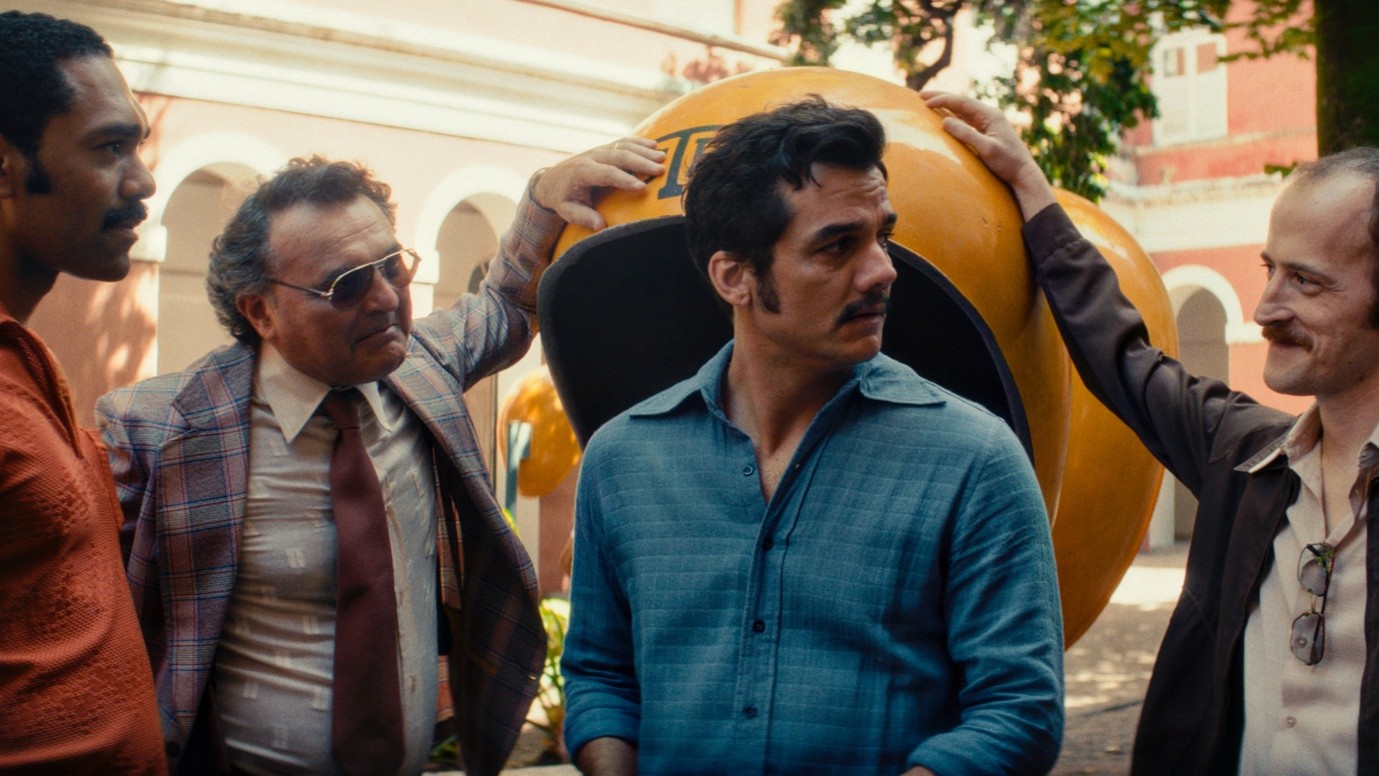
Kleber Mendonça Filho certainly keeps the audience on its toes with his multilayered portrayal of corruption in 1970s Brazil. Full of bright yellows – Marcelo’s VW Beetle is a thing of beauty – and deep crimsons, the decade has never looked so colourful, and is a sumptuous backdrop to a pleasingly complex narrative.
This period of governmental and bureaucratic malversation is understatedly referred to as The Great Mischief, a time when everyone from the police to the state was dishonest and on the make. Assassinations and disappearances were common under the dictatorship, but in The Secret Agent, Filho cleverly withholds information until the very last minute.
Marcelo is driving to Recife, but on the way, he stops to refill with petrol. A corpse, already days old and covered half-heartedly with a flattened cardboard box, lies unattended while the police who arrive ask Marcelo for ‘donations’. He can only hand over the few cigarettes left in his squashed carton. The policeman is very interested in the bright red fire extinguisher that drivers are obliged to carry in their cars.
When he arrives in Recife, he is greeted by the elderly Dona Sebastiana (a marvellous turn by Tânia Maria), who shows him to his apartment in her complex and introduces him to the other residents. With its cast of waifs and strays – in fact, we find out, they are political enemies of the state – Sebastiana’s building is reminiscent of Anna Madrigal’s house in Armistead Maupin’s Tales of the City. Both serve as havens from dangerous worlds.
If Marcelo is the secret agent of the title, we are not told until the second part of the film what he has done to deserve being hunted by two fairly useless hitmen. And to add to his woes, the chief of police, bent as a five-bob note, always accompanied by his gaggle of adult sons, decides to take Marcelo under his wing, inviting him to view the war scars of an old World War Two soldier who now works as a tailor. Chief Euclides believes the tailor to be a German soldier; we find out that he’s Jewish.
Other strange scenes like this ensure that the film is always compelling, but there is humour too. A prim, serious colleague takes a sexual interest in Marcelo when he starts working in the registry for births, deaths and marriages. She sends him typed come-ons. One evening back at Casa Sebastiana, the “refugees” blurt out their real names in a rare act of honesty. However, the oddest feature must be the two-headed cat that stalks around the tables at this party, perhaps a symbol of everyone’s duplicity.
Wagner Moura won Best Actor at Cannes for his portrayal of Marcelo, and like the film, he gives nothing away, although his facial hair often changes. He also plays Marcelo’s son in the future, a flashforward that isn’t really necessary. It’s the only misstep in the whole film, which, at over two-and-a-half hours, nevertheless hurtles by. Moura is such a watchable actor, and here he never overdoes the misery that his character is enduring. Marcelo is a decent man, full of resolution, but full of warmth, too.
The Secret Agent isn’t the perfect film, but it comes very close. It’s gorgeously shot on Panavision, and as Mardi Gras is close at hand, the music is outstanding. A true festival of colour and a lorry load of clues.
The Secret Agent is screening at the BFI London Film Festival 2025 from 8-19 October.
