

Writers: Qiaochu Guo and Tianyi Zheng
Director: Tianyi Zheng
To be successful, documentaries must be objective, accurate and authentic whilst performance art is subjective and interpretative. A merger of the two disciplines, as is attempted in Where Comes Mulan, written by Qiaochu Guo and Tianyi Zheng and directed by the latter, does not sound an ideal match.
The viewer is dropped in at the deep end as the film opens in a rush with documentarian Tianyi Zheng explaining that a previous work on classic female figures in different time periods gave her the idea of exploring the myth of Mulan who, according to legend, took her aged father’s place in the conscription for the army by disguising herself as a man. Tianyi Zheng returns to her ancestral village in Huangpi, Wuhan, where Mulan is said to have originated, to share ideas and provoke discussion.
The possibility that Disney’s animated version of Mulan might amount to cultural appropriation is not addressed and there is no criticism of the company’s commodification of the legend. Actually, the documentary shows the authorities in Huangpi have taken a similar exploitative approach and cynically promoted the area as Mulan’s birthplace in order to attract tourists. Strangely, Tianyi Zheng is less critical of the commercialisation of a legend than the fact the process is unsuccessful in her birthplace.
The official narrative, that the exploitation of Mulan has been a money-making success, is explored and found to be unreliable. The documentary visits a Mulan theme park which is dismissed as being a tatty hodgepodge. A stark sequence, which might be taken out of a novel by J.G. Ballard, features the documentarians exploring hotels built to accommodate anticipated tourists but now derelict and flooded. There is an eerie atmosphere as promotional material intended to attract trade and thank-you letters that were never sent are discovered and read aloud.
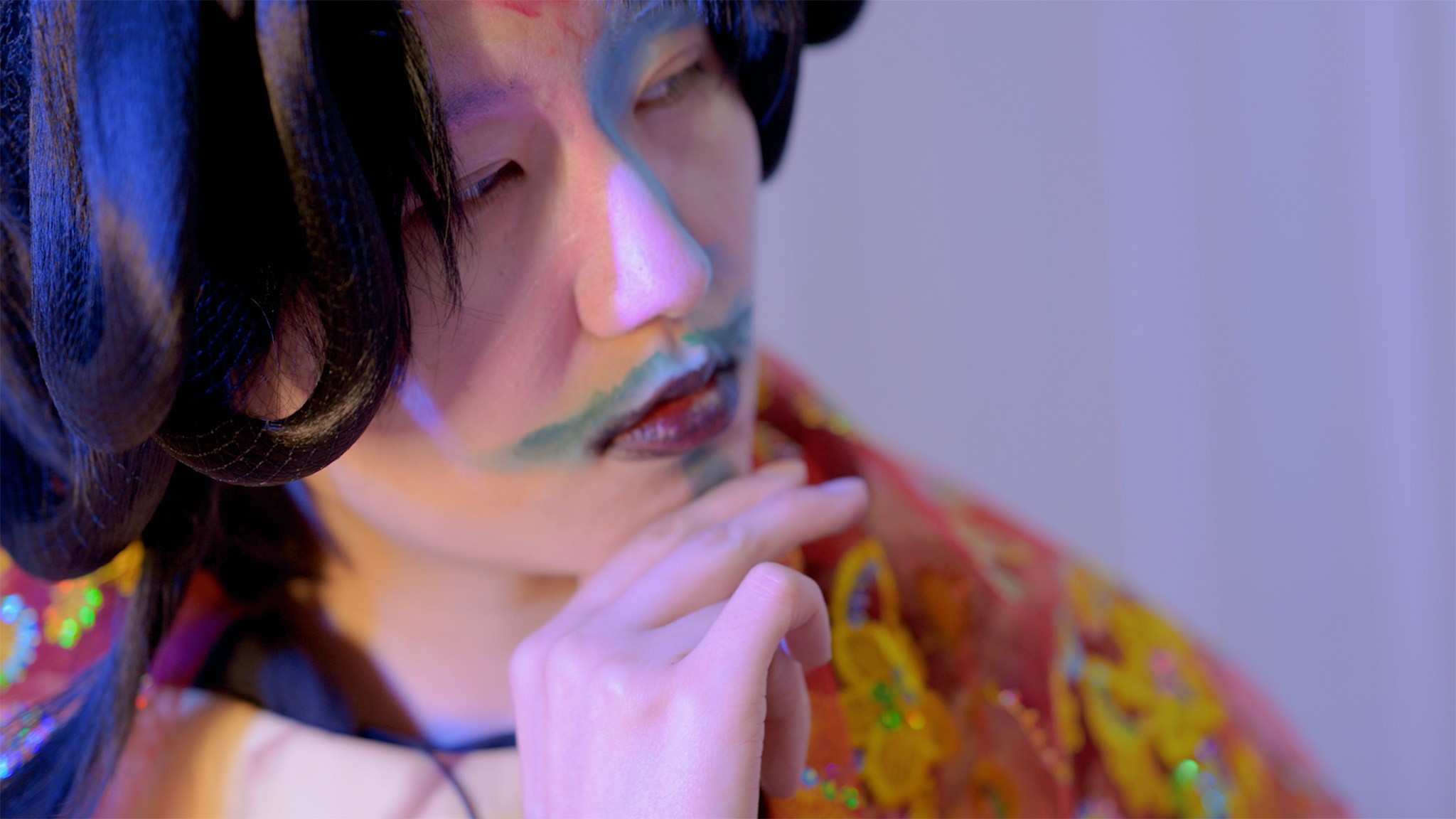
Mulan’s gender is apparently open to debate with ‘General’ Mulan portrayed as male but temples having male and female statues of the character. Possibility to off-set the impression Mulan is now regarded as a cash-in commodity instead of a cultural icon Tianyi Zheng invites performance artist Qiaochu Guo to the village to embody Mulan through a queer lens. Actually, Qiaochu Guo seems to perceive Mulan less as a sexual figure and more the ultimate nonconformist – so determined not to adhere to heteronormative standards and live as a housewife she committed seppuku – Japanese ritualistic suicide.
The film becomes performative as Qiaochu Guo acts out a number of sequences. The most successful closes the film with Qiaochu Guo in full costume on a temple enacting the various ways Mulan is rumoured to have ended her life- slitting throat or stomach or ripping out her heart.
The objective approach of the documentary makes the improvisation nature of performance art at times look a bit amateurish. A half-hearted duel using elongated sparklers ends when the fireworks burn out. The rehearsal for the suicide mime is filmed but, the commitment to authenticity is such, the distracting presence of a dog, clearly in view, is retained.
Director Tianyi Zheng does not seem to have had a clear objective in mind with Where Comes Mulan but rather made adjustments to take account of developments experienced on location such as efforts by the local authorities to financially exploit the legend. The experimental hybrid documentary and performative film format adds to the visual aspect of the film but is not really analytical making Where Comes Mulan an interesting curiosity but not completely successful.
Queer East runs from 1 May to 6 June 2026.
The Reviews Hub Star Rating
-
4
