

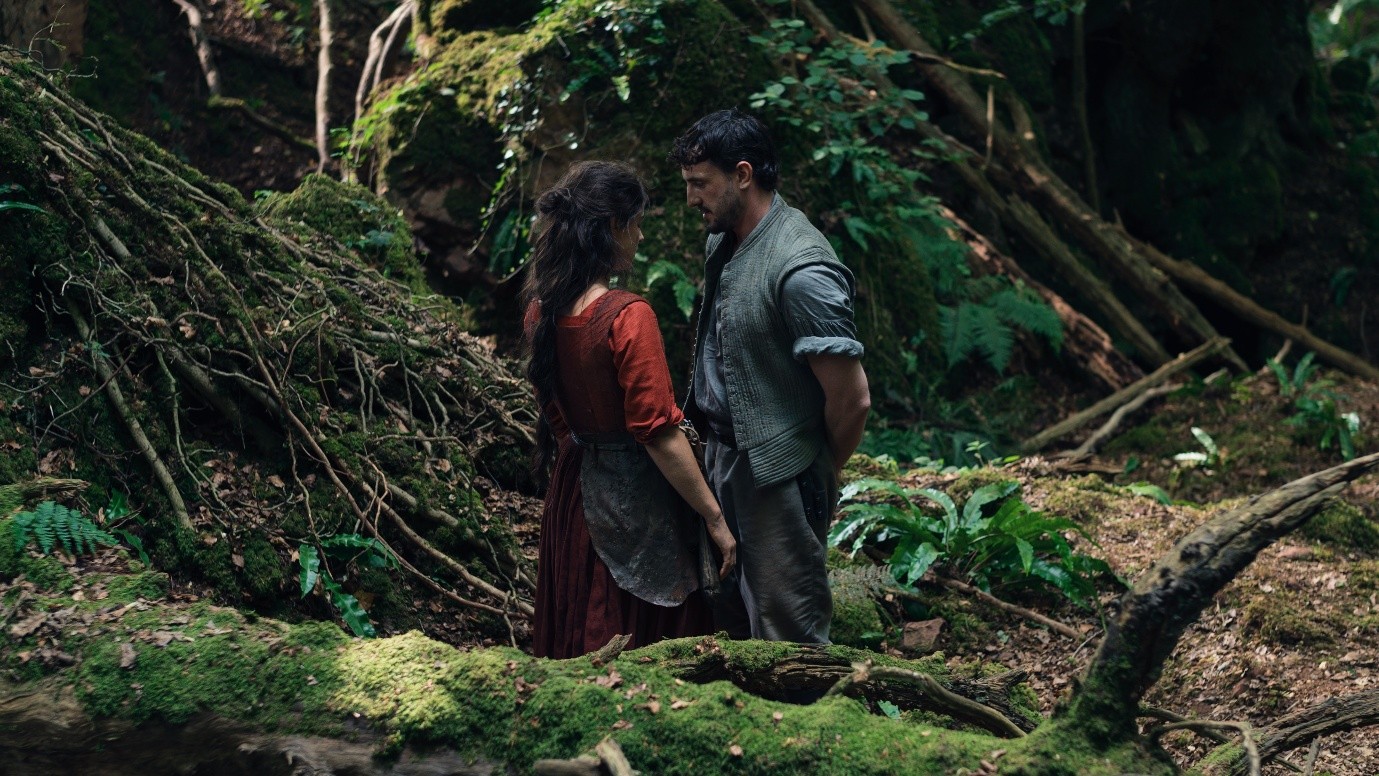
Writers: Chloé Zhao and Maggie O’Farrell
Director: Chloé Zhao
It would be quiet something to know that the greatest play ever written was written for you, and Maggie O’Farrell’s novel Hamnet captures a version of true events affecting William Shakespeare’s family and the death of his young son that inspires the play that almost bears his name. Screening at the BFI London Film Festival, O’Farrell has worked with Writer-Director Chloé Zhao to co-adapt her book which, after a rather disappointing stage production by he Royal Shakespeare Company last year, finds all the right notes with its focus on family life and the sudden, overwhelming grief of the Shakespeare clan. A room of sniffling film critics at this Festival press screening tells you all you need to know about this heartbreaking adaptation.
Certain she will have two children at her deathbed, Agnes is surprised when she ends up with three babies including twins Judith and Hamnet. A local healer with knowledge of medical herbs and the value of the environment, Agnes is married to a Stratford glovemaker turned playwright who she encourages to seek his own substance in London. Left alone with the children, life is happy until a plague descends on the household and loss consumes them, causing a rift between husband and wife.
Zhao’s film is absolutely beautiful, and while you may be expecting a standard period drama with a lot of to-do about Shakespeare, this sensitive and well-paced movie will surprise and floor you. Rearranging the multiple timelines of O’Farrell’s book (credited as co-screenwriter), the film finds depth in the building love and ordinariness of family life which make the inevitable cruelty of its destruction all the more potent. O’ Farrell tries to misdirect us and Agnes, whose immersive point of view is capture well, experiencing another kind of doom, giving intensity to the consuming grief and its aftermath which is highly affecting.
The expansive approach of the book is simplified and the film remains modest in scale and approach – this really happened to real people is the emphasis and the normalcy of their life only makes the scale of that tragedy all the more pressing. The name William Shakespeare is uttered only once, late in the story when the narrative shifts to his London perspective, but otherwise this is just a husband and wife, mother and father making compromises and sacrifices for their family and devastated by tragedy. Any fame or recognition of the legend Shakespeare was becoming in these years is minimalised allowing Agnes’ story to dominate.
Jessie Buckley’s performance is one of her best, in almost every scene she illuminates the interior life of Agnes a local woman treated with suspicion who finds everything she needs in the family she makes for herself with Will. Her palpable grief, particularly in the moment of death is heart stopping, as is the cooling realisation of what her husband has done with his own pain, and there won’t be a dry eye in the house. Paul Mescale gives Will an everyman quality and ease that makes Shakespeare a real person rather the inevitable timeless poet that always dogs portrayal of the writer. Mescale and Buckley have great chemistry and he reveals the shape of his own grief later in the film with a moment when Agnes sees beyond her own grief for the first time,
Hamnet can’t resist a spending a bit too long on Hamlet itself and using the speeches in the latter part of the film which is a little laboured and entirely unnecessary given the connection between the boy and the play is all there, but it really appreciates just how timeless and affecting this play has become, why it touches so deeply. But this is such a thoughtful and meaningful adaptation of grief and its effects on ordinary families which just so happens to inspire the greatest writer to produce his masterwork.
Hamnet is screening at the BFI London Film Festival 2025 from 8-19 October.
