

Composers: Franz Liszt, Fiona Brice and others
Conductor: Jérôme Kuhn
Film Director: Mat Collishaw
To frame “descent into hell” as a theme for this night at the South Bank Centre’s Multitudes festival could be seen as tempting fate. This newly annual exercise in engaging new audiences for classical music through daring collaborations with other disciplines polarises audiences. Purists decry it as dumbing down, while, beyond spectacle, newcomers risk becoming overwhelmed by layers of artistic intentions.
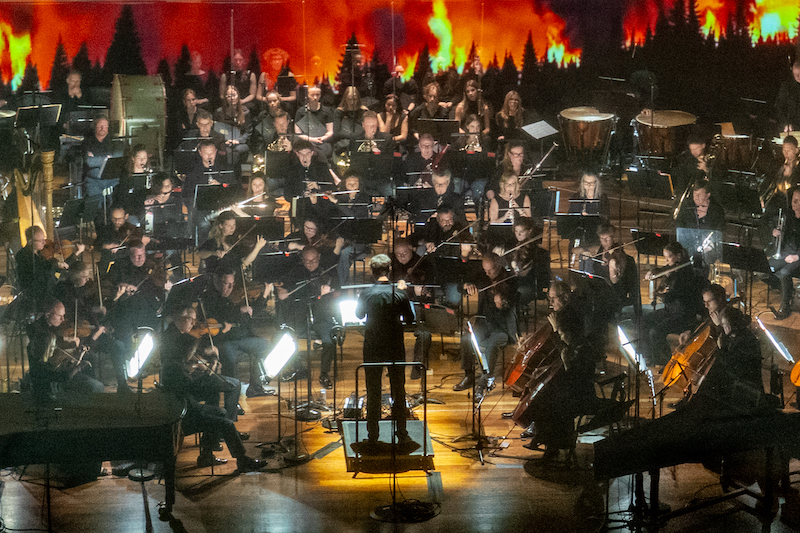
Placing Liszt’s Dante Symphony as the fulcrum of the evening, composer Fiona Brice, visual artist Mat Collishaw and BBC Concert Orchestra conductor Jérôme Kuhn build a musical and visual narrative that is as compelling as it is cohesive and as important as it is impressive.
The performance starts in the foyer. The audience is enveloped in a literal haze while live musicians from the orchestra perform Brice’s Visions of Dante: Liszt Remixed, an orchestral and electro-acoustic reworking of the night’s main themes. Perhaps a shade monotonous and over-long, there is no cause for concern: this is not the main event in tonight’s feast. It’s not even an amuse-bouche.
That comes on arrival in the hall. While visual projection in the adjacent Royal Festival Hall often seems disconnected from the musical offering in that wide open space, the proscenium stage at the Queen Elizabeth Hall allows the orchestra to perform behind a kind of haze of their own, in this case, a gauze rear-projection screen. The effect is magical. Collishaw’s visual language builds cunningly quietly through the night’s appetisers.
In Hildegard of Bingen’s O quam mirabilis est, The Inferno Singers commence proceedings in meditative unison over a cello pedal. Couperin’s Le Rossignol en Amour follows with Ileana Ruhemann deliciously whimsical on flute and Mishka Rushdie Momen on harpsichord. Momen then moves to the piano for Messiaen’s L’alouette Calandrelle. The projections are playful but show thoughtful restraint, setting these chamber pieces with untypical intimacy in such a vast setting.
For Liszt’s epic work, Collishaw makes virtue of the symphony’s fabled formlessness. The slow panning shots through an environmental hell guide the audience with ease into the purgatory that Liszt intended. The music is precociously cinematic, and the visual narrative shows a real synergy with the score. This seems like the natural successor to Godfrey Reggio’s 1982 film Koyaanisqatsi, which captured life out of balance between nature, humanity, and technology to a score by Philip Glass. Tragically, in Collishaw’s purgatory, the opportunities for balance have long been exploited, and the environmental impact of humanity is unequivocally represented with uncompromising force. Throughout, the BBC Concert Orchestra can be seen in fragments through the gauze. The musicians bristle with excitement at their starring role in this integrated collaboration, bringing energy, engagement and exquisite precision to this night of high drama.
The final shot, panning upwards on a derelict Shard to a stork’s nest, is so apocalyptic as to induce vertigo in audience members close enough. Collishaw’s message is important and inescapable. The storks, at least, represent some hope for rebirth.
Closing with a compact coda by Brice, which melds post-romanticism with pop rhythms and rap delivered in nightmarish form by TaliaBle is a risk, but My Precious Fool is a potent closing statement that many claim Liszt’s two-movement symphony lacks.
The end result is a performance that is far greater than the sum of its parts. It is personally challenging but artistically rewarding. This is the Multitudes festival at its best. If it wins the Southbank Centre new audiences for its classical programming, then it is richly deserved.
Reviewed on 29 April 2026
Multitudes Festival runs until 30 April 2026
