

Writer: David Mamet
Director: David Thacker
Before the use of the word ‘underclass’ became commonplace, author David Mamet detailed the grim lifestyles of the disaffected and desperate in his early play, American Buffalo.
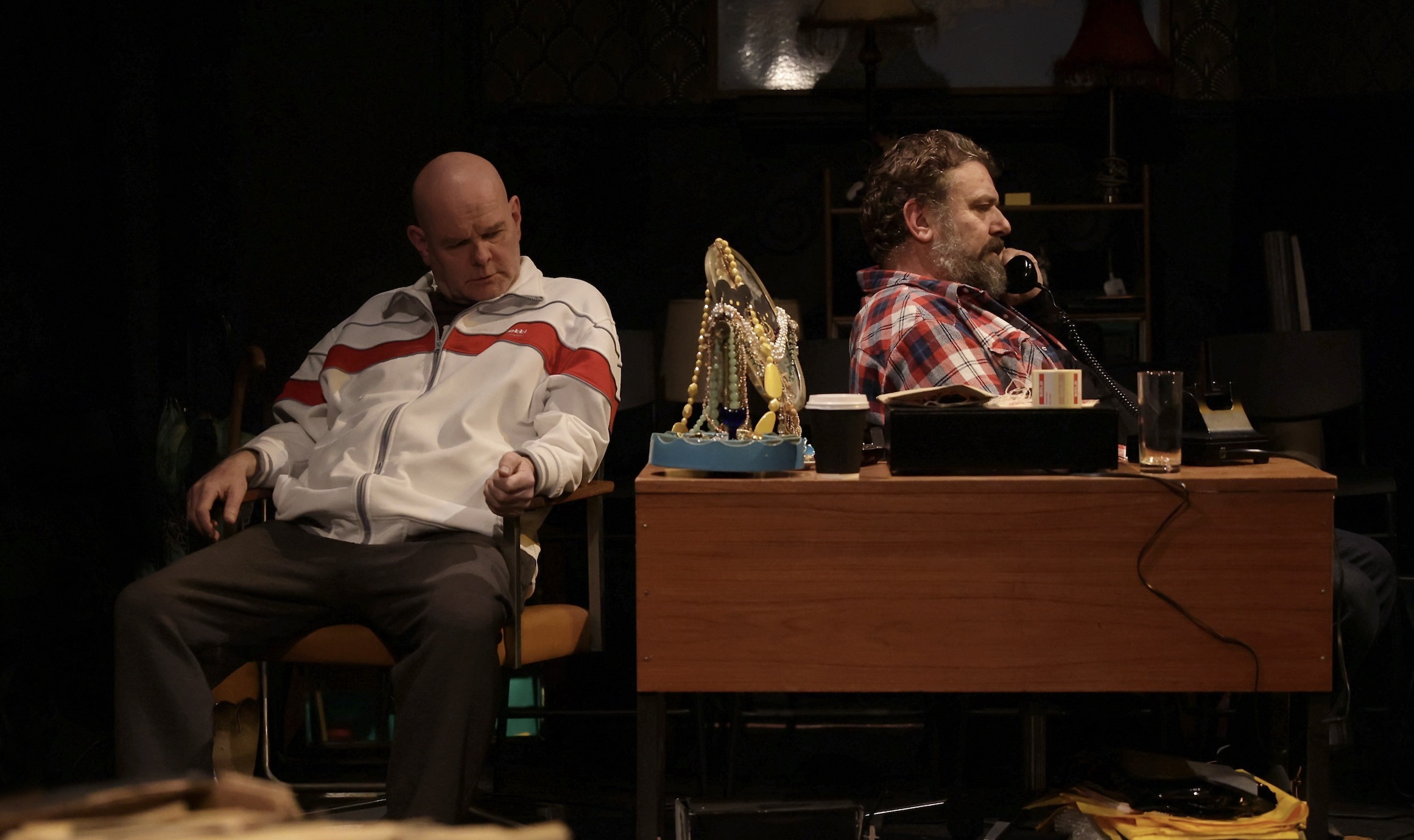
Junk shop owner Don (Colin Connor) is having seller’s remorse. Having sold a buffalo nickel to a collector he becomes convinced the customer got the better part of the deal. From Don’s distorted viewpoint this entitles him to steal back the coin and he enlists the eager-to-please Bob (John O’Neill) to burgle the collector’s home. However, Don’s poker buddy Teach, (David MacCreedy) feels this plan lacks ambition and proposes he, rather than Bob, should perform the robbery and steal not just the buffalo nickel but the entire coin collection and any other valuables in the house. But, as there is rarely honour among thieves, events do not work out as planned.
The characters in American Buffalo are resentful and grudging, convinced they are entitled to exploit others as compensation for having been cheated by a long list of perceived offenders, particularly women who are described as dykes or broads. Their language is crude; not just because of the regular use of profanities but in showing a very limited vocabulary, almost as if they are proud of displaying ignorance. Which makes a revival of the play in the year when Donald Trump returns to the political arena horribly appropriate.
Rising Moon Productions have pushed the boat out on the design of the show which is staged as theatre-in-the-round. A gloriously ramshackle junk shop set fills the entire performance space so there is a risk inattentive audience members might sit within, rather than around the boundary of, the set.
Director David Thacker provides a rhythmic production. Thacker catches the odd cadence in Mamet’s dialogue, so speeches, although verbose, sound natural rather than contrived. Lengthy speeches about apparently inconsequential matters suddenly bang up against a sharp truth or an hilarious insight.
The pomposity of the characters’ self-aggrandising, in seeing themselves as entrepreneurs or businessmen rather than shabby crooks, is taken seriously which makes it all the funnier or, depending on your viewpoint, more depressing. There is a restless, nervous energy to the production as if the relentless discussion is a means by which the characters psych themselves up before they can act.
Colin Connor and David MacCreedy behave like a long-married couple engaged in an ongoing argument. MacCreedy gives a shockingly self-righteous performance showing Teach as someone with a grudge against the world and thin-skinned enough to take offence at the least perceived slight. Although physically slighter than Connor he does not hesitate to hector and bully to get his way and must have the last word in any argument. Teach cannot accept responsibility, if his actions result in harm, it is the other person’s fault.
Colin Connor takes a similar blustering approach to justify Don’s illegal intentions but there is a greater awareness of the consequences. There is a nervousness underlying Connor’s performance, he seems to be always on the edge of looking over his shoulder as if too many of his schemes have gone wrong in the past. Don seems to be looking for someone else to solve his problems – there is reference to a fourth character who, Godot-like, will appear and sort everything out.
There is a gauche innocence to John O’Neill’s interpretation of Bob. O’Neill’s clingy approach shows a desperate puppy-dog need to secure Don’s approval. Bob turns out to be the catalyst that brings the only hope of redemption for the characters. Although the word ‘friendship’ occurs regularly in the dialogue none of the characters appreciates their tarnished relationship is their only truly valuable possession.
American Buffalo is a ‘you should have been there‘ show – a rare opportunity to see a high-quality cast in an intimate setting. Ironically, although the play concerns a nickel, the production is solid gold.
Runs until 23rd March 2024
