

Writers: David Bickerstaff and Phil Grabsky
Director: David Bickerstaff
Take a look at any portrait James McNeill Whistler painted of himself, and you would think he’s a man easily summed up. That style, that smirk. Flamboyant? Yes. Self-aggrandizing? Always. Oscar Wilde famously dubbed him the artist who “spells Art with a capital I”. The American ex-pat, who made London his home, not only knew his worth, he’d tell you about it too.
In their latest documentary, James McNeill Whistler, Exhibition on Screen are delving into the world of Whistler, coinciding with the recent exhibition at Tate Britain. The gift that Whistler hands to researchers is that unlike artists such as Caravaggio, who didn’t leave much of a paper trail, with Whistler, hoards of letters and notes vividly connect us to his bold and effervescent personality.
Extending their normal practice of detailed interviews with uninterrupted views of the artwork, Exhibition on Screen have wisely used Whistler’s own words to tell his story. Skilfully voiced by Bret Jones, a larger-than-life southern drawl is our first clue to the artist’s love of self-mythologising (he was actually born in Lowell, Massachusetts). The documentary, while confirming what we already know about Whistler, also demonstrates that Whistler wasn’t just an accomplished portraitist: he was a technician and an innovator.
Flouncing out of America after his painting, At The Piano, met faint critical praise, Whistler found his muse in the rougher, grimier parts of London. In his tonal washes of colour, Whistler found poetry in the mundane. Exhibition on Screen’s assembly of experts carefully re-construct Whistler not as a bon vivant but an artist keenly interested in what he called the “science of colour.” In his layering on, and scraping away of paint, Whistler was exploring abstraction, years before the Impressionists. The unfinished qualities of his later work may not have impressed the critics (he took Ruskin to court, and won), but look at his palette, the exploration of line and shape and it’s pre-empting artists such as Rothko.
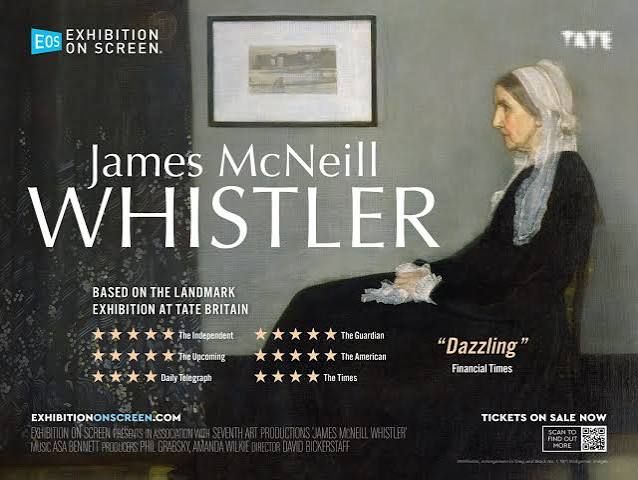
The joy of this documentary is in the contradictions within Whistler himself. The famous portrait of his mother may have been dubbed the “Mona Lisa of the Victorian era” but Whistler was very much a twentieth-century man. Embedding himself in the Aesthetic Movement – art for art’s sake – his career was centred around making the paint on the canvas the subject itself. Yes, the portraits are gorgeous but the paint is what Whistler wants you to look at. Combine this serious creative intent with his riotous, gossipy letters and Exhibition on Screen has presented a view of the artist that goes beyond even his own extravagant self-image.
In stripping away the character that Whistler created for himself, Exhibition on Screen paints a different portrait. An artist pushing his own boundaries of technique and style, Whistler’s art leaned away from his boundless personality. His art reveals a talent for editing away the excess: a quality that makes Whistler, and his legacy, far closer to our age than his own. He was, in every sense, ahead of his time.
James McNeill Whister is in cinemas nationwide from 15 September.
