

Writer and Director: Lilwen Faulkner
How much do you really judge your friends, especially the ones who have chosen an entirely different lifestyle to your own? Lilwen Faulkner’s new play Scar Tissue analyses 25 years of male friendship in just 55 minutes as two very different friends unpick their shared history and whether anything but habit keeps them together. Performed at the Old Red Lion Playhouse, Faulkner has an ear for ordinary conversation that skims between topics and offers some interesting thoughts on the social glues that bind people together, which could be further developed.
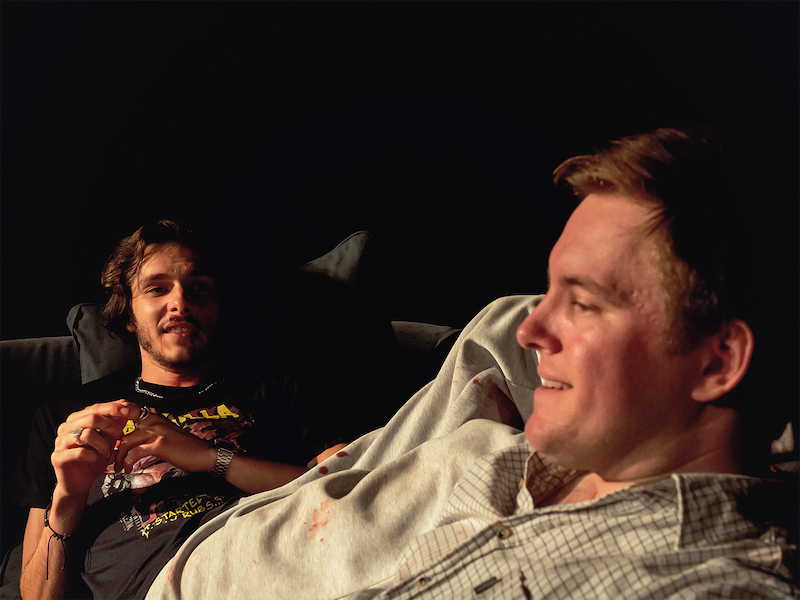
Arriving on his doorstep at 9pm on an ordinary night, Joey’s face is covered in blood from a broken nose and he demands Mac’s help. Aware of his wife and young son upstairs, Mac nonetheless falls into old patterns as he attends to his friend’s injuries, fearful of asking what happened. Instead, the men talk about their friendship, starting to wonder what keeps them together.
For Scar Tissue to work, the audience has to accept a series of dramatic conveniences that allow this particular conversation and the issues the friends confront to happen on this night of all the nights they have known each other for a quarter of a century: especially when Joey questions whether Mac’s wife of 10 years really likes him and claims to barely know their school-age child. For someone who was best man at their wedding, these seem like unlikely questions. Faulkner argues that Mac and Joey see each other only every few months, always during one of Joey’s emergency dilemmas, but there needs to be a stronger reason for this particular evening to be the trigger for long-buried resentments.
Once the conversation begins, the ways in which it unfolds are interesting and often well-written, talking around the reason for Joey’s dramatic appearance as well as flitting back and forth between shared memories and catching up on current life events, which feels typical of long-standing relationships. Faulkner also manages the growing tension well, hints of unevenness between the friends as the domesticated Mac silently judges his pal’s choices and the jeopardy he creates by not making the same decisions as everyone else. And how this leads to the discussion of a childhood power imbalance that instigated their friendship is also loaded with potential that could take the duologue in more interesting directions.
Killian Thomas Lefèvre is suitably evasive as Joey but also continually aware of the disadvantageous position he puts himself in in Mac’s home, asking for help. Jacob Freda gives Mac a weariness with his life in general, and a future version of this character could focus more on the vicarious excitement that Joey’s friendship offers to even out the dynamic.
The ambiguous ending feels appropriate, beginning a new cycle of absence within the friendship, but there is a lot more to say here about the addictive nature of this male friendship, the differently abusive behaviours that Joey endures as a route to love, from Mac as much as anyone, and the traditions that form between people who have known each other too long to give up on their friendship.
Runs Until 15 September 2026
