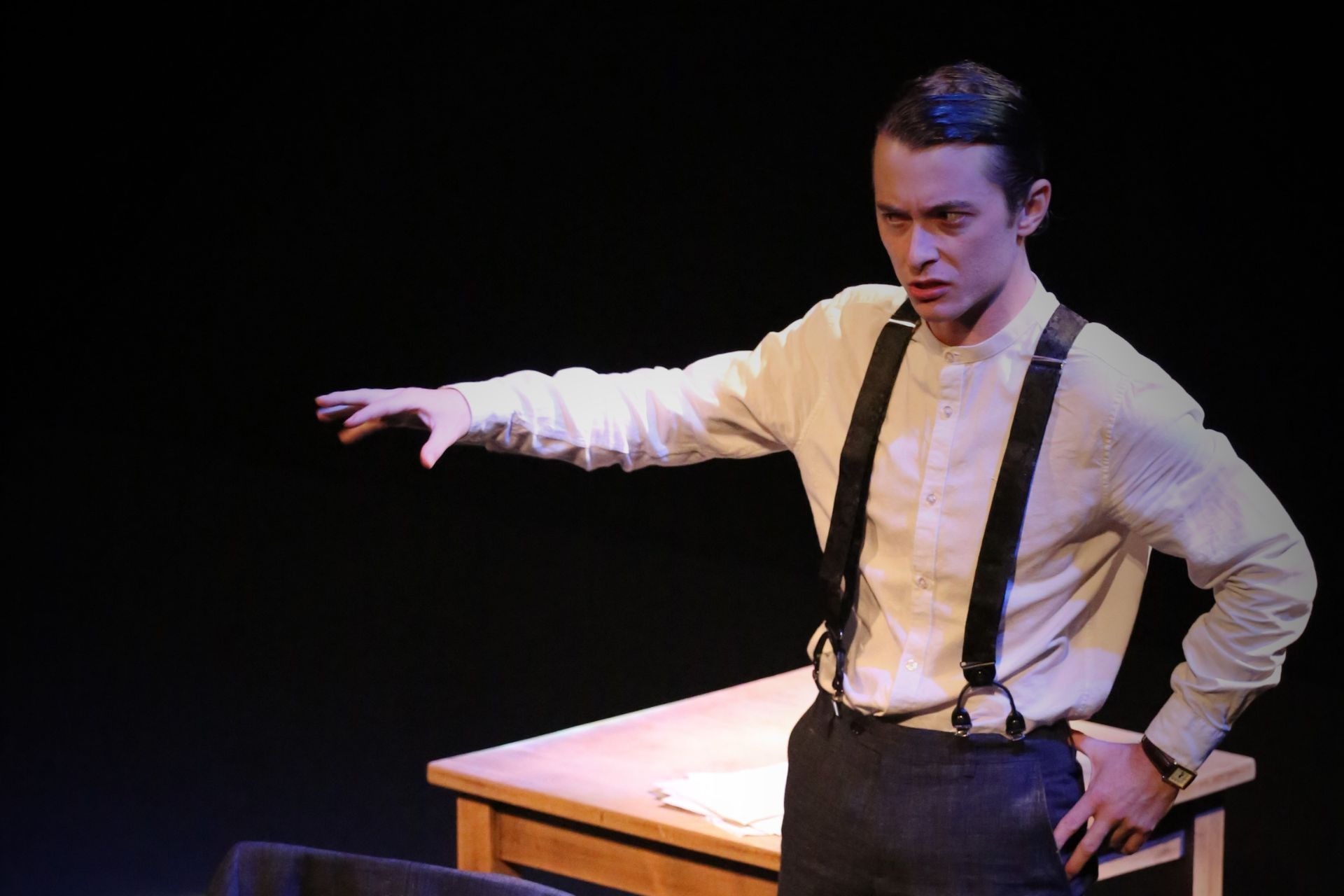
Ahead of bringing his original One Man Poe production to Ripon Theatre Festival and premiering a brand new show at York Theatre Royal, before taking it to the Edinburgh Festival Fringe, we spoke to Stephen Smith, Artistic Director of Threedumb Theatre. We discussed the show, Edgar Allan Poe and developing new work.
For those who might not know, who is Edgar Allan Poe?
Edgar Allan Poe was an American writer, poet, critic and pioneer of Gothic Horror. He’s often credited with inventing the detective story, helping shape science fiction, and influencing the psychological horror genre long before cinema existed. His work explored the horrors of the human mind in a way that still feels startlingly modern nearly 200 years later. Even people who don’t realise they know Poe have usually encountered his influence somewhere in horror culture.
What was your first encounter with the work of Edgar Allan Poe?
I first encountered Poe through classic Universal Horror movies when I was a child and, a little later, the Roger Corman/Vincent Price film adaptations. I never got into actually reading Edgar Allan Poe’s stories until the pandemic, however. As soon as I started, I was hooked, and found it astounding how starkly different the film adaptations were to the original source material.
What inspired you to adapt and perform Poe’s works for the stage?
Oddly enough, it really began during the pandemic. I started creating digital theatre adaptations of Poe stories online during lockdown because his work felt strangely suited to isolation – intimate, confessional, psychological.
The Tell-Tale Heart was the first one in May 2020, then we did The Black Cat in March 2021, which won an Off West End Award. I realised very quickly that audiences were leaning in, even in the middle of a global pandemic. When theatres reopened, I embraced the challenge of learning two more Poe stories, The Pit and the Pendulum and The Raven, and presented Poe live on stage in a show called One Man Poe, in October 2021.
I use as much of the original text as possible and what you get is pretty much verbatim – I didn’t want to modernise or “improve” his text. I wanted audiences to experience the musicality and theatricality already inside the writing itself.
Having won awards and enjoyed sell out runs, why do you think people enjoy seeing Poe’s stories live on stage?
Poe’s biological parents were both actors, and I think that he honours this in some of his writing – like Shakespeare, Poe is better when read out-loud. I think there’s something uniquely powerful about hearing these stories shared live in a dark room with other people. Horror becomes communal. You can feel an audience collectively holding its breath. Poe also understood that the most frightening things are deeply human: guilt, mortality, obsession, grief, ego. The stories aren’t really about monsters. They’re about us. And because I perform the pieces solo, audiences become incredibly active participants in the storytelling. Their imagination completes the world. That creates a very immediate and personal experience. And because I use Poe’s original text wherever possible, audiences often forget they’re listening to writing that’s nearly 200 years old.
As well as Edinburgh Festival Fringe, you’re taking your shows to Ripon Theatre Festival and Greater Manchester Fringe. How important are these spaces for developing new theatrical work?
They’re absolutely vital. Festivals like Ripon and Greater Manchester Fringe allow artists to take creative risks and build audiences organically. A show like One Man Poe simply would not exist without fringe spaces. The first time I presented One Man Poe was at the Watford Palace for the Watford Fringe – my home town. They also create opportunities for audiences outside London to encounter ambitious new work. Some of my favourite performances have happened in smaller regional venues where audiences arrive incredibly open and engaged. This year is especially exciting because York audiences will actually receive the world premiere of two brand new Poe adaptations before they head to Edinburgh Fringe.
When did you first decide that making theatre was something you wanted to do as a career?
I think I knew quite young, honestly. I was always obsessed with storytelling, films, characters and performing. But it became serious for me during my training at LIPA, where we created our theatre company. I’ve always been an artist, and producing my own theatre show combined two of my passions – my keen artist eye and love of creating posters and marketing materials, and acting.
What have been some of the highlights of your theatrical career so far?
Since premiering One Man Poe at Watford Palace Theatre in 2021, the show has been invited to many places over the world – Dubai, Italy, Off-Broadway – but I think the most magical moments have been performing Poe’s stories in the places where he actually lived and breathed, in homes, cottages and museums across the East Coast. I’ve even performed just feet away from his mortal remains in Baltimore! Having the world’s leading Poe organisations expressing such gratitude for what I do and the way I do it, has been incredibly affirming. Even Poe’s descendants have seen my show, and have told me that they’ve seen so many Poe adaptations over the years, but nothing as good as One Man Poe. Winning The Derek Award for Best Overall Show at Edinburgh Fringe last year was another huge milestone, particularly considering the scale of the festival. But honestly, some of the most meaningful moments are often the quieter ones — audience members telling me they’ve rediscovered classical literature through the show, or younger audiences realising that nineteenth-century writing can still feel visceral and alive.
What are some of your future aspirations for One Man Poe and Threedumb Theatre more broadly?
I’m particularly excited to discover how audiences respond to The Business Man and The Case of M. Valdemar. One is surprisingly funny and satirical, while the other may be the most disturbing story Poe ever wrote. Together they reveal sides of Poe that audiences rarely get to see. This summer I’ll be performing six Poe stories, totalling almost 19,000 words of original text, across 42 performances in 23 days at Edinburgh Fringe. Five years ago, One Man Poe was an experiment created during lockdown. The fact that it has grown into something of that scale is extraordinary, and I’m excited to see where it goes next. Beyond that, international touring remains a huge ambition. Poe has connected with audiences everywhere I’ve taken the work, from Watford to Baltimore, and I feel we’re only just beginning to explore the possibilities.
One Man Poe will be playing at a plethora of venues across the country this summer, including Barnstaple, Exeter, Prescot, Salford, York, Ripon, Watford, London, Colchester, and the Edinburgh Festival Fringe.
Visit Threedumb Theatre’s website to see which titles will be appearing where.