

Writers: Yuvraj Bhatia, Irina Ivanova and William Shakespeare
Director: Yuvraj Bhatia
Last year, Reverie Theatre presented With You, a short one-act play about two strangers trapped together in a bunker after some sort of cataclysmic event. That same piece returns in Fragments, where it is joined by two other pieces of similar length.
Promotional materials suggest that the triptych of plays exists in “interwoven worlds,” but while that could be true, there’s scant evidence in the pieces themselves. There are emotional connections between the pieces, though, so the combination of the three short pieces does at least feel coherent.
With You, the sole completely original work, still feels the strongest. Two people with different experiences of “The Blackout” tentatively explore one another’s background and emotional state. Family histories, or ignorance of them, are key to understanding each character’s reaction to their circumstances.
Last year’s performance was plagued by inter-scene music crashing in to subsume the performers’ dialogue; the same happens here, suggesting an intentional choice whose intent remains opaque. Still, there remains a connection between the piece’s writers and performers, Yuvraj Bhatia and Irina Ivanova, that fuels the intrigue.
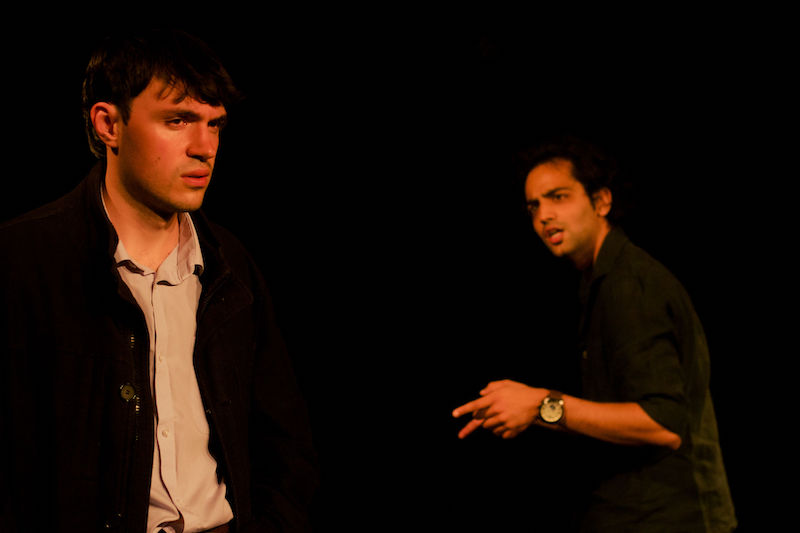
That is followed by Demons, a modern-day reinterpretation of a plot strand from Dostoyevsky’s novel of the same name. Bhatia and Arthur Drury are Peter and Nicholas, two childhood friends from opposite sides of the class struggle. Bhatia’s Peter is now an activist fighting against the ruling class, and tries to convince Drury, whose character is the scion of the elite Peter is trying to overthrow, to join him.
Some of the ways in which the two characters circle each other, by turns emotionally together and fundamentally apart, are of great interest. There are a few too many instances where the dialogue turns to hurried shouting, intelligibility falling afoul of emotion, but the intrigue remains high. A subplot about what Nicholas did with an 11-year-old girl – the subject of a chapter of Dostoyevsky’s novel that involved sexual abuse and which its original publisher refused to publish – becomes a focal point here, with Drury’s character feeling the weight of being blackmailed about what really happened.
The moral complexities of both characters are what intrigues most about this play, hampered somewhat by the realities of Peter’s eventual plan and his ability to convince Nicholas to be part of it. It feels as if Demons needs a few more steps for us to believe that these characters could exist in the world Bhatia’s writing has created.
The final piece of the triptych initially seems familiar. Macbeth fillets Shakespeare’s medieval horror substantially, starting for the most part in the run-up to the Macbeths’ murder of King Duncan. Ivanova’s Lady M exerts a full-blooded control over her husband (Bhatia), whose soliloquies before executing Duncan seem already detached from reality.
Even as Macbeth takes on the mantle of king, he is already a clearly broken man, much earlier than in standard, longer productions, which typically draw out his emotional disintegration over a longer period. That continues with the assassination of his friend, Banquo – but rather than the latter making merely a spectral appearance at the feast, Drury’s portrayal becomes a supernatural antagonist, embodying the spirit of the witches whose prophecy has doomed all.
This reimagining offers a new ending for Lady Macbeth, turning her sleepwalking scenes into a pre-suicide confession. The filleting of Shakespeare’s poetry works in that context; less so, the excision of much of the latter half of the original play, with Macduff completely removed. Instead, it is Banquo, or whatever force appears in his visage, who becomes Macbeth’s final nemesis.
This reinterpretation certainly strips the original play of some of its longeurs, gives a dramatic exit for one of its female leads and produces a taut piece that tonally matches Demons. Together, the two pieces strike a sombre, bloodthirsty note that sits uncomfortably with the altogether tamer With You. Fragments may be a trio of plays, but its first, strongest element feels dwarfed by the somewhat bloodthirsty pessimism of the two plays following.
Runs until 1 May 2026
