

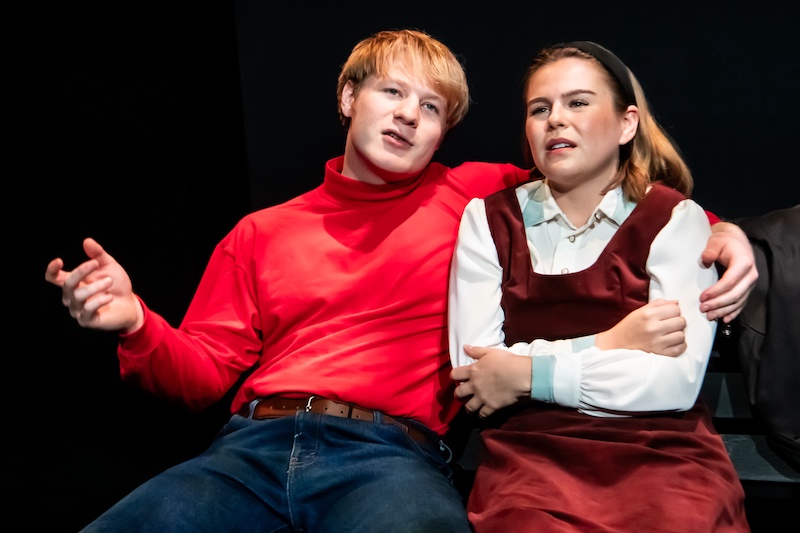
Writer and director: Sarah Shelton
Rather surprisingly, Sarah Shelton’s Blessings is a new play. It is a family drama that takes place in 1969, and its style feels even more dated than its subject matter or its time setting. Seeing the play performed in the modern fringe venue that is Riverside Studios brings the anachronism into still sharper focus.
The voice of Tony Blackburn telling us to turn off our phones informs us that we are being transported back to the 1960s, and snippets from familiar songs scattered throughout the play remind us of the fact. The Deacons are a respectable lower-middle-class family, living in a small English town. Patriarch Frank (Gary Webster) is the breadwinner, but he faces regular complaints that he withdraws from involvement in family affairs, and he finds solace at the local pub. Matriarch Dorrie (Anna Acton), a staunch Roman Catholic, is, seemingly, the rock that supports the whole family. Her support comes from the parish priest, who is accused of prying too deeply into family business.
Son Martin (Freddie Webster) has already flown the nest for London, but he shows determination to maintain family unity and respectability, particularly when faced with the news that his unmarried teenage sister Frances (Hannah Traylen) is pregnant. Other sisters, Penny (Milly Roberts) and Sally (Emily Lane), face up to their own problems. There is enough meat here for the writer to bite on to extract either comedy or drama, but by packing the play with subplots, she is only able to scratch at the surfaces of both characters and storylines, leaving the actors very little to work with.
In structure and in content, the play resembles a very long episode of, say, EastEnders, with a succession of short scenes bringing together characters who then disappear behind the screens which feature in Alice Carroll’s curious set design. The 1960s saw a new age of realism in British drama, but this is rarely reflected in this production, and many of the dramatic flashpoints feel lacking in authenticity.
The writer should question the wisdom of directing the play herself. Perhaps a fresh pair of eyes could have added valuable perspectives to the drama and injected life into many leaden scenes. As it is, Shelton seems content for the characters to wander on and off stage and merely speak the lines that she has written. At times, her production looks amateurish, doing little justice to the commitment of six accomplished actors.
Shelton lays to rest the theory that a night out at the theatre should provide a contrast to a night in watching television soaps. Blessings is a mix of tired old plot lines, stilted dialogue and clunky staging. The biggest blessing is the shortish running time, which is under 90 minutes without an interval.
Runs until 26 October 2025

1 Comment
All those comments are fair, and even the setting is not spot on.
The over-scaled geometric prints are more the era of Abigail’s Party. There were geometric prints in the late 60s but the patterns tended to be smaller, and florals were also very popular. The homes of trendier professional and artistic middle class people would have Morris papers or David Hicks fabrics but this “look” did not become universal until the 70s. Almost all interiors of this era had a lot of coloured glass. Cheaper Czech and Polish glass in the homes of the less affluent, Whitefriars, Mdina and designer Scandinavian and Italian pieces in the homes of the wealthy. Kingfisher Blue was the colour of 1960/70.
And there is always the marvellous “Bronco Bullfrog” film to get a real sense of what 1969 felt like in the UK.
More importantly the play lacks a final act. Logically, you would take the action forward to some point in the future. The baby Laura, now going through going through her mother’s possessions as a middle aged women in her mid 50s in our present day…there must have been some sort of denouement that could have been created out of that.